News Break
Conditions Precedent: The Debt Lawsuit Defense in the Collector's Own Contract
October 12, 2026
Blog / News Break
The collector may have sued too late. Brian Parker on the dates to compare, the state deadlines, and the one-year FDCPA clock that restarts with each violation.

Every state sets a deadline for a creditor or a debt collector to sue on a debt. Some collectors sue after the deadline anyway. Brian Parker's reason is simple: seven or eight of every ten people who are sued never answer, so a late lawsuit usually wins by default.
This video covers the statute of limitations as a defense, which Brian calls one of his favorites. It also covers a second clock that runs for you: your own deadline to sue a debt collector that broke the law.
Key Takeaways
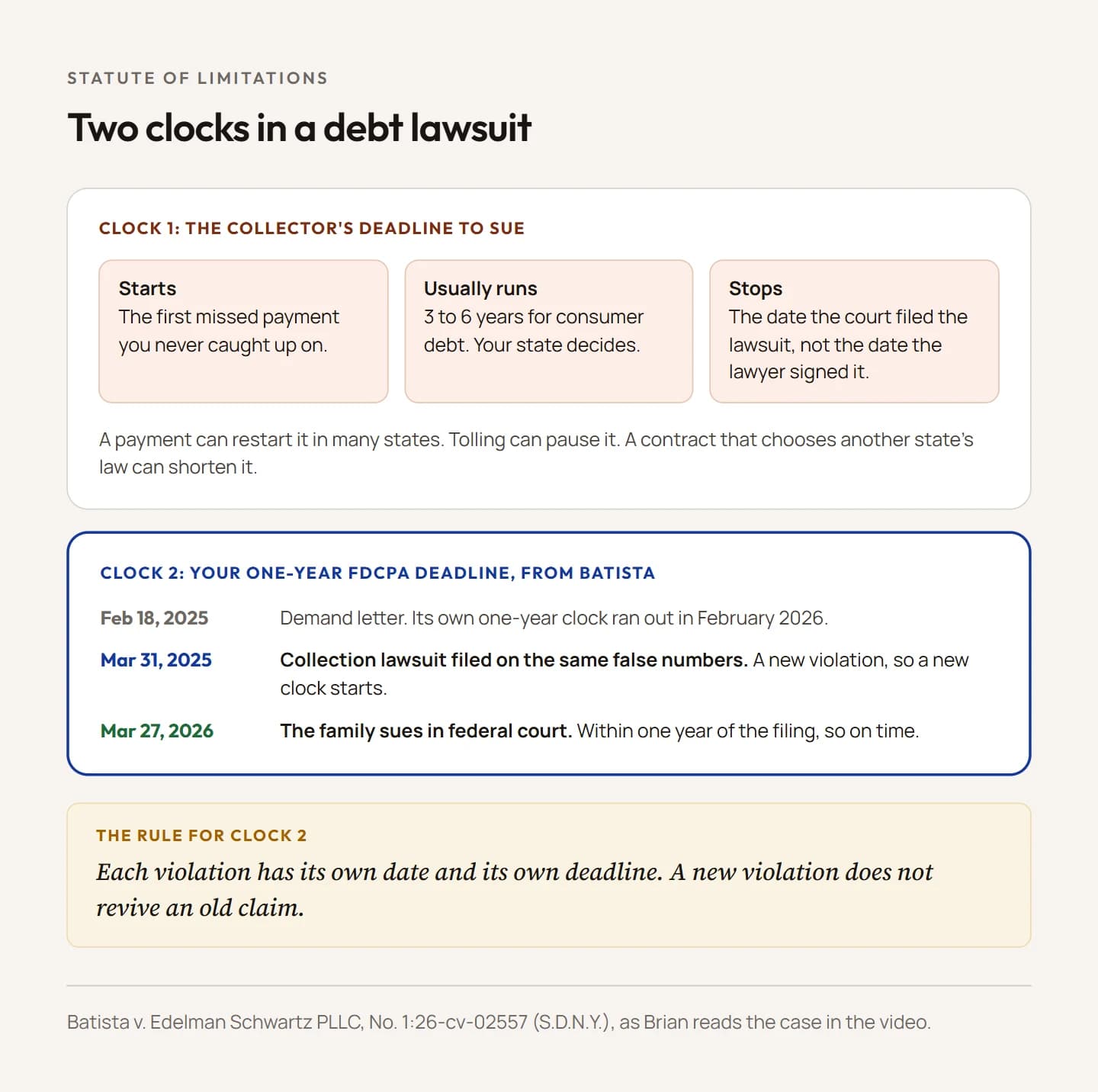
- Measure the deadline from the first missed payment to the date the court filed the lawsuit. The date the lawyer signed the complaint does not count.
- Deadlines for consumer debt are usually three to six years, and the rules differ by state.
- Raise the defense in your answer with the dates, or you can lose it.
- Your deadline to sue a collector under the FDCPA is one year, and each new violation starts a new clock.
Raise it or lose it. The statute of limitations is an affirmative defense. If you have a good-faith reason to believe the lawsuit came too late, put the defense in your answer. You can drop it later. You cannot always add it later.
The deadline usually ends the right to sue, not the debt. In most states the debt still exists after the deadline. The collector loses the right to sue on it, but it can still ask you to pay. Wisconsin is an exception: there, the debt itself is extinguished when the deadline runs. If a collector keeps contacting you about an old debt, send a cease and desist letter. A collector that contacts you after that letter gives you a claim.
The lawsuit deadline is not the credit report deadline. A negative entry generally stays on a credit report for seven years. That period is separate from the deadline to sue. The two clocks are explained here.
The start date. The clock usually starts at the default: the first missed payment that you never caught up on. For most people, that is about a month after the last payment. Find it in your bank records, your credit reports, and the papers attached to the lawsuit.
The filing date. A complaint carries two dates. One is the date the lawyer signed it. The other is the date the court filed it, which is later. The filing date measures the deadline, and it gives you more time. Brian has had cases where the difference was one or two days, because the complaint reached the clerk after the deadline.
These are the periods Brian gives for consumer debt. The period can depend on the type of contract, so read your state's statute for your type of debt.
| State | Deadline | Note from the video |
|---|---|---|
| New York | 3 years | A later payment does not restart the clock on consumer credit debt. |
| North Carolina | 3 years | Contract claims. |
| Delaware | 3 years | Matters when a contract chooses Delaware law. |
| Texas | 4 years | A debt buyer may not sue after the deadline. A payment does not revive it. |
| Pennsylvania | 4 years | Contract claims. |
| Florida | 4 or 5 years | Depends on whether the debt is treated as written. Brian assumes 5. Florida guide. |
| Georgia | 4 to 6 years | Depends on the contract type. |
| Illinois | 5 or 10 years | Depends on the contract type. |
| Ohio | 6 years | |
| Michigan | 6 years | Michigan guide. |
| Wisconsin | 6 years | The debt itself is extinguished when the deadline runs. |
Governing law can shorten it. Many contracts choose the law of one state. If the contract chooses Delaware, with three years, and you are sued in Michigan, with six, you can argue that the shorter period applies. Brian makes the same argument in private student loan cases where the contract chooses California law.
A payment can restart it. In many states, a payment or a promise to pay revives an old debt and starts a new deadline. Collectors know this. They ask for a small "good faith" payment. Brian once defended about ten lawsuits in a row where a collector's records showed a $10 payment that the client never made, inside the deadline. Do not make that payment until you know your state's rule.
Tolling can pause it. In some states, time you spend living outside the state does not count. A bankruptcy filing also pauses the clock.
Brian's form of the defense states the facts, not only the label:
Put the same dates in your counter affidavit. In discovery, ask for the full account statements and the payment history. Answer deadlines are short, so check your summons on the first day.
If a default judgment was already entered, the defense is not available until the judgment is set aside. A motion to set the judgment aside is the way back.
A plaintiff that sees a strong statute of limitations defense often dismisses its own case without prejudice, sometimes after months. That leaves you with the cost, and the plaintiff can file again.
A counterclaim changes that. The plaintiff can dismiss its own claim, but it cannot dismiss yours. If it wants the whole case to end, it must ask you. Your counterclaim also gives you something to trade: they drop their claim, and you drop yours.
You have a deadline too. Under the FDCPA, you must sue a debt collector within one year of the violation. That is short, but each violation starts its own clock.
Batista v. Edelman Schwartz PLLC (opens in a new tab) shows how. As Brian reads the case, the Batistas are a low-income family in the Bronx who rented through the Section 8 voucher program. Under that program, the housing authority pays part of the rent directly to the landlord, and the tenant cannot be charged for that part. The complaint alleges that the building had hazardous conditions, that the city ordered it vacated in December 2023, and that the housing authority stopped its payments because the building failed federal standards. The landlord then allegedly added about $8,000 of those lost payments to the family's ledger.
The law firm sent a demand on February 18, 2025. It filed a collection case in housing court on March 31, 2025, for more than $9,000. The family answered alone, then with legal aid, and the housing case was later settled. On March 27, 2026, the family sued the firm, one of its attorneys, and the landlord in federal court.
The firm argued that the family was too late, because the demand letter was more than a year old. The court disagreed. Each false representation is its own violation, and the housing-court filing on March 31, 2025 was a new one. The family sued within a year of that filing.
The limit matters too. A new violation starts a new clock for that violation only. It does not revive a claim on the February 2025 letter.
The lesson: every collection letter and every court filing has a date, and each violation has its own deadline. A first letter more than a year old does not mean you are too late.

About the author
Brian Parker
I have over 30 years of experience defending consumers against debt collection lawsuits and have seen every tactic, threat, and pressure play that collectors use. Through KillDebt and ParkerGPT, I have systematized the proven defense strategies that actually work - so consumers can respond from a position of knowledge, not fear. My approach focuses on aggressive legal defense based on documented case success rather than false hope that leads to default judgments.