News Break
Sued by a Debt Collector With No Warning Letter? Why It Happens and What to Do
October 9, 2026
Blog / News Break
A debt buyer says it did everything required before it sued. Brian Parker reads an LVNV file to show how the loan agreement and state law prove it did not.
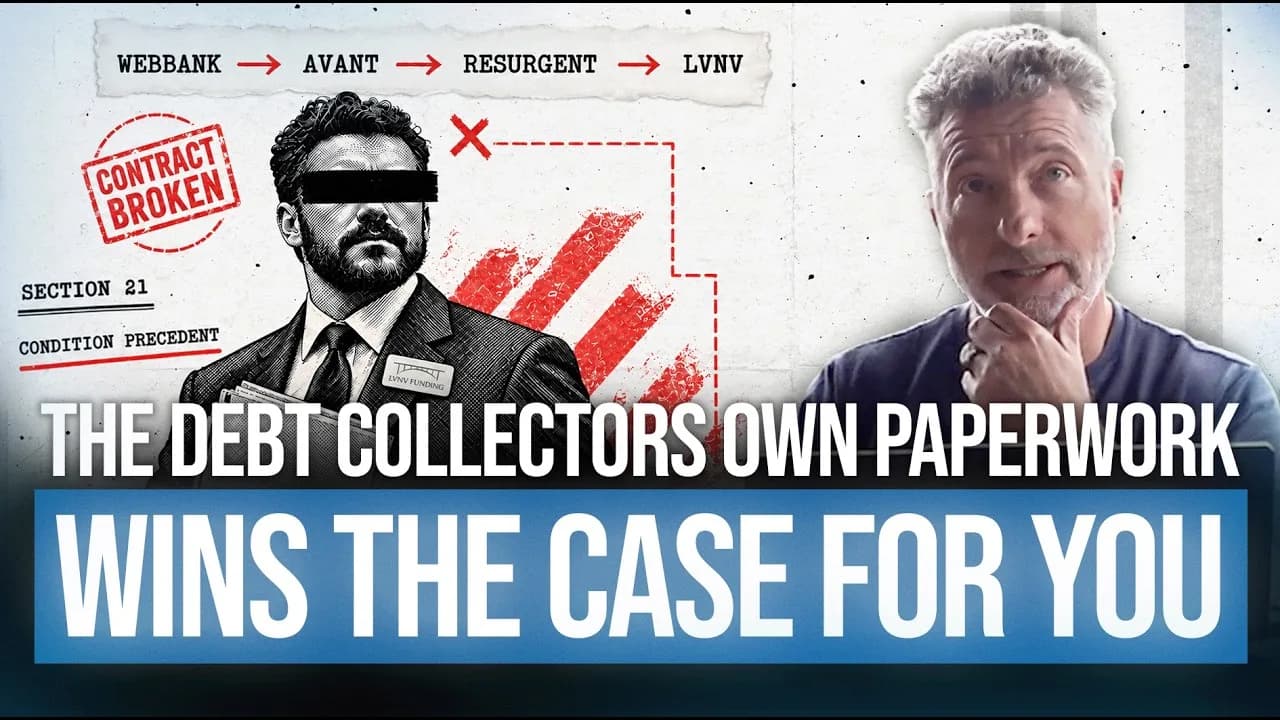
A debt buyer that sues you says it stands in the shoes of the original creditor. It says it owns the contract, and it says you broke the contract. Brian Parker's point in this video is that the shoes come with the contract's duties too. If the loan agreement says what a party must do before it sues, the debt buyer must do it.
Those duties have a name: conditions precedent. Brian recorded this video in the Blue Ridge Mountains of North Carolina, on the road for a deposition. He uses a Florida case file to show the defense. A client brought him an LVNV Funding lawsuit, and he reads the documents on screen.
Key Takeaways
- A condition precedent is a step the plaintiff must complete before it can sue. It comes from the contract or from a statute.
- Most complaints say in one sentence that all conditions were performed. Find that sentence. It is often the weak point of the case.
- Read the loan agreement the plaintiff attached. It can require a written dispute notice and a waiting period before a lawsuit.
- Do not answer with the word "denied" alone. Name each condition and say that the plaintiff did not perform it.
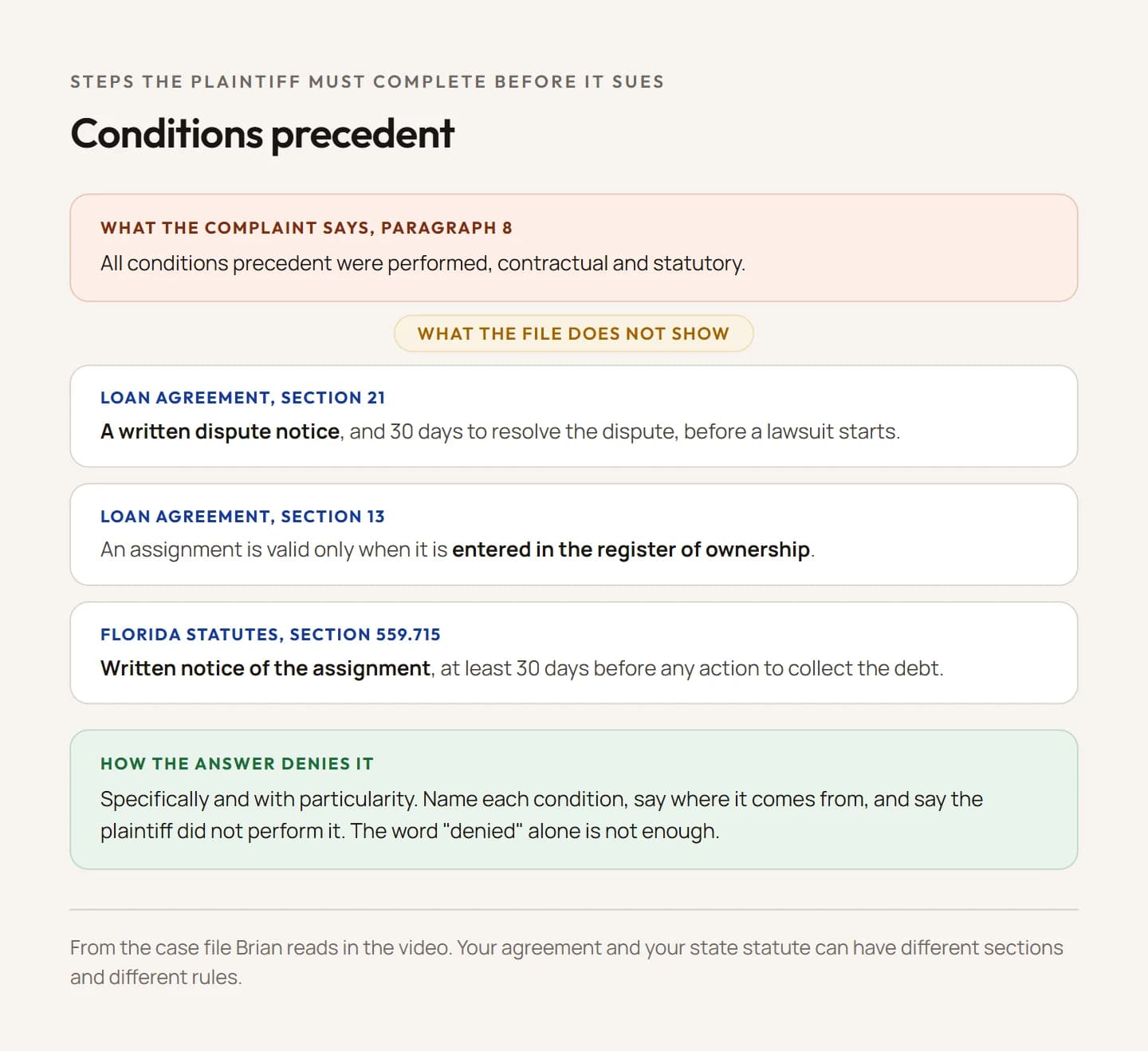
Paragraph 8 of the complaint in this file says that all conditions precedent to the action were complied with or occurred. It names two kinds: contractual notice provisions and statutory notice provisions.
That sentence is a claim of fact. If one condition was not performed, the sentence is false. Brian looks for the one paragraph that the case depends on, and in this file it is paragraph 8.
The lender on the loan was WebBank, and Avant was the servicer. LVNV attached the loan agreement to its complaint, because LVNV wants the court to enforce it. Brian reads two sections of that agreement.
Section 21: notice before a lawsuit. The agreement asks what a party must do before it starts a lawsuit or an arbitration. The agreement's own answer is to send a written dispute notice and to work to resolve the dispute. The other party gets 30 days. Brian says LVNV did not send his client a dispute notice before it sued her.
Section 13: the register of ownership. The agreement says an assignment or transfer of the note is valid only when it is entered in a record of ownership that the servicer keeps. LVNV says the debt passed through a series of assignments. The agreement says each one must be in that register. No register entry is attached to the complaint.
The contract is one source of conditions. State law is the other.
Florida Statutes section 559.715 (opens in a new tab) says the assignee of a consumer debt must give the debtor written notice of the assignment. The notice must come at least 30 days before any action to collect the debt. Brian says his client did not receive that notice from LVNV or from any earlier owner.
Other states have a different rule with the same effect. Some require a right to cure notice before a creditor can sue. The four-tools article lists states to check.
Brian finds three more faults in the documents. Each one goes in the counter affidavit.
The bill of sale also says it was made pursuant to a purchase and sale agreement. That agreement is not attached, and you can demand it. The same kinds of gaps appeared in a Velocity Investments file.
A plaintiff can plead conditions precedent in general words. The defendant cannot deny them in general words.
In Florida, Rule of Civil Procedure 1.120(c) says a denial of performance must be made specifically and with particularity. Federal Rule 9(c) (opens in a new tab) says the same thing for federal court. An answer that says only "denied" to paragraph 8 can lose the defense.
Brian's answer to paragraph 8 does three things:
This case continues, and Brian does not claim a result in it. His point is about the method. The plaintiff must rely on its paperwork in court, and the paperwork is where the defense is. A member used the same method against two LVNV lawsuits.
Members can find the letters that ask for assignment records in the member library.

About the author
Brian Parker
I have over 30 years of experience defending consumers against debt collection lawsuits and have seen every tactic, threat, and pressure play that collectors use. Through KillDebt and ParkerGPT, I have systematized the proven defense strategies that actually work - so consumers can respond from a position of knowledge, not fear. My approach focuses on aggressive legal defense based on documented case success rather than false hope that leads to default judgments.