News Break
Statute of Limitations on a Debt Lawsuit: Two Dates to Check and a Second Clock
October 16, 2026
Blog / News Break
Moved to a state with a longer deadline? A borrowing statute can apply the shorter deadline from the state where the debt began. Brian Parker explains, with PRA v. King.

Americans move often. Suppose you opened a credit card while you lived in a state with a three-year deadline to sue, and you later moved to a state with six. A collector can file in your new state and argue that the longer deadline applies. Brian Parker has defended these cases. In one, a collector filed in Michigan, with six years, on a claim that was already too old under the three-year deadline where it began.
A borrowing statute stops that. This video follows Brian's statute of limitations video. He recorded it with the flu, and he kept to his schedule.
Key Takeaways
- If a claim is too old in the state where it began, a borrowing statute can make it too old in the state where you are sued.
- For a credit card, the claim often arises where the bank is. Many card banks are in Delaware, South Dakota, Utah, or Virginia.
- A debt buyer stands in the shoes of the creditor it bought from. It does not get a new deadline.
- A governing-law clause can help too, but a general clause may not bring in the other state's deadline. Plead both arguments.
Brian has a new word for the steps he teaches: RACE.
The governing-law clause. Most card agreements say which state's law governs. If the agreement chooses Delaware, with three years, and you are sued in Michigan, with six, you can argue that Delaware law applies. There is also a fairness point. If the plaintiff relies on the agreement for interest, late fees, and attorney fees, it should accept the agreement's choice of law too.
This argument has a weak spot. Many courts treat a deadline as procedure, not as part of the contract. A clause that says only "governed by Delaware law" may cover the contract and not the deadline. And debt buyers often cannot produce the signed agreement at all. With no agreement, there is no clause to argue from.
The borrowing statute. This argument does not depend on the contract. It depends on your state's own law about where the claim arose. If the claim is too old there, it is too old where you are sued.
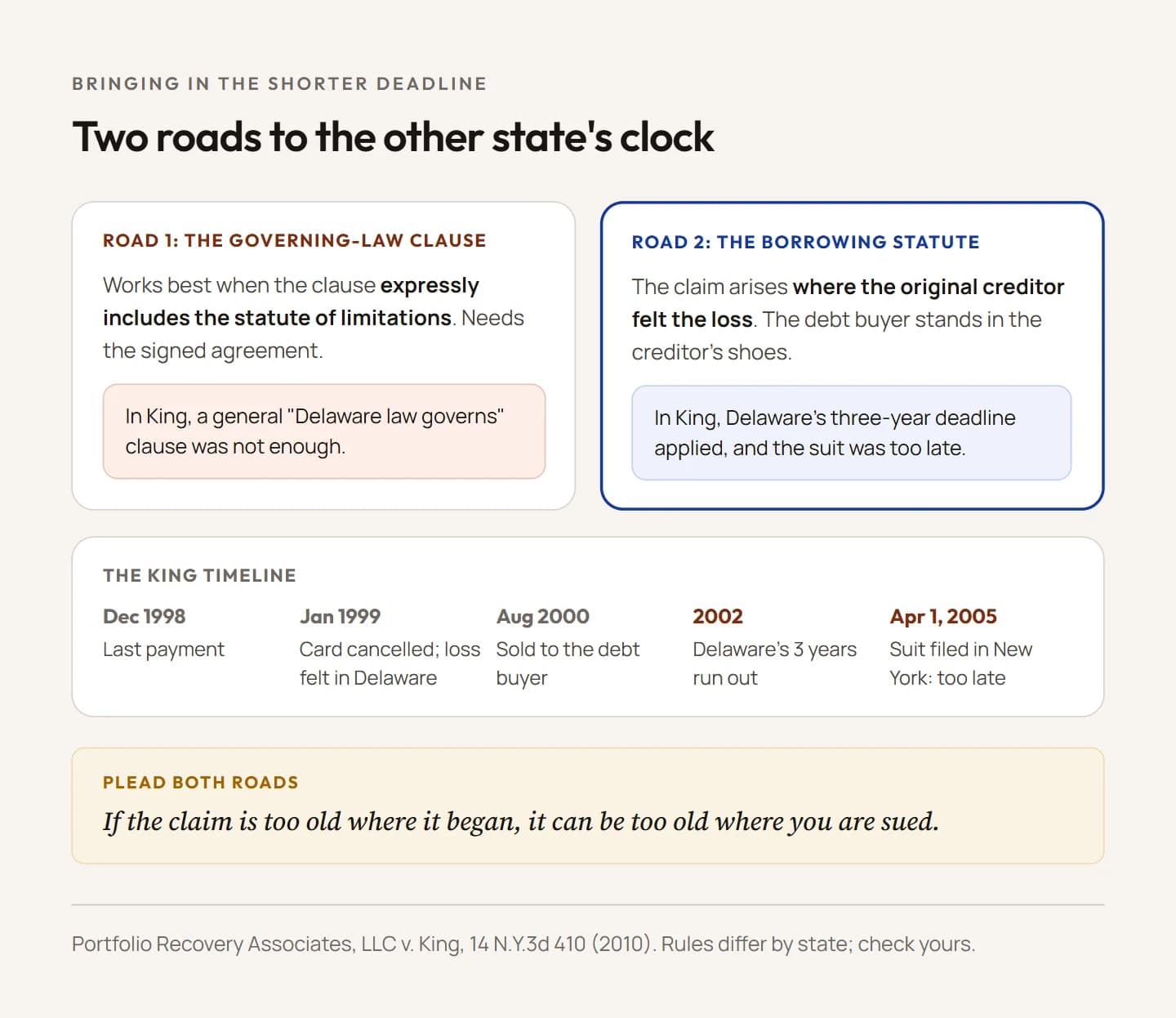
Portfolio Recovery Associates, LLC v. King (opens in a new tab), 14 N.Y.3d 410 (2010), is New York's leading case on this point. Jared King defended himself without a lawyer.
The facts, from the opinion:
New York's deadline for contract claims was six years. Delaware's was three. The trial court and the Appellate Division ruled for PRA. New York's highest court, the Court of Appeals, reversed. It made three rulings that matter to you.
1. The general clause was not enough. The court held that the Delaware clause did not bring in Delaware's deadline. Choice-of-law clauses usually cover substantive issues, and New York treats deadlines as procedural. The agreement did not say that Delaware's limitations period applied.
2. The borrowing statute applied. New York's borrowing statute, CPLR 202, requires a claim that arose outside the state to be on time under both New York's deadline and the deadline where it arose. For an economic loss, the claim usually arises where the plaintiff lives and feels the loss. Discover felt the loss in Delaware, so Delaware's three-year deadline applied. The suit should have been filed by 2002. It was filed in 2005, so it was too late.
3. The debt buyer got no fresh start. The court said PRA, as assignee, "is not entitled to stand in a better position" than Discover. The court looked at where Discover was, not where PRA was. Buying the account did not restart the clock.
The court also checked Delaware's rule that pauses the clock when a defendant is out of the state. It held that the rule did not apply to King, who never lived in Delaware.
A clause that says "governed by Delaware law" covers the contract. A clause that says Delaware law governs including its statute of limitations covers the deadline too, and a court is much more likely to apply it. Most card agreements use the general wording. Look for the words "statute of limitations" or "limitations period."
Courts do not all agree on this. Check how the courts in your state treat these clauses, and check whether your state has a borrowing statute and how it decides where a claim arises.
Brian's example language raises both arguments, so that one can win if the other fails. Adapt it to your state and your facts:
Put the same dates in your counter affidavit. Raise the defense or you can lose it.
Brian also suggests a counterclaim when a collector sues on a time-barred debt. The statute of limitations article explains why: it stops the plaintiff from dismissing and refiling at will, and it gives you something to trade.

About the author
Brian Parker
I have over 30 years of experience defending consumers against debt collection lawsuits and have seen every tactic, threat, and pressure play that collectors use. Through KillDebt and ParkerGPT, I have systematized the proven defense strategies that actually work - so consumers can respond from a position of knowledge, not fear. My approach focuses on aggressive legal defense based on documented case success rather than false hope that leads to default judgments.