News Break
Suing a Debt Collector Under the TCPA: 3 Mistakes From Rios v. Credence
October 26, 2026
Blog / News Break
A Georgia family behind on payments won a wrongful repo case because they objected before the tow. Brian Parker reads Hart v. Hill & Associates.

The Harts were behind on their car payments. The tow truck found their car in a strip mall parking lot, booted it, and lifted it into the air. Then the Harts came out and objected, loudly. The drivers towed the car anyway. More than three years later, a federal court ruled the repossession wrongful, and the Harts won on liability.
The facts were not clean. The husband left the parking lot in handcuffs. In the video below, Brian Parker reads Hart v. Hill & Associates of Georgia and shows why none of that changed the outcome. In Georgia, one rule stands above everything else when a car is repossessed: once the borrower says stop, the repo has to stop.
Key Takeaways
- In Georgia, a repo that continues over the borrower's clear oral protest is a breach of the peace, and a breach makes the repo wrongful.
- A boot on the car does not end your right to object. The protest counts at any point before the car is taken away.
- Repo companies are debt collectors for one FDCPA section, 1692f(6). Taking a car with no present right to possession violates it.
- Object with words, on camera. Never touch the driver or the truck, and keep weapons out of it.
Kimberly Hart bought a 2014 Ford Escape from DK Auto in February 2022 on an installment contract. She fell behind on the payments. On June 30, 2023, DK Auto sent a repo order to Hill & Associates of Georgia, and two drivers found the car outside a nail salon in Douglasville.
One driver put a boot on the car. The tow truck hooked it and lifted it into the air. Bystanders called the police. Ms. Hart came out of the salon and objected, and her husband objected too. According to Ms. Hart's testimony, the officers told her, "There is nothing we can do. He already has it up in the air." The drivers towed the car away after the husband was arrested.
The repo company did not dispute the key fact: both Harts vigorously objected after the boot went on and before the car was towed.
Brian is direct about the rest. The Harts did not have clean hands. One driver wrote that the husband pulled an AR-15 and threatened to blow their heads off. The husband later pleaded guilty to terroristic threats and acts, two counts of simple battery, and possession of a firearm by a convicted felon. Brian notes the couple's young son was at the scene too.
The Harts sued in June 2024, just before the FDCPA's one-year deadline ran out.
The repo company named three disputes it said a jury had to decide: whether there was physical contact, whether the husband and son were inside the car when it was booted, and whether the husband threatened the drivers with a gun.
The district judge said those facts "might add hue to this colorful dispute," but they did not change the outcome. Georgia's version of UCC section 9-609 (opens in a new tab), O.C.G.A. 11-9-609, lets a lender repossess after default without a court order only if it proceeds without a breach of the peace. Georgia courts hold that a breach happens when the repo continues over the unequivocal oral protest of the borrower, or of a spouse protesting for the borrower. Both Harts protested. That was enough.
The court also rejected the "angry husband" defense. A borrower's angry protest does not excuse the repo company for taking the car over that protest. In Brian's reading, the arrest and the guilty plea proved the court's point: continuing the tow over a protest pushed the scene toward violence, which is what the oral protest rule exists to prevent.
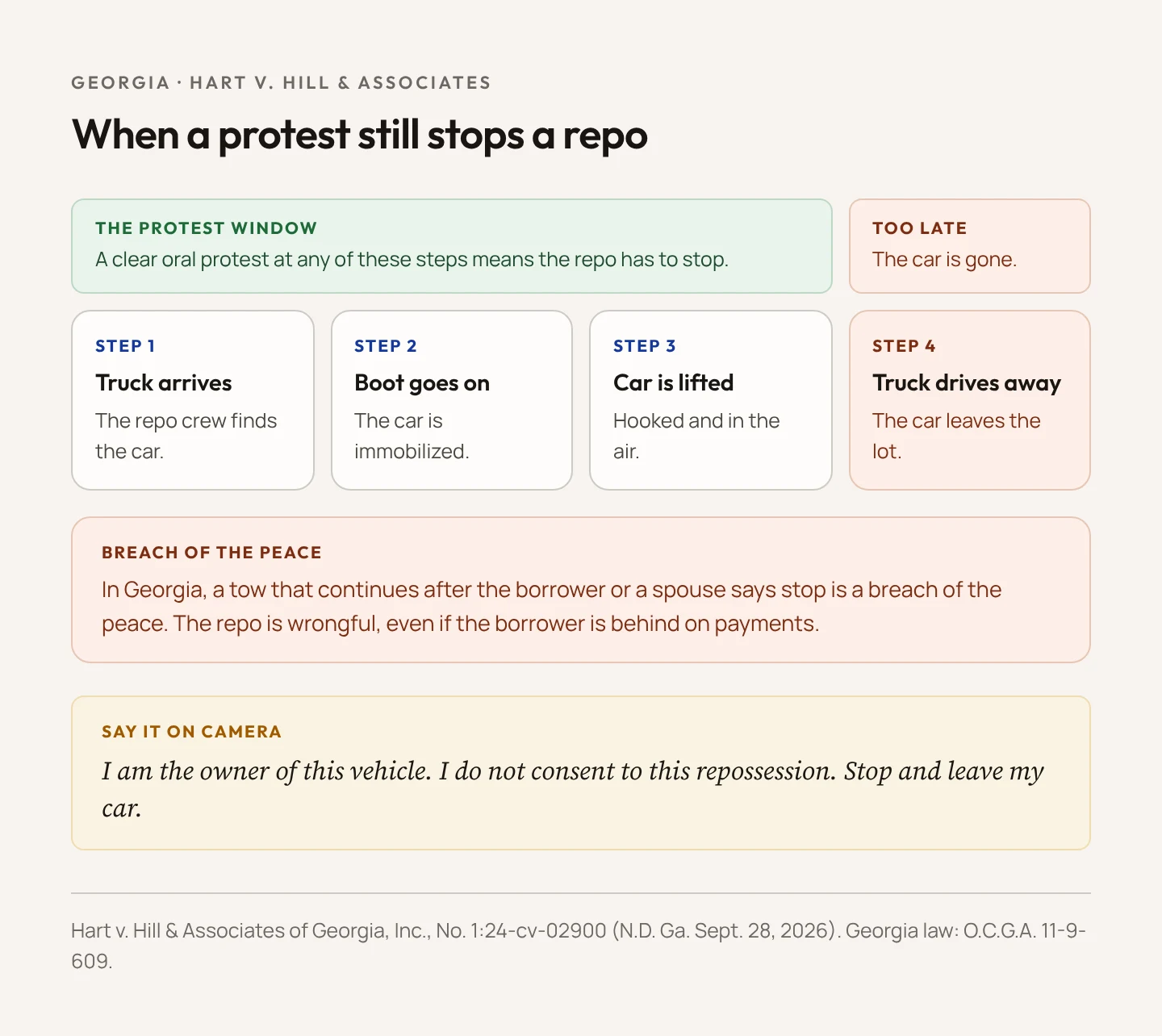
The repo company tried one more angle. It argued the protest came too late because the car was already booted and immobilized.
The court found no law for that, and the repo company cited none. Georgia cases say the protest matters at any point before the car is taken away. The car can be locked, booted, and in the air. If you come out and say stop before it leaves, the repo company has to stop.
Ms. Hart admitted she was behind on her payments. It did not matter. In Georgia, a repo is wrongful if the borrower is not in default or if the repo breaches the peace. Either one is enough. On September 28, 2026, the district judge adopted the magistrate judge's recommendation (opens in a new tab) in full and granted the Harts summary judgment on liability for three claims:
The repo company argued it was not a debt collector. The FDCPA has a special definition for this one section: it covers any business whose principal purpose is enforcing security interests (15 U.S.C. 1692a(6) (opens in a new tab)). The court pointed to two facts. The company got paid by checks in the mail, and it got its repo assignments by email. Mail plus internet was enough.
Brian explains the two-judge structure. A magistrate judge did the work and recommended the result, and the district judge adopted it. He says that happens nine times out of ten. The amount of damages still goes to a jury.
The repo company argued the Harts had no medical bills, no counseling bills, and no diagnosis. The court said that does not end the case. Emotional distress counts as actual damages under the FDCPA, and federal courts in Georgia have held that your own testimony can be enough, as long as it is specific and not general.
The repo company also argued that the son's trauma came from watching his father get arrested, not from the repo. The court said that was a credibility question for a jury. As Brian puts it, the clear "no, don't take my car" won the case. Everything else made it harder.
Brian splits his repo protection kit into three stages.
Say these three sentences, loud and clear, with your phone recording:
Then follow the rules:
If the police show up and side with the repo company, read what a Michigan court said about police at a repo.
Brian says repossessions went from about 1.7 million in 2024 to about 2.2 million in 2025, and 2026 is not slowing down. Busy repo companies cut corners. The before letter, the after letter, the deficiency letter, and the UCC checklist are all in Brian's repossession defense kit inside ParkerGPT.

About the author
Brian Parker
I have over 30 years of experience defending consumers against debt collection lawsuits and have seen every tactic, threat, and pressure play that collectors use. Through KillDebt and ParkerGPT, I have systematized the proven defense strategies that actually work - so consumers can respond from a position of knowledge, not fear. My approach focuses on aggressive legal defense based on documented case success rather than false hope that leads to default judgments.