News Break
Wrongful Repossession: How "Stop" Won a Georgia Repo Case
October 28, 2026
Blog / News Break
A Michigan repo was ruled wrongful because the car left only after police told the owner to let it go. Brian Parker reads Hart v. North Star Recovery.
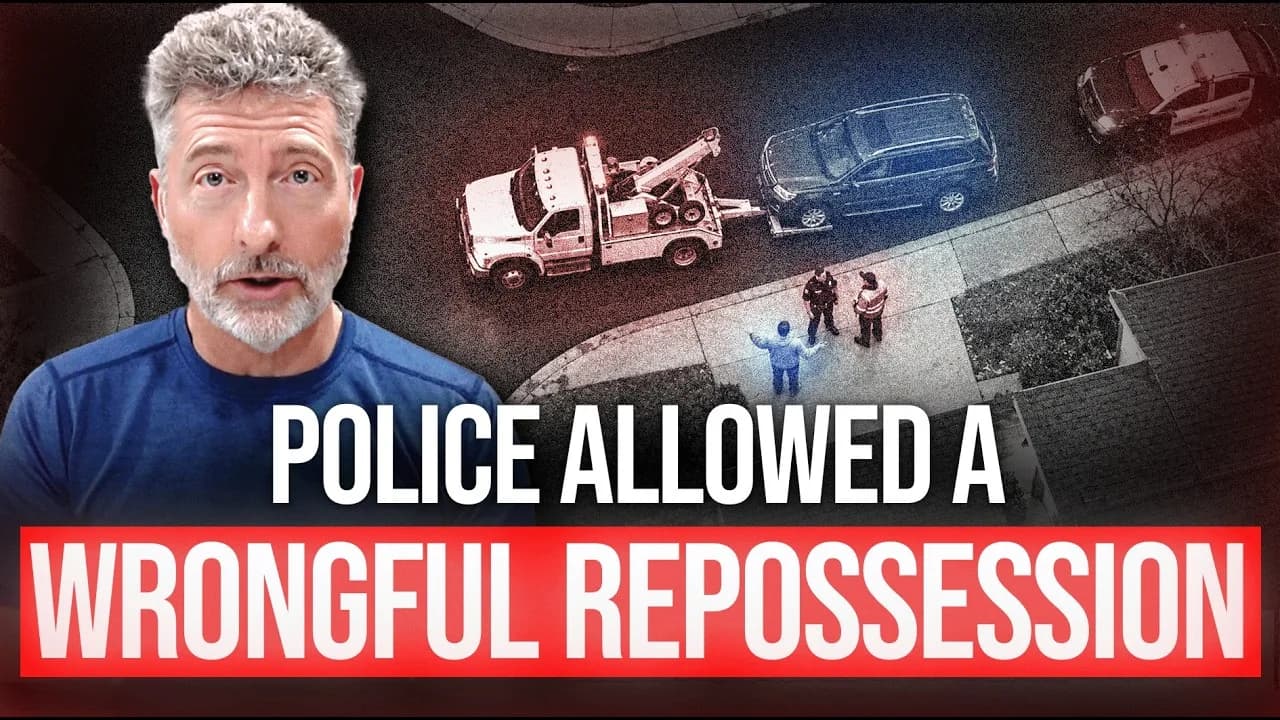
Jack Hart yelled at the repo driver in his own driveway. He cursed. He balled up his fists. By his own account he lost his temper, and the repo company says he went inside and destroyed his bedroom. He still won his wrongful repossession case on liability.
The reason was one undisputed fact: the car left the driveway only after a police officer told Jack he had to let it go. In the video below, Brian Parker reads Hart v. North Star Recovery, a 2025 Michigan federal case, and shows how police who take the repo company's side can turn a repo into a breach of the peace.
Key Takeaways
- Self-help repossession works only without the courts. A police officer who tells you to hand over the car is acting as a "curbside courtroom," and that can make the repo wrongful.
- It does not matter who called the police. What matters is that the police ended up helping the repo company.
- The repo agent can always leave. The violation happens when the agent keeps taking the car after the confrontation.
- Object to the officer, calmly and on camera. Then comply, and make the record.
This is Brian's second wrongful repo video in a row, and the plaintiff has the same last name by coincidence. In the first case, Hart v. Hill & Associates, a Georgia family objected while their car was booted and in the air. Police told them there was nothing they could do, and the car was towed. The Georgia court ruled the repo wrongful on the oral protest alone.
The Michigan case adds the police problem. Brian also points to an earlier Michigan ruling that police who step in and tell you to give up your car can themselves create a breach of the peace, with the repo company held liable under the FDCPA.
Jack Hart Jr. lives in Bronson, Michigan, near the Indiana border. His father died in November 2023 and owned a 2018 Hyundai Santa Fe financed through Credit Acceptance. There was no will, the estate was never probated, and the car stayed titled in his father's name. Jack believed his father wanted him to have it, so he took it home and kept paying. According to the repo company's summary judgment brief, he paid about $4,000 between November 2023 and March 2024, and then stopped.
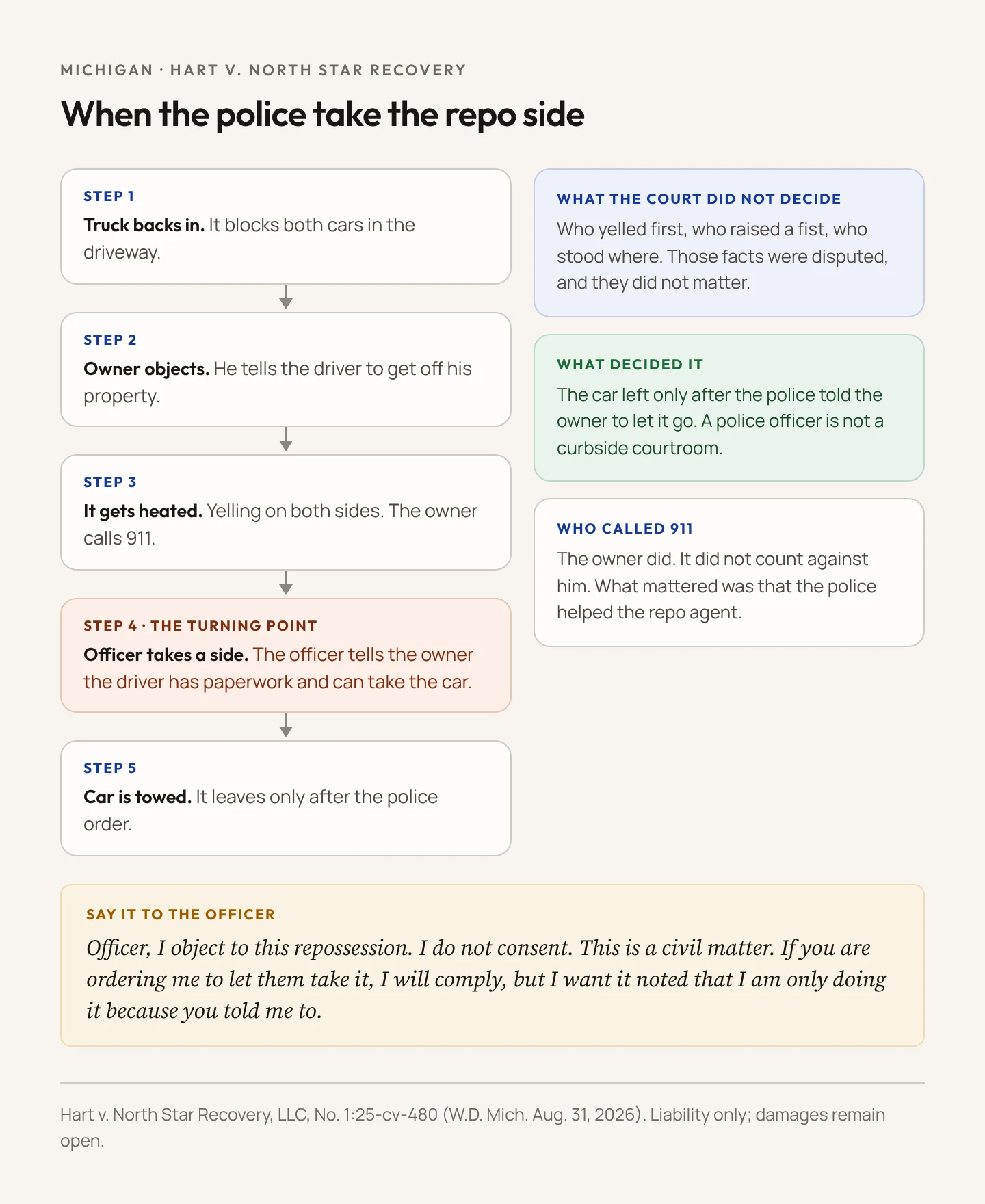
Credit Acceptance sent North Star Recovery. As Brian tells it, a tow truck drove past the house twice shining a spotlight on the cars, then backed into the driveway and blocked both of the Harts' vehicles.
Jack ran out and asked the driver why he was there. The driver said he was repossessing the Santa Fe. In his deposition, Jack said: "Respectfully, you are not taking anything today, and you need to get off my property." After repeating it, he started yelling and cursing. He stood between the tow truck and the car. The driver moved fast toward him, and Jack jumped back and balled up his fists. Jack later admitted the driver might just have been moving quickly.
Jack said he was calling the police. The driver answered, "Go right ahead, I have got F'ing paperwork." Jack called 911. When the officers arrived, they told Jack the driver had the paperwork and could tow the car. The driver towed it. Jack never got it back, and he and his wife were late to work because the truck had them blocked in.
The repo company told a different story: Jack started the yelling, raised his fist first, and the driver toned it down.
North Star asked the court to throw out the case. It made three arguments.
Jack could not sue because the car was in his late father's name. The court disagreed. Any person harmed by an unfair collection practice can sue under the FDCPA, not only the debtor. For the state claims, the court held that Jack had an equitable interest in the car as his father's heir, even without legal title.
Michigan's breach of the peace requires violence. North Star argued you only breach the peace with violence or conduct likely to cause it. The court noted that Michigan's Supreme Court has never defined breach of the peace for repos and that courts around the country disagree. In the earlier ruling, the court found that moving so close to someone that they must step back, then shouting profanities at them, is the kind of conduct that tends to provoke violence.
Nothing happened that rose to a breach of the peace. On August 31, 2026, the court ruled for Jack on liability for all three claims (opens in a new tab): the FDCPA, Michigan's repossession statute (opens in a new tab), and conversion. Brian notes that Michigan's conversion statute (opens in a new tab) allows three times the actual damages. The amount of damages is the next phase of the case.
Here is the key. The judge did not have to sort out who yelled first, who raised a fist, or who stood where. Those facts were disputed. One fact was not: the car was taken only after the police told Jack he had to let it go. That alone decided liability.
That is the judge's phrase, borrowed from another federal case. Self-help repossession is allowed only because it happens without the courts. If you object, the lender is supposed to go get a court order. The official comment to UCC section 9-609 (opens in a new tab) says self-help does not authorize a lender to use a police officer's help.
When an officer stands in your driveway and announces who gets the car, that is the government deciding a debt dispute on the spot, with no judge and no hearing. It chills your right to object.
Jack called 911 himself, and the repo company argued that should count against him. The court said no. What matters is that the police ended up helping the repo company.
North Star said Jack started it. The court answered that a homeowner can create a tense situation, but the violation happens when the agent keeps taking the car anyway. The agent always has the option to walk away. The homeowner cannot leave his own home.
In the Georgia case, the officers told Ms. Hart there was nothing they could do because the car was already in the air. That court did not need to rule on the police issue, because the oral protest was enough in Georgia. Put the two cases side by side and the message to repo companies is the same: when people are objecting and the police are on the way, stop. Not every state or court agrees, so check your own state's law.
Brian's script:
"Officer, I object to this repossession. I do not consent. This is a civil matter. If you are ordering me to let them take it, I will comply, but I want it noted that I am only doing it because you told me to."
You are not fighting the officer. You are making a record that you objected, and that the car was taken because of a police order.
Brian's advice: when you know a repo is coming, have the breach-of-the-peace rule for your state printed and in your hand, even taped to your door. If an officer starts acting like a judge, ask calmly whether they are familiar with the rule, on camera.
If your car was taken after an officer told you to hand it over, you may have a case against the repo company. You have one year to bring an FDCPA claim. Brian's repossession defense kit covers before, during, and after the repo, and the pleadings from this case are inside ParkerGPT.

About the author
Brian Parker
I have over 30 years of experience defending consumers against debt collection lawsuits and have seen every tactic, threat, and pressure play that collectors use. Through KillDebt and ParkerGPT, I have systematized the proven defense strategies that actually work - so consumers can respond from a position of knowledge, not fear. My approach focuses on aggressive legal defense based on documented case success rather than false hope that leads to default judgments.