News Break
Sued by a Debt Collector? Read the Lawsuit First. Here Is What to Look For
October 23, 2026
Blog / News Break
A court recommended dismissing all three TCPA claims a man filed against a debt collector. Brian Parker reads the ruling and shows what each claim needed.
A man got four calls from a debt collector in ten days. He sued under the Telephone Consumer Protection Act on three theories: an autodialer, a prerecorded voice, and the Do Not Call Registry. On October 22, 2026, a federal magistrate judge recommended dismissing all three. For now, he lost. A district judge rules on the recommendation next.
The law did not fail him. His complaint did. In the video below, Brian Parker reads the findings in Rios v. Credence Resource Management and walks through each claim: what the plaintiff wrote, why the court found it short, and what a stronger claim says instead. If collectors are calling you and you are thinking about a TCPA claim of your own, these are the mistakes to avoid.
Key Takeaways
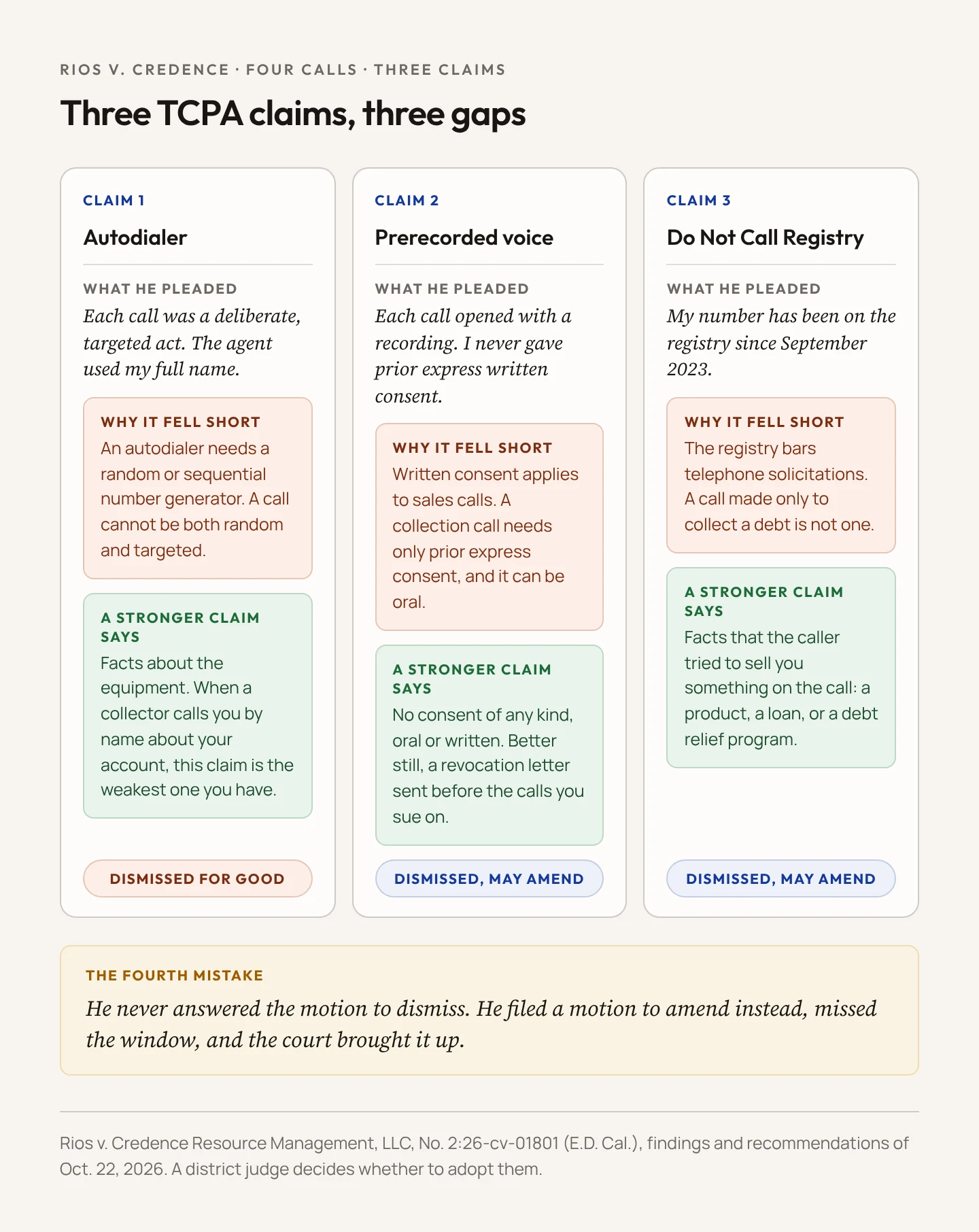
- An autodialer claim needs a random or sequential number generator. A call that names you and your account is targeted, and a call cannot be both random and targeted.
- Debt collection calls need prior express consent, which can be oral. Pleading only "no written consent" leaves the claim open.
- The Do Not Call Registry covers sales calls. A call made only to collect a debt is not a telephone solicitation.
- Answer every motion. He filed to amend instead of answering the motion to dismiss, and the court held it against him.
The plaintiff represented himself. His amended complaint said Credence called his cell phone four times between March 25 and April 3, 2026. Each call opened with a recorded message that the call would be recorded, and then an agent came on and addressed him by his full name. He said his number had been on the National Do Not Call Registry since September 2023 and that he had no account or debt with Credence.
He filed in Sacramento County Superior Court. Credence removed the case to the U.S. District Court for the Eastern District of California and moved to dismiss. The magistrate judge's findings and recommendations (opens in a new tab) go next to the district judge, who decides whether to adopt them. Brian explains why: a magistrate judge does much of the motion work in federal court and recommends an outcome, and the district judge usually adopts it.
Brian's own view of the facts is blunt. Four calls in ten days is a small case, and he would not file it. A weak claim costs you credibility with the court. A strong one can be leverage: if a collector is suing you and broke the law in the process, your claim against it can sit on the table next to its claim against you.
Here is how each of the three claims did.
The TCPA bars calls to a cell phone made with an "automatic telephone dialing system" without prior express consent (47 U.S.C. 227(b)(1)(A) (opens in a new tab)). In Facebook, Inc. v. Duguid (opens in a new tab) (2021), the Supreme Court held that a necessary feature of that equipment is the capacity to use a random or sequential number generator. A system that dials a stored list of customer numbers usually does not qualify.
The complaint said Credence used an autodialer and gave no facts about the equipment. It also said each call was a "deliberate, intentional, targeted act" by an agent who knew his name. The court put the problem in one line: a call cannot be both random and targeted. It recommended dismissing this claim without leave to amend, which means it cannot be fixed.
When a collector calls you by name about a specific account, the autodialer claim is the weakest one you have.
Brian calls the prerecorded voice claim a strong one, and it rests on the same statute. Each of the four calls opened with a recording. That is the kind of fact the claim needs.
The complaint failed on consent. It alleged the plaintiff never gave "prior express written consent." Written consent is the standard for advertising and telemarketing calls. For a debt collection call, the caller needs only prior express consent, and that consent can be oral. The complaint never said whether he had given oral consent, so it did not plead the element. The court recommended dismissal with leave to amend.
Brian's point on consent is practical. When you open a card or a loan, you almost always check a box that lets the lender call, text, and email you. That consent can follow the account. So do not leave consent to an argument. Send a written revocation, and then every later call is a call made after you said stop. That is where the money is, in Brian's words: the TCPA pays $500 per call, and $1,500 per call when the violation is willful, as when you sent a letter saying stop and they kept calling. So he sends the revocation letter the minute the calls and letters start. FCC rules let you revoke by any reasonable method (47 CFR 64.1200(a)(10) (opens in a new tab)), but a certified letter is the proof that holds up.
The prerecorded voice rule matters more each year. Brian says about 25% of the collection calls people face now are AI-generated. In February 2024, the FCC issued a declaratory ruling (opens in a new tab) that AI-generated voices are "artificial" voices under the TCPA. Before that ruling, Brian says, collectors often argued their AI bots were exempt because they did not play back a traditional recording. The ruling took that defense away. A collector that uses an AI agent to talk to you is using an artificial voice. You do not have to prove an autodialer as well. A call to your cell phone with an artificial voice and no consent is enough to state the violation. For how AI is changing collection work, see Brian's breakdown of a Bounce AI lawsuit.
The registry rule bars "telephone solicitations" to registered numbers (47 CFR 64.1200(c)(2) (opens in a new tab)). A telephone solicitation is a call made to encourage you to buy, rent, or invest in something. The court cited the FCC's statement that calls made only to collect a debt are not telephone solicitations. The complaint called Credence a debt collector and did not plead that the calls tried to sell him anything. The court recommended dismissal with leave to amend.
The registry stops telemarketers. It does not stop debt collectors. If a collector pitches a product, a loan, or a debt relief program during the call, write that in your call log. That fact is what could move the call into solicitation territory.
Credence moved to dismiss, and the plaintiff never answered the motion. As Brian reads the record, he read the dismissal motion and filed a motion to amend his lawsuit instead, to fix what it pointed out. But you get only a set window to amend automatically, and Brian says he missed it. The court brought up his failure to respond to the motion to dismiss, and Brian calls that one of the reasons he lost.
A motion to amend is not an answer to a motion. When the other side files a motion, you file a response by the deadline, every time.
For the full picture of what TCPA damages pay and how a revocation letter builds willfulness, read the Capital One late-night calls case.

About the author
Brian Parker
I have over 30 years of experience defending consumers against debt collection lawsuits and have seen every tactic, threat, and pressure play that collectors use. Through KillDebt and ParkerGPT, I have systematized the proven defense strategies that actually work - so consumers can respond from a position of knowledge, not fear. My approach focuses on aggressive legal defense based on documented case success rather than false hope that leads to default judgments.