Success Stories
LVNV Sued Him for $15,000 in Georgia. Unanswered Requests for Admission Won the Case
October 21, 2026
Blog / News Break
The first defense costs nothing: read the complaint and its exhibits. Brian Parker shows six faults he found in real debt lawsuits just by reading them.
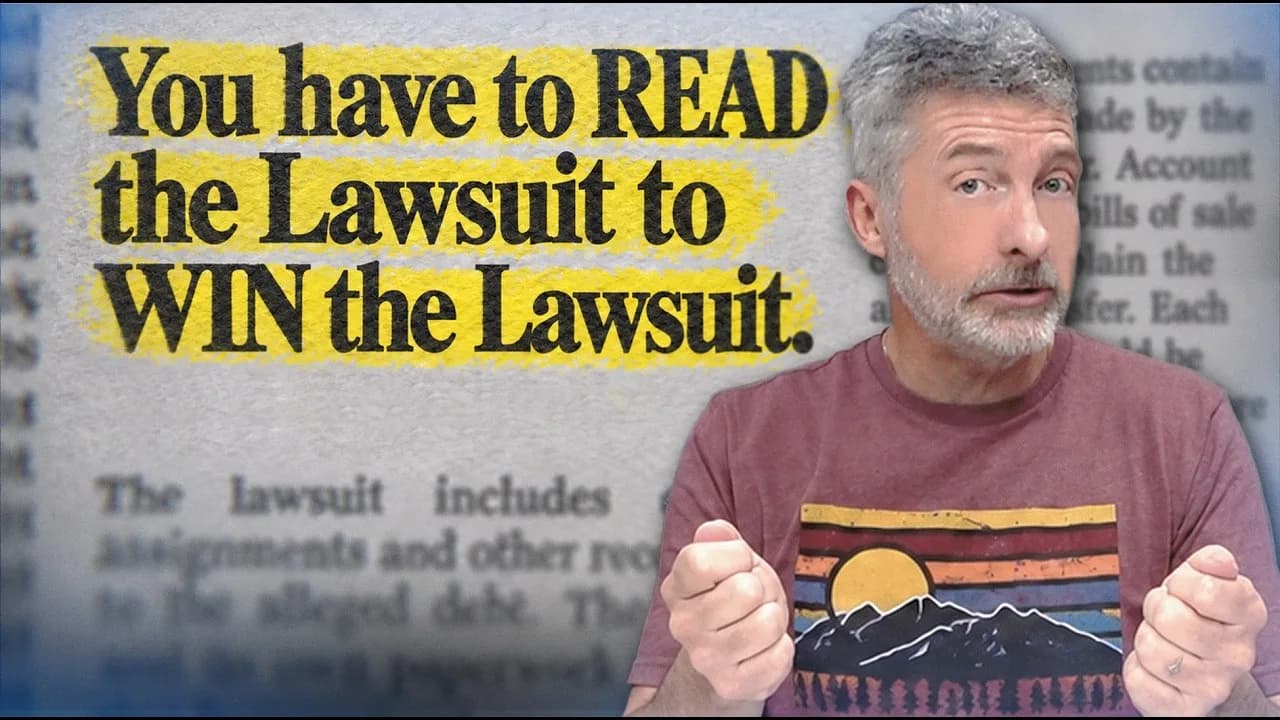
In Brian Parker's interview with Scott, the Georgia member who beat LVNV, Brian asked for one tip from start to finish. Scott's answer was to read. Read the complaint, read what is attached, and notice what is missing. Then put it down for a while so that your first reaction does not drive your answer.
This video takes that tip and shows what reading finds. Brian walks through real lawsuits from his own files. Every fault below was in the plaintiff's own papers.
Key Takeaways
- Reading the complaint and its exhibits is the first defense, and it costs nothing.
- Check who the plaintiff says it bought the account from, and whether that makes sense.
- Check what the bill of sale says it rests on, and whether that agreement is attached.
- Compare names, file names, and dates between the complaint and the exhibits. Mismatches go in your counter affidavit.
Brian's steps are now RACE:
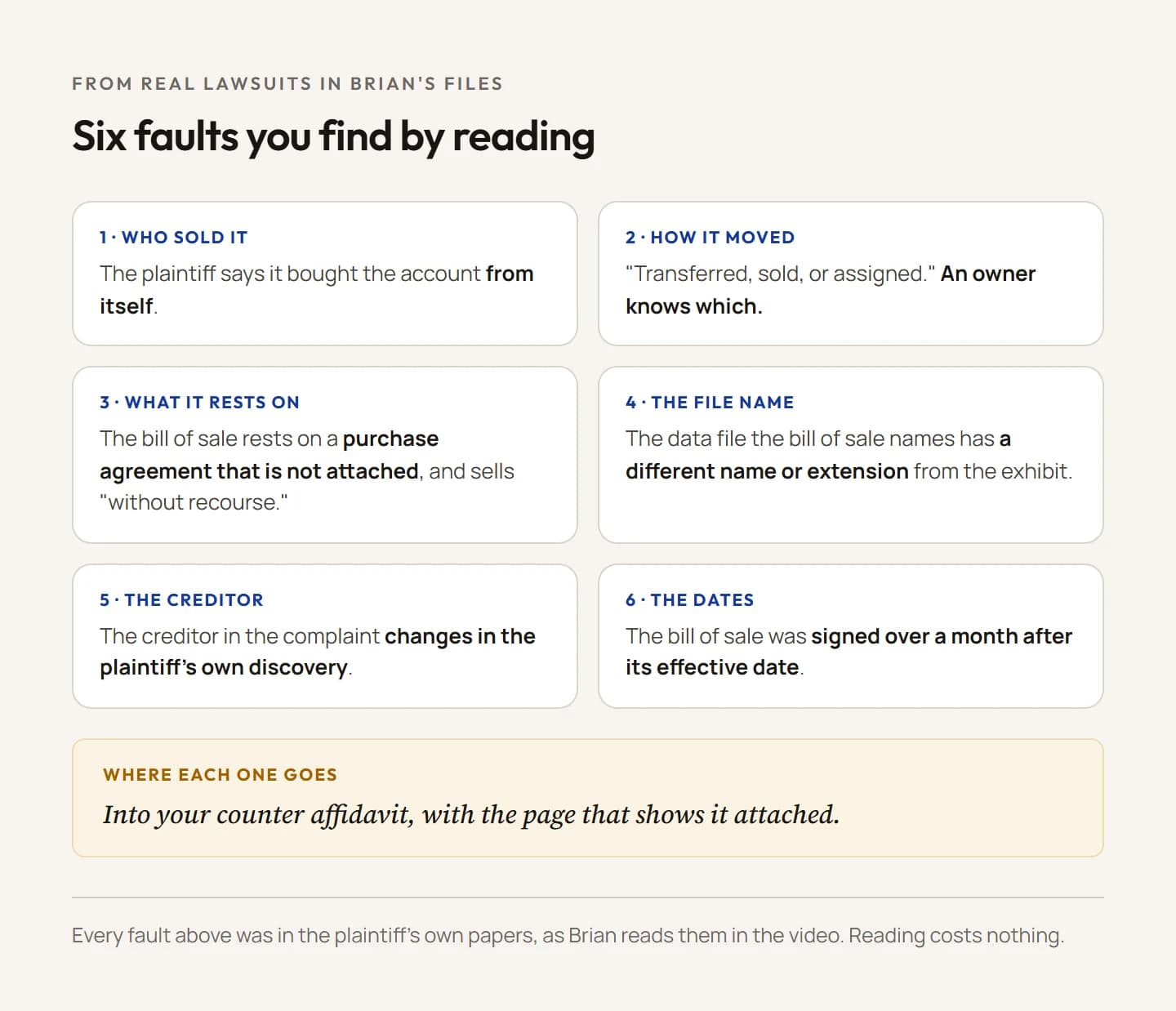
1. The plaintiff bought the account from itself. In one case, the plaintiff was an SLM private education loan trust. Paragraph 4 of the complaint said that before the suit, the plaintiff acquired the account from that same trust. A plaintiff cannot buy from itself. It should have named the original creditor. Brian says the case went through five plaintiff attorneys over about a year before the fifth one admitted the error and asked to amend. By then the rules required his consent or the court's permission. The case settled on terms Brian calls very good for his client.
2. "Transferred, sold, or assigned." Another complaint said that on a stated date the account "was transferred, sold, or assigned" from Barclays to the plaintiff. Which one? A party that owns an account knows how it got it. Point the hedge out to the court.
3. A bill of sale that rests on a missing agreement. The same file's bill of sale said the sale was made pursuant to the terms of a forward flow purchase agreement. That agreement was not attached. It also said the sale was "without recourse," with no warranty of title or enforceability. In plain words: the seller did not promise it owned what it sold. The bill of sale is only a receipt, and the agreement it rests on is the document to demand.
4. A file name that does not match. The bill of sale said the accounts sold were in a named data file. The exhibit offered as proof had a different name, or added a file extension and a prefix. Brian's comparison: an email address without the ".com" is not the same address. A file with a different name or format may not be the file the bill of sale describes.
5. A creditor that changes. In a DNF Associates case, the complaint named the original creditor as the Bank of Missouri with a retail brand. Brian says no company exists by that combined name. Then the plaintiff's own request for admission asked his client about an account with the Bank of Missouri and a different store brand. His response denied it, and pointed out that neither the complaint nor any other request named that account.
6. Dates that do not line up. One bill of sale had an effective date of October 29, 2021, and was signed more than a month later. Read every date on every exhibit, and put them on a timeline.
Brian explains this point in the most detail, because most people skip it.
Every document the plaintiff offers to prove ownership is hearsay: a statement made outside court, offered to prove that what it says is true. It comes in only through an exception, usually the business-records exception (opens in a new tab). That exception depends on the record being reliable and on a witness who can vouch for how it was kept.
A bill of sale that names one file, attached to an exhibit with a different name or format, raises a fair question. Was the data exported, converted, renamed, or assembled after the sale, possibly by the buyer rather than the seller? If so, the printout in front of the court may not be the record the seller transferred. That is a question about authenticity and chain of custody, and the plaintiff has to answer it.
Brian adds a point about Portfolio Recovery Associates. PRA has been under a CFPB consent order since 2015, and in March 2023 the CFPB went back to court (opens in a new tab) over violations of that order. Brian reads the order as requiring PRA to have the original account documents, and he notes that PRA's lawsuits still arrive with a sale file instead. If PRA is suing you, ask for the original documents.
The word "assignment." A document titled "bill of sale and assignment" is not an assignment because it says so. Your state's statute of frauds sets what an assignment needs, often a writing signed by an authorized person.
The signature line. A line that says the signer is an "authorized party" is a claim, not proof. Ask for the document from the original creditor that gave that person authority to sign.
Put every fault in your counter affidavit, and attach the pages that show it. Quote the bill of sale's own words. Ask the court where the agreement is that the bill of sale rests on. Put the dates on a timeline, as the Velocity file showed. Then answer on time.
Scott's results came from doing this. He estimates three wins removed $40,000 to $50,000 in claimed debt, and two of his cases continue.

About the author
Brian Parker
I have over 30 years of experience defending consumers against debt collection lawsuits and have seen every tactic, threat, and pressure play that collectors use. Through KillDebt and ParkerGPT, I have systematized the proven defense strategies that actually work - so consumers can respond from a position of knowledge, not fear. My approach focuses on aggressive legal defense based on documented case success rather than false hope that leads to default judgments.