
News Break
Click to Defend: Navigating Remote Debt Lawsuit Filings Online
June 18, 2026
Blog / News Break
Learn how to file a Motion to quash service, meet deadlines, and protect your rights in a debt lawsuit.
A motion to quash service is one of the most powerful — and most overlooked — tools a defendant has when facing a debt lawsuit.
Quick answer: If you were not properly served with a summons and complaint, you can file a motion to quash service to challenge the court's jurisdiction over you. Here's what that means in plain terms:
Debt collectors are notorious for cutting corners on service. This is sometimes called "sewer service" — where a process server claims to have served you but never actually did. If that happened to you, the law gives you a way to fight back before the case even gets started.
But here's the catch: timing is everything. File anything else first — even a simple response — and you may permanently waive your right to challenge service.
I'm Brian Parker, founder of KillDebt, and over my 30+ years fighting debt collectors and collection law firms in courtrooms across the country, I've used the motion to quash service strategy to stop cases dead in their tracks before they ever got off the ground. Read on — I'll show you exactly how to do the same.
To understand a motion to quash service, we first have to talk about a fundamental constitutional right: due process.
When a debt collector files a lawsuit against you, they cannot simply walk into a courtroom and get a judgment. The U.S. Constitution requires that you receive formal, legal notice of the lawsuit. This notice is delivered through two documents: the Summons (which tells you that you are being sued and how long you have to respond) and the Complaint (which outlines the debt collector’s specific claims against you).
The formal delivery of these documents is called service of process. Until you are properly served, the court does not have personal jurisdiction over you. In other words, the judge has no legal authority to make decisions that affect your life or your bank account.
If a debt collector claims they served you, but they did not follow the strict statutory rules for doing so, you can file a motion to quash service. This motion asks the judge to officially declare the purported service invalid (to "quash" it).
However, you must be incredibly careful about how you approach the court when challenging service. In many jurisdictions, including Florida and Michigan, courts distinguish between two types of appearances:
If you make a general appearance before challenging service, you legally waive your right to object to improper service. The court will assume you have consented to its jurisdiction, and you will have to fight the lawsuit on its merits, even if the process server threw the lawsuit papers in a ditch.
Before you take any steps in court, it is vital to understand the landscape of your lawsuit. We highly recommend reviewing our What to Do When Sued by a Debt Collector: Complete First Steps Guide to ensure you do not accidentally waive your rights.

What actually makes service of process "improper" or "defective"? Debt collection agencies and their process servers make mistakes constantly. Here are the most common legal grounds for filing a motion to quash service:
This is the most egregious form of defective service. "Sewer service" happens when a process server falsifies a proof of service (or "return of service") document, claiming they hand-delivered the papers to you when, in reality, they threw them in the trash, left them on a random porch, or never even visited your address.
Process servers often get lazy. If they cannot find you, they might hand the papers to a neighbor, a landlord, a coworker, or a roommate who does not meet the legal criteria for receiving service on your behalf. In Florida and Michigan, substituted service is allowed, but only under very strict conditions. For instance, you cannot just hand court papers to a random child or a visitor at the house.
If a process server cannot find you personally, they may attempt substituted service.
If a debt collector cannot locate you, they might ask the court for permission to serve you by publication (putting an ad in a local newspaper). However, they cannot do this just because they want to. They must prove they exercised reasonable diligence in trying to find you first. If they did not perform a diligent search—such as checking utility records, voter registration, or conducting basic internet searches—you can quash the service.
While our primary focus is on Florida and Michigan, other states have similar strict statutory guidelines. For example, California’s rules under California Code, CCP 418.10. outline how defendants can challenge service, highlighting that proper service is a universal constitutional requirement across the United States.
When you are sued, you have several defensive motions at your disposal. It is crucial to choose the correct one, as using the wrong motion can result in a quick defeat or an accidental waiver of your rights.
Let's break down how a motion to quash service differs from other common responsive filings, such as a demurrer or a motion to dismiss.
The landmark California case Stancil v. Superior Court reaffirmed a vital legal principle that applies nationwide: a motion to quash service cannot be used to challenge the underlying merits or factual allegations of a complaint. If you want to argue that you do not owe the debt, or that the statute of limitations has run, you must do so through an Answer or a Motion to Dismiss, not a motion to quash.
Here is a quick comparison table to help you keep these strategies straight:
| Feature | Motion to Quash Service | Demurrer | Motion to Dismiss |
|---|---|---|---|
| Primary Goal | Invalidate improper service / challenge personal jurisdiction | Dismiss complaint for failing to state a legal claim | Dismiss the case entirely based on procedural or substantive defects |
| What It Admits | Nothing. You are making a "special appearance." | Admits the facts of the complaint only for the sake of argument. | Depends on the grounds (can challenge jurisdiction, process, or merits). |
| Common Outcome | Plaintiff must re-serve you properly (delays the case). | Plaintiff is usually given leave to amend and rewrite the complaint. | Case may be dismissed with or without prejudice. |
| When to File | Before filing an Answer or any general appearance. | Before filing an Answer (in states that use demurrers). | Before or alongside your Answer, depending on state rules. |
Choosing the wrong path can expose you to rapid default judgments. To map out your entire defensive strategy, take a look at our comprehensive Debt Lawsuit Defense Guide.

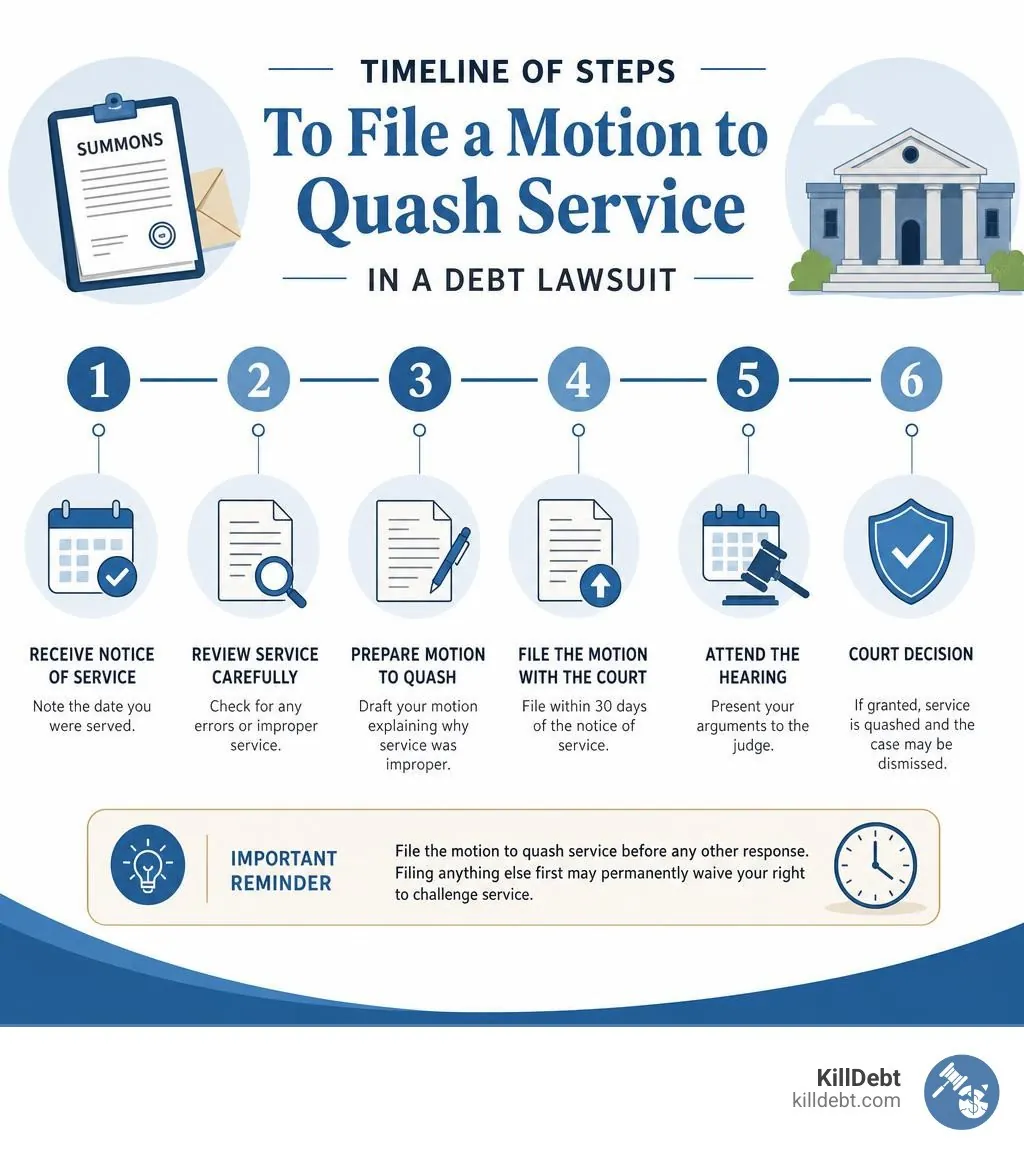
If you have confirmed that you were improperly served, and you want to challenge the debt collector's bad service, you must act quickly and precisely. Here is the step-by-step process to file your motion.
Before you write your motion, you need to see exactly what the process server told the court. Call or visit the court clerk's office and request a copy of the Return of Service (also called the Proof of Service or Affidavit of Service). This document lists the date, time, location, and description of the person allegedly served.
Compare the Return of Service with reality.
Your motion must include:
File the original motion with the court clerk. You may need to pay a motion filing fee depending on your local court rules. Once filed, you must serve a copy of the motion on the plaintiff's attorney and file a Proof of Service with the court showing you did so.
If you are feeling overwhelmed by court rules, don't panic. You can learn the fundamentals of responding to court documents in our guide on How to Answer a Debt Summons.
In the legal world, deadlines are absolute. If you miss your window, you lose your rights.
Filing a motion to quash service extends your time to plead. This means that while your motion is pending before the judge, the debt collector cannot enter a default judgment against you. The clock stops ticking until the judge makes a ruling on your motion.
A motion to quash is only as good as the evidence supporting it. If it is just your word against the process server's sworn affidavit, the judge will almost always believe the process server. You must provide concrete, objective evidence.
Useful evidentiary attachments include:
Once you present this evidence, the burden of proof shifts. While the process server's affidavit creates a presumption of valid service, your evidence rebuts that presumption. The plaintiff (the debt collector) must then step up and prove to the judge that service was, in fact, legally sufficient.
Filing a motion to quash service is a highly effective way to hold debt collectors accountable to the letter of the law. If they want to sue you, they must respect your constitutional right to due process.
But you don't have to navigate these complex procedural rules, affidavits, and court deadlines alone. At KillDebt, we have built a DIY legal defense system designed specifically to level the playing field for everyday consumers.
Our platform is powered by ParkerGPT, an AI trained on consumer debt law and real-world courtroom strategies developed over 30+ years by myself, attorney Brian Parker. Unlike generic AI tools, ParkerGPT:
And our newest breakthrough, the Court Tester, lets you upload your filings and run an AI courtroom simulation. You can practice arguing your motion to quash in front of an AI judge, face off against AI opposing counsel, and receive private, strategic advice from an AI co-counsel whispering tips only you can see.
Don't let debt collectors walk over your rights with sloppy service. Get started with KillDebt's AI-powered defense tools today and take control of your case!
Get started with KillDebt pricing
Important Legal Disclaimer
This educational content is based on general legal principles and my experience in debt collection defense. It is provided for informational purposes only and does not constitute legal advice. Laws vary by state and by local court. For specific legal advice, consult a qualified attorney licensed in your jurisdiction. No attorney-client relationship is created by reading this guide.
Critical Multi-State Variations: FDCPA applies uniformly at the federal level, but state consumer protection laws may provide additional rights and remedies. Statute of limitations periods vary significantly by state and debt type. What constitutes sufficient debt validation varies in practice across jurisdictions. State-specific rules on call frequency, written notice requirements, and permissible collector conduct may differ from federal minimums.

About the author
Brian Parker
I have over 30 years of experience defending consumers against debt collection lawsuits and have seen every tactic, threat, and pressure play that collectors use. Through KillDebt and ParkerGPT, I have systematized the proven defense strategies that actually work - so consumers can respond from a position of knowledge, not fear. My approach focuses on aggressive legal defense based on documented case success rather than false hope that leads to default judgments