News Break
She Caught an Altered Debt Collection Affidavit and Still Lost in Federal Court. Here Is Why
November 20, 2026
Blog / Success Stories
Robert beat LVNV twice. Now Cavalry SPV is suing him in Maryland, and its own papers name LVNV. Part 1: the defects he found before trial.
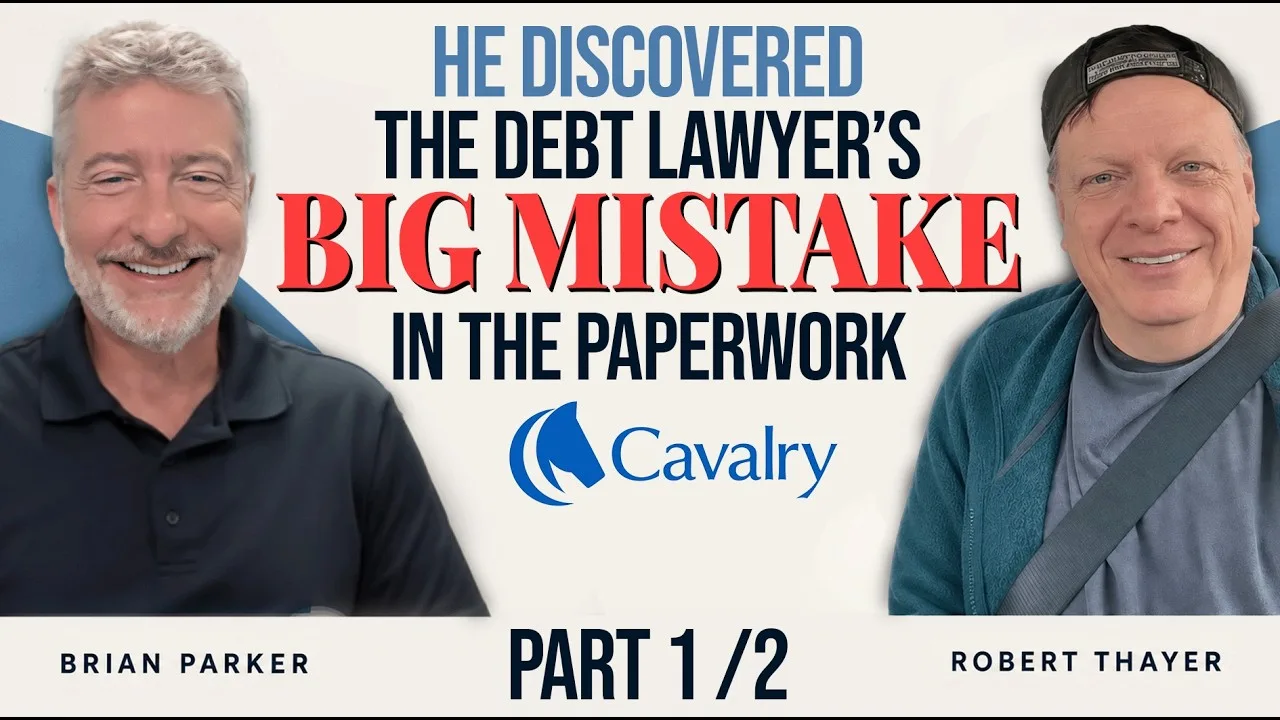
Robert is a KillDebt member in Maryland. He lost his first debt case, appealed, and beat LVNV Funding twice. Now Cavalry SPV is suing him over a Synchrony credit card.
This time, he says, he could not wait for the process server to hand it over. In part 1 of a two-part interview, he shows Brian Parker what he found just by reading the lawsuit. His trial is set for December 18. Part 2 will cover what happens there.
Key Takeaways
- Read the complaint again and again. Robert found the biggest defect in Cavalry's own paperwork: a notice that names LVNV Funding.
- A bill of sale is a receipt. Look at who signed it, for whom, and when.
- Ask whether the signer of their affidavit can speak to how the original creditor made the records. Without that, it is hearsay.
- Rank your defects. Lead with the strong ones, and let the weaker ones add up.
Before his trial, Robert went to court and watched the judge he will face. He saw a young man who represented himself. The man said he disputed the debt. When the judge asked why, he said he had been sick and lost his job.
That is not a defense. The judge gave him another chance to add anything. He said no, and the judge entered judgment for the plaintiff. Robert says the judge was fair to both sides. A judge cannot argue your case for you. You have to bring a real defense, such as a missing contract, invoices that do not prove the amount, or a witness with no personal knowledge.
Robert also watched 16 people who never answered take default judgments. "If you contest it, then there's a burden of proof," he says. The plaintiff then has to prove the amount, charge by charge, and prove it owns the account.
Brian's advice for the first week has not changed: have a five-minute pity party, then read the lawsuit.
Cavalry attached a bill of sale signed by one person for several companies: Synchrony Bank and the other sellers listed on it. Brian calls it his favorite bill of sale, because he sees the same signer on many of them. His question: does she have the authority to sign for all of those companies?
The bill of sale says the sale happens "as set forth in" a master account sale agreement. That agreement is not attached. Brian says debt buyers do not want to hand it over, so ask for it in discovery when your court allows discovery. More on the forward flow agreement behind most of these sales.
Robert spotted the dates. The bill of sale says it was executed on October 18. The signature is dated October 27. "When I go to Walmart and get a receipt, it says the day and time I bought something," he says. "It's not two weeks later."
Brian agrees with the comparison. These documents are receipts for something sold between several companies. And each transfer in the chain of assignment needs its own paper. Robert points out that Cavalry shows one transfer only.
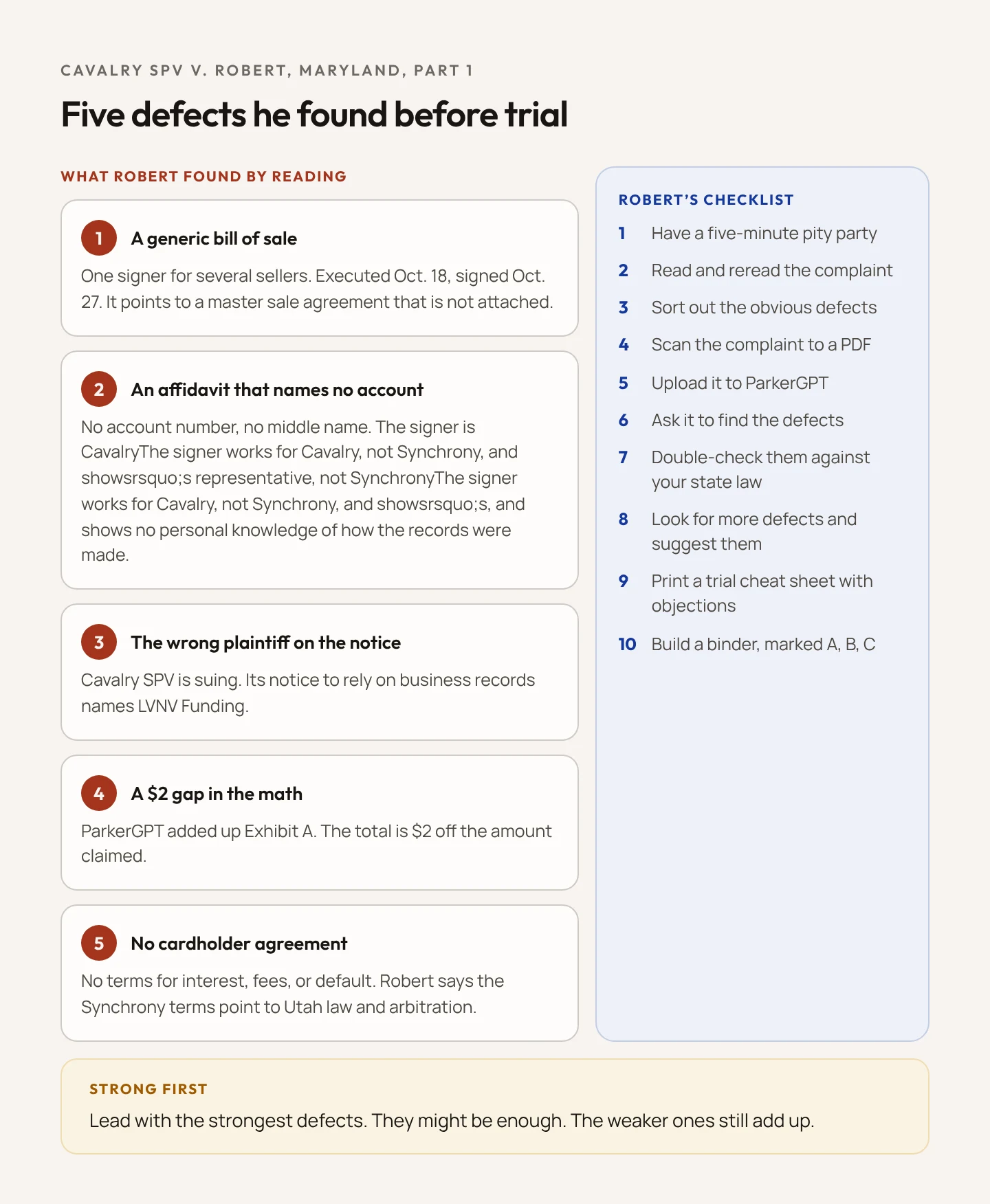
Cavalry's affidavit is a pre-made form. Robert says the signer filled in a name and little else. It does not say which account. "Is it my Netflix account?" he asks. It has no account number and no middle name.
The signer is an authorized representative of Cavalry. Robert says she does not claim to work for Synchrony, and shows no personal knowledge of how Synchrony created and stored the statements. Without that foundation, he argues, the records do not fit the business records exception, and they are hearsay. In Maryland, the business records exception is Rule 5-803(b)(6), and Rule 5-902 covers certified business records. Robert plans to object to each record when they offer it.
Then Brian put up the notice of intent to rely on business records. The case is Cavalry SPV against Robert. The notice names LVNV Funding. "That's how much care they put into it," Brian says. They got the plaintiff wrong on the very document that asks the court to let their records in.
Robert scanned the complaint to a PDF and uploaded it to ParkerGPT. He asked it to look for defects. It ranked each one as strong, moderate, or weak.
Why rank them? "You want to put the strongest ones up first because it might be enough," Robert says. If not, the weak ones build on the strong ones.
Robert says Maryland has a checklist debt buyers fill out, and it lets them show card statements instead of the contract. The Maryland District Court does use an Assigned Consumer Debt Checklist for these cases. Robert's read on why they skip the contract: it might send the case somewhere else.
He looked up Synchrony's terms. He says they call for arbitration, with an exception for small claims, and for Utah law. He also says Utah gives a creditor more time to sue than Maryland's three years, so he plans to keep the fight in Maryland.
Without the agreement, he says, nobody can show his terms for interest, late fees, or default. "There's no one saying that I even had to pay it back if you don't see the agreement."
Brian noticed Robert's amended answer is short: a general denial and a demand for strict proof. That goes against Brian's usual rule. Brian calls for a responsive pleading with a counter affidavit.
Robert says he has no choice in his court. In Maryland small claims, he says, he cannot do discovery, file a counterclaim, or file a counter affidavit. He tried a counter affidavit in his first trial, and he says the judge would not allow it.
Brian's note: you can still sue a debt collector for suing you with improper documents. He says he might wait until after the win.
Brian put Robert's process on screen:
The cheat sheet lists possible objections and tells him when to raise them, such as when the plaintiff's lawyer starts to present the invoices. If the judge overrules an objection, Robert plans to say he will keep it in reserve for appeal. Brian calls that an attorney move.
Robert is building a binder with the affidavit's defects highlighted and marked A, B, C, D, E, each with an explanation.
Brian's advice: whatever you give the court, you must also give the other side, with a proof of service. A binder you keep for yourself, you do not have to share. And do not read from it. "Nobody likes to be read to other than your kids," Brian says. Know your strong points, and say them while you look at the judge.
Robert does not expect Cavalry to bring a witness. He expects a coverage attorney, a local lawyer who stands in for the collection firm, with a few pieces of paper.
He also emailed the firm and asked for any records beyond what they had already sent. They did not reply. If they now tell the court he had a chance to review more records, he wants to raise it. Brian's point: a coverage attorney cannot say "I know nothing about this" when you show up, and then ask for a default when you do not. See what not to say in court.
Robert's trial is set for December 18. Brian plans to talk with him again after the case is resolved. Until then, the case continues, and nothing has been decided.
If a debt buyer just sued you, start the way Robert did. Read it, then let ParkerGPT read it with you.

About the author
Brian Parker
I have over 30 years of experience defending consumers against debt collection lawsuits and have seen every tactic, threat, and pressure play that collectors use. Through KillDebt and ParkerGPT, I have systematized the proven defense strategies that actually work - so consumers can respond from a position of knowledge, not fear. My approach focuses on aggressive legal defense based on documented case success rather than false hope that leads to default judgments.