News Break
Certificate of Conformity in a Midland Lawsuit: How to Use It Against Them
November 6, 2026
Blog / News Break
A blank answer beats a default, but not by much. Brian Parker shows how a responsive pleading with a preliminary statement makes your case stand out.
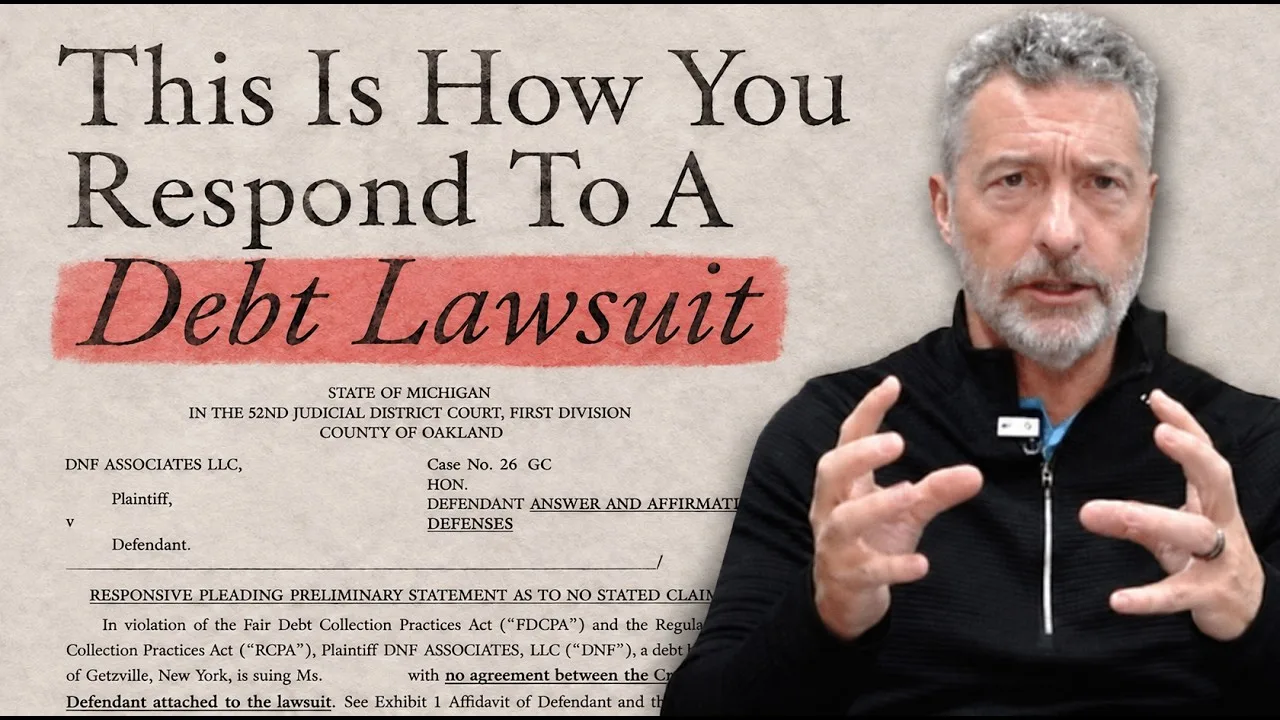
Any answer is better than a default. But Brian Parker says a blank, repetitive answer is not much better. It tells the debt buyer's attorney you will not fight, and it leads to a bad settlement.
In the video below, recorded from a hotel room on the road, Brian shows the difference between an answer and what he files instead: a responsive pleading. It opens with a preliminary statement, it says "I dispute" from paragraph 1, and it makes your case stand out from everyone else on the docket that day.
Key Takeaways
- Your answer is a responsive pleading. Use it to tell the judge why the plaintiff's case fails.
- Open with a preliminary statement. Name the gaps in their proof before you respond paragraph by paragraph.
- Say "I dispute" in every response, starting with paragraph 1.
- Stand out from the crowd. A blank answer looks like every other one, and the court treats it that way.
Brian's framework for a debt lawsuit is RACE.
The summons says you must answer. Brian points out there is no question to answer. The plaintiff filed a complaint with allegations against you, and you must respond to each one. The formal name for your filing is a responsive pleading: the document a defendant files to respond to a summons and complaint.
Brian titles his that way on purpose. Anybody can file an answer. He wants you to respond.
Brian's one rule for every response: say you dispute the debt.
You can write a long, careful answer. If it never says "I dispute," Brian says the judge will notice, and the other side will point it out: he is not even disputing this. He compares it to the old proverb about the kingdom lost for want of a nail. The nail is one sentence: I dispute this debt.
In Brian's own pleadings, paragraph 1 says the defendant denies the plaintiff's claims and disputes them. He calls it ABC: always be closing. Every paragraph says why you should win.
Brian does not start with the paragraph-by-paragraph response. He starts with a preliminary statement that tells the judge what the case is about and where it fails.
He shows two from real cases:
Brian says you do not need to copy his words. The point is to put your best face forward and show the judge exactly what you want them to look at.
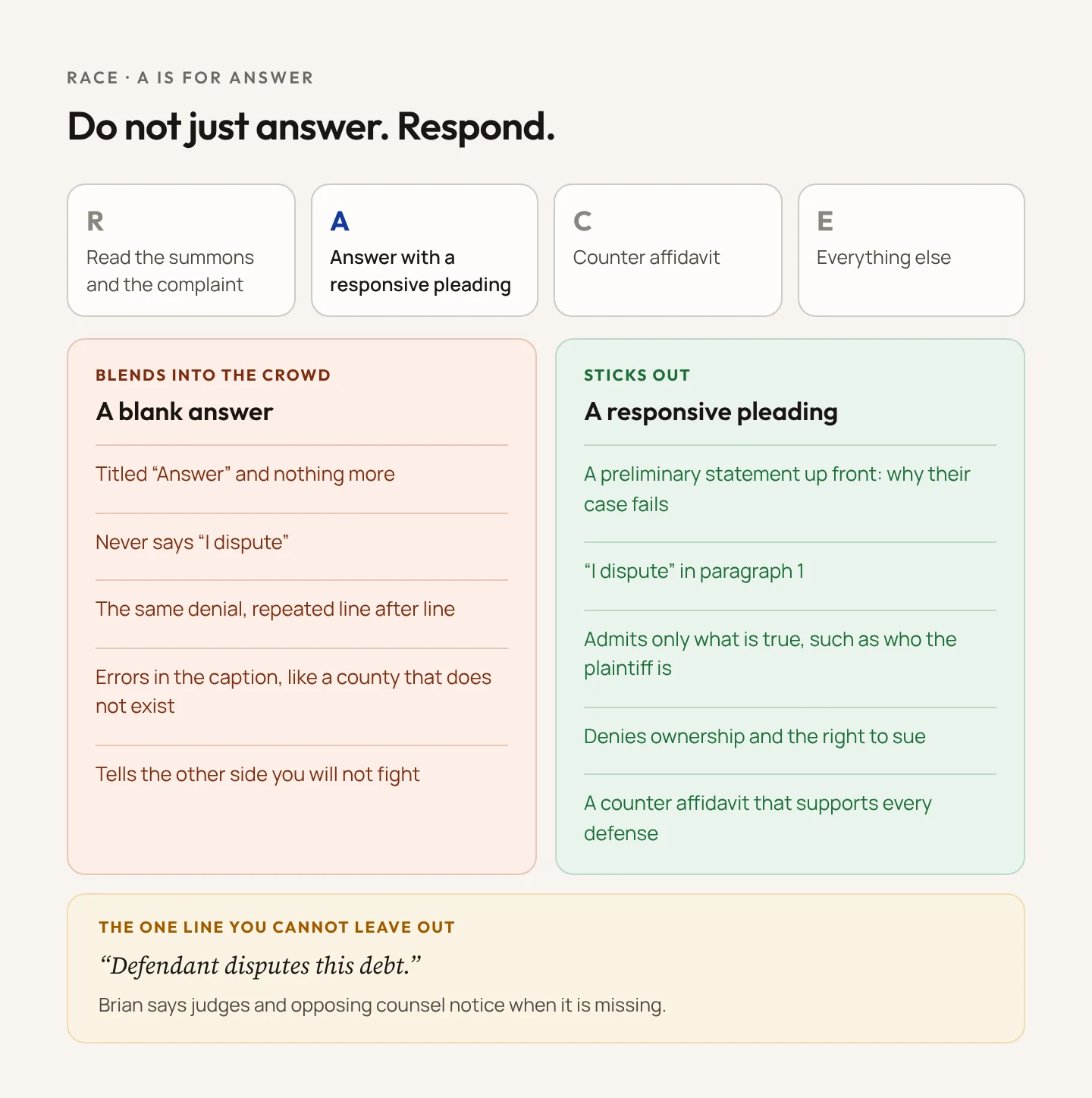
Brian shows the kind of answer he does not want you to file. It is blank and repetitive. It does not allege anything, and it does not dispute the debt. The caption names the 53rd Judicial District Court in "Howell County," Michigan. There is no Howell County. Howell is a town in Livingston County.
Brian says the attorney on the other side reads a filing like that and assumes he will collect everything. The response you get matches the answer you file.
Brian's rule for any situation: when you are part of a crowd, you lose your ability to win as an individual. At a busy debt docket, the court may send every unrepresented defendant to talk with the one attorney who represents all the plaintiffs that day. Brian calls it a cattle call. Whatever the crowd's theme is, fear, a lost job, no money, that is what the judge sees.
A responsive pleading with a preliminary statement takes you out of that crowd. Brian says it also shows the court respect.
Most people never get that far. Brian says at least 8 out of 10 people sued for a debt never answer and end up with a default judgment, citing Pew's research. In Michigan, he says, a default judgment can follow you for 20 years. All you had to do was file an answer and show up.
Brian says a strong answer brings better settlement offers. He also sees cases simply dropped once the debt buyer's attorney sees you will fight. They let it die on the vine.
Scott, the Georgia member who beat LVNV, is his example. Brian says Scott saved over $40,000 by making the debt collector prove its case, and that his responsive pleadings are how he did it. He still has two more cases coming, and Brian says he cannot wait.
If you want to see how a judge might react to your answer, the Court Tester lets you practice in private with an AI judge and an AI co-counsel.

About the author
Brian Parker
I have over 30 years of experience defending consumers against debt collection lawsuits and have seen every tactic, threat, and pressure play that collectors use. Through KillDebt and ParkerGPT, I have systematized the proven defense strategies that actually work - so consumers can respond from a position of knowledge, not fear. My approach focuses on aggressive legal defense based on documented case success rather than false hope that leads to default judgments.