Success Stories
Sued by Midland Credit Management on Three Cards: How David Fought Back in South Carolina
November 4, 2026
Blog / News Break
Midland attaches a New York real estate form to debt suits in other states. Brian Parker shows what it fails to prove and how to use it against them.
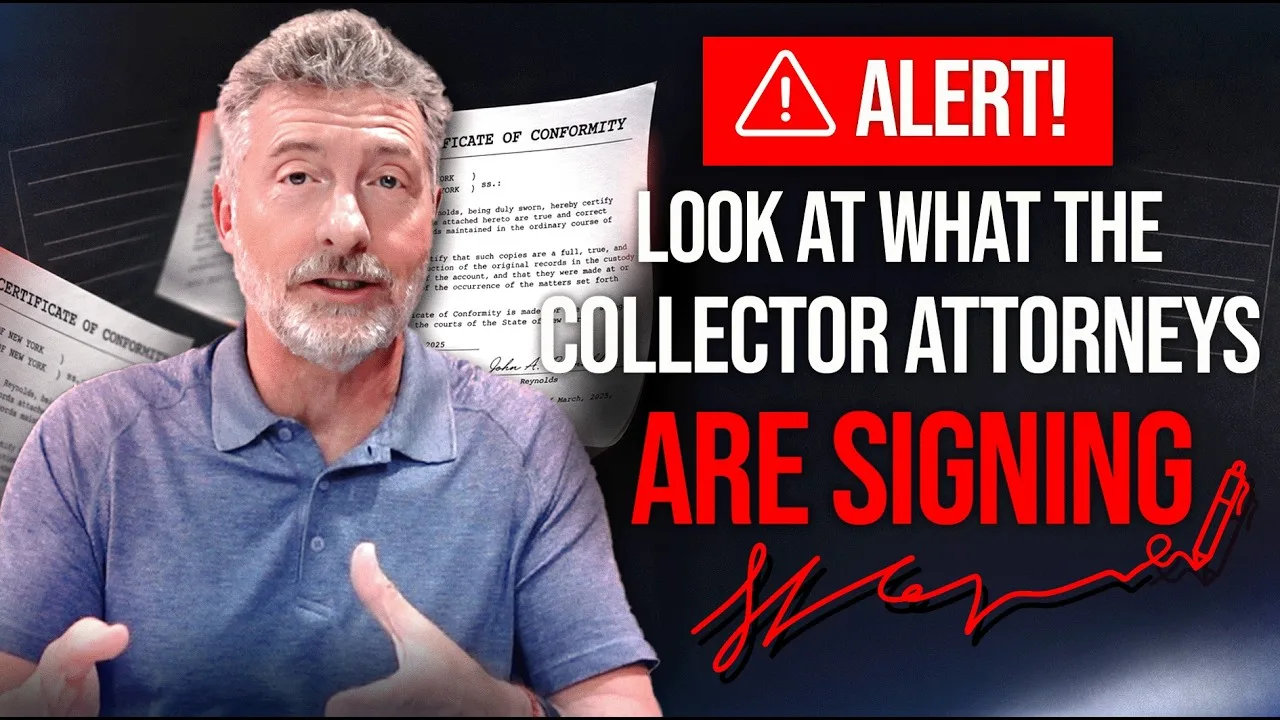
Open the exhibits to a Midland Credit Management lawsuit and you may find a page called a certificate of conformity. It cites section 299-a of New York's Real Property Law. Your case is about a credit card. It is probably not in New York. And Brian Parker says New York itself stopped needing this certificate in 2024.
In the video below, Brian shows certificates from Midland cases in Florida, Pennsylvania, and Kentucky. He explains what they fail to prove, and how to use them against the company suing you.
Key Takeaways
- A certificate of conformity vouches for how another affidavit was signed. It says nothing about your account.
- The form cites New York's Real Property Law, a rule for deeds, in credit card cases in other states.
- Do not lead with "real estate law does not apply." Argue that the affidavit lacks a business records foundation.
- Verify every signer. Look up the attorney with the state bar and the notary's commission.
In his last video, Brian interviewed David, the South Carolina member who fought Midland on three cards. David found it by reading the lawsuit. Midland's affidavit opened with "Plaintiff Midland Credit Management Inc. personally appearing before me." Brian asks how a billion-dollar corporation appears in person before anybody to be sworn. There was a signature, but no notary stamp.
That is the R in Brian's RACE framework: read the lawsuit. Then answer, file a counter affidavit, and do everything else.
Brian commonly sees a Midland lawsuit carry an affidavit of sale or an affidavit of account, followed by a certificate of conformity. He calls it insecurity. The company keeps adding papers to back up the papers it already filed.
He compares it to a rock singer asked how he knew his solo work would succeed: throw enough at the wall and some of it sticks. Brian says the volume is on purpose. If you do not show up, the judge picks up a pound of paper and may assume it must be true.
Brian traces the form to New York. New York's rule on out-of-state affidavits, CPLR 2309(c), borrowed the standard for recording deeds in section 299-a of the Real Property Law. That law is about land. It has nothing to do with collecting a credit card debt.
Brian says New York dropped the need for the certificate in 2024. Since January 1, 2024, New York's CPLR 2106 (opens in a new tab) lets any person, wherever they are, sign an affirmation under penalty of perjury in place of a notarized affidavit. As Brian puts it, nobody told Midland that New York law does not govern a Montana or Michigan case, or that the certificate is not needed after 2024.
Florida. An affidavit of sale says Synchrony Bank, formerly GE Capital, sold accounts to Midland. Brian says it does not name whose debt, when, or how much. A Florida attorney signed the certificate of conformity attached to it. The form reads "he/she," and it cites New York's real property law in a Florida case that has nothing to do with real property. The case was in January 2025. Brian shows another from June 2025, after the New York change, and one from 2021 by the same attorney. The footer of one affidavit carries a New York form number dated 2017.
Pennsylvania. The certificate again cites section 299-a. The attorney's signature has no printed name under it. Brian says that is purposeful: you cannot check whether the signer is even an attorney.
Kentucky. This attorney printed a name and a bar number. The certificate speaks of the "acknowledgement or proof of deeds of real property." There is no real property in the case. At the top are a contract ID, an addendum ID, and a document ID. The footer says Encore, Midland's parent company. Brian reads it as a document produced in batches under a vendor contract: sign here, sign here, no need to read.
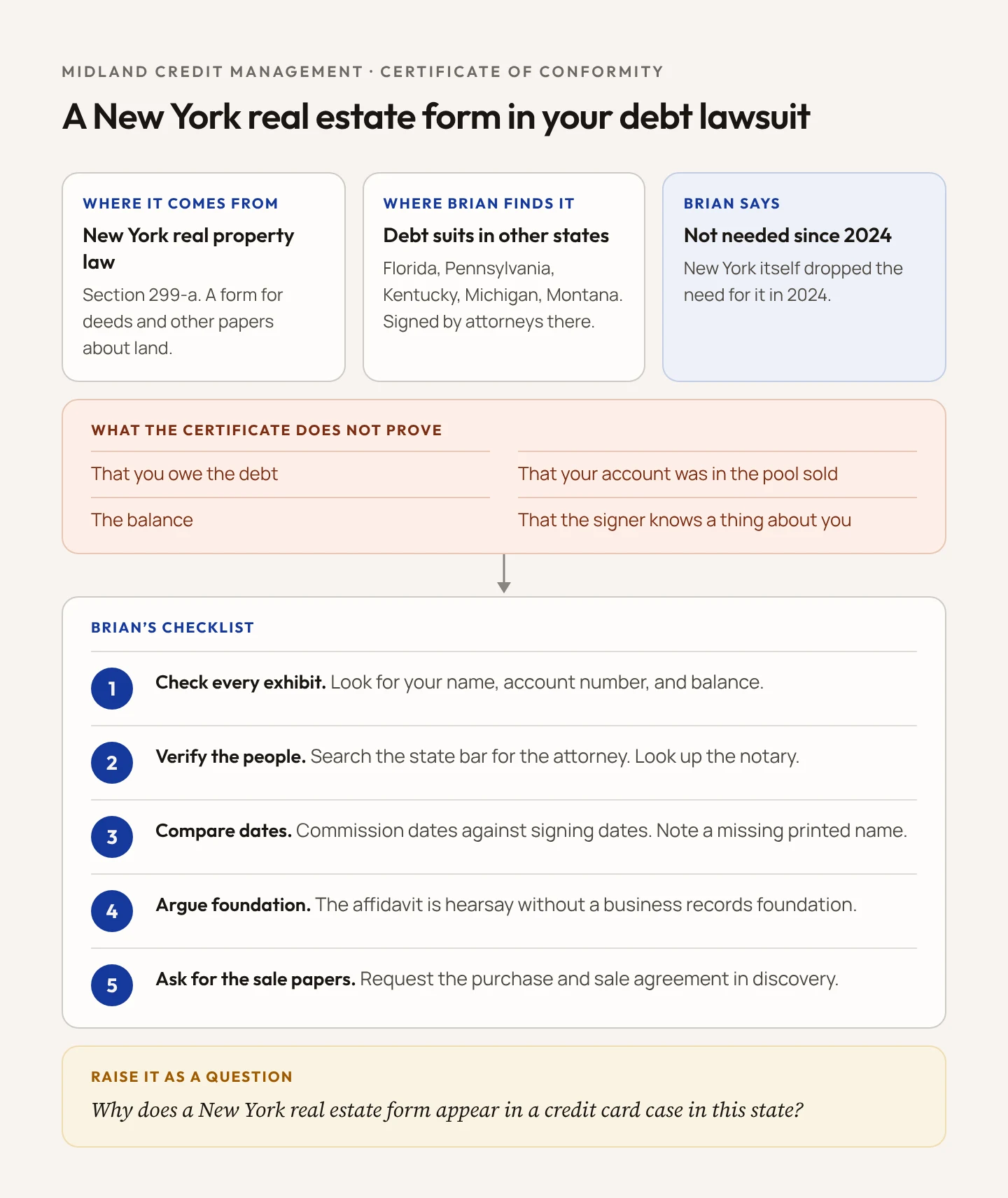
Brian is direct about it. The certificate:
Brian says this matters because if the affidavit fails, the whole case can fail. The extra paper is a positive for you. More documents mean more mistakes you can use against them.
Midland's parent, Encore, has consent orders with federal and state regulators. Brian says some cover conduct like what he shows here, and that can support a counterclaim against the collector.
Scott, the Georgia member who beat LVNV, gave the same first step: read what was filed with the complaint, and what was not. Then set it down for a bit so you can think about it without emotion.
The cheat sheets give you the questions a judge may ask and how to answer them, so you can raise these points calmly at the hearing.

About the author
Brian Parker
I have over 30 years of experience defending consumers against debt collection lawsuits and have seen every tactic, threat, and pressure play that collectors use. Through KillDebt and ParkerGPT, I have systematized the proven defense strategies that actually work - so consumers can respond from a position of knowledge, not fear. My approach focuses on aggressive legal defense based on documented case success rather than false hope that leads to default judgments.