News Break
Debt Collector Consent Orders: How to Use Them in Your Defense
November 2, 2026
Blog / Success Stories
Midland sued a South Carolina man on three cards. He read every page, found the missing right to cure notice, and Midland offered to dismiss with prejudice.
David was at work in Lake City, South Carolina, when the local constable knocked on his back door. He had known the man for 30 years. The constable handed him a lawsuit from Midland Credit Management over three credit cards, Milestone, Destiny, and Indigo, and told him to show up to court.
David had never heard of Midland. He is almost 65, and he says he has never lost a fight. So he sat down after work and read the lawsuit line by line, page by page. In the video below, Brian Parker walks through what he found, and how it brought Midland to offer a dismissal with prejudice on all three cards.
Key Takeaways
- Read every page of the lawsuit, more than once. David found something new each time he read it.
- In South Carolina, a creditor must give a notice of the right to cure before it can accelerate the balance. Midland could not show the judge a valid one.
- "On information and belief" means the plaintiff does not know. Make it prove the fact.
- Show up. David was the only defendant in the courthouse, and he says Midland did not expect him to come.
Brian's advice is the same in every video: read the lawsuit. Two weeks before this interview, Scott, the Georgia member who beat LVNV, said the same thing. Sit down, stay calm, and read.
David scanned the papers into his computer and asked Google's AI to explain the legal terms in plain words. He played Brian's YouTube videos on the TV while he worked. Then he read the lawsuit a couple of times a day. "Every time I found something more," he says.
His deadline was 30 days. He was served around July 7 and filed his answer, affirmative defenses, and a counterclaim on July 30.
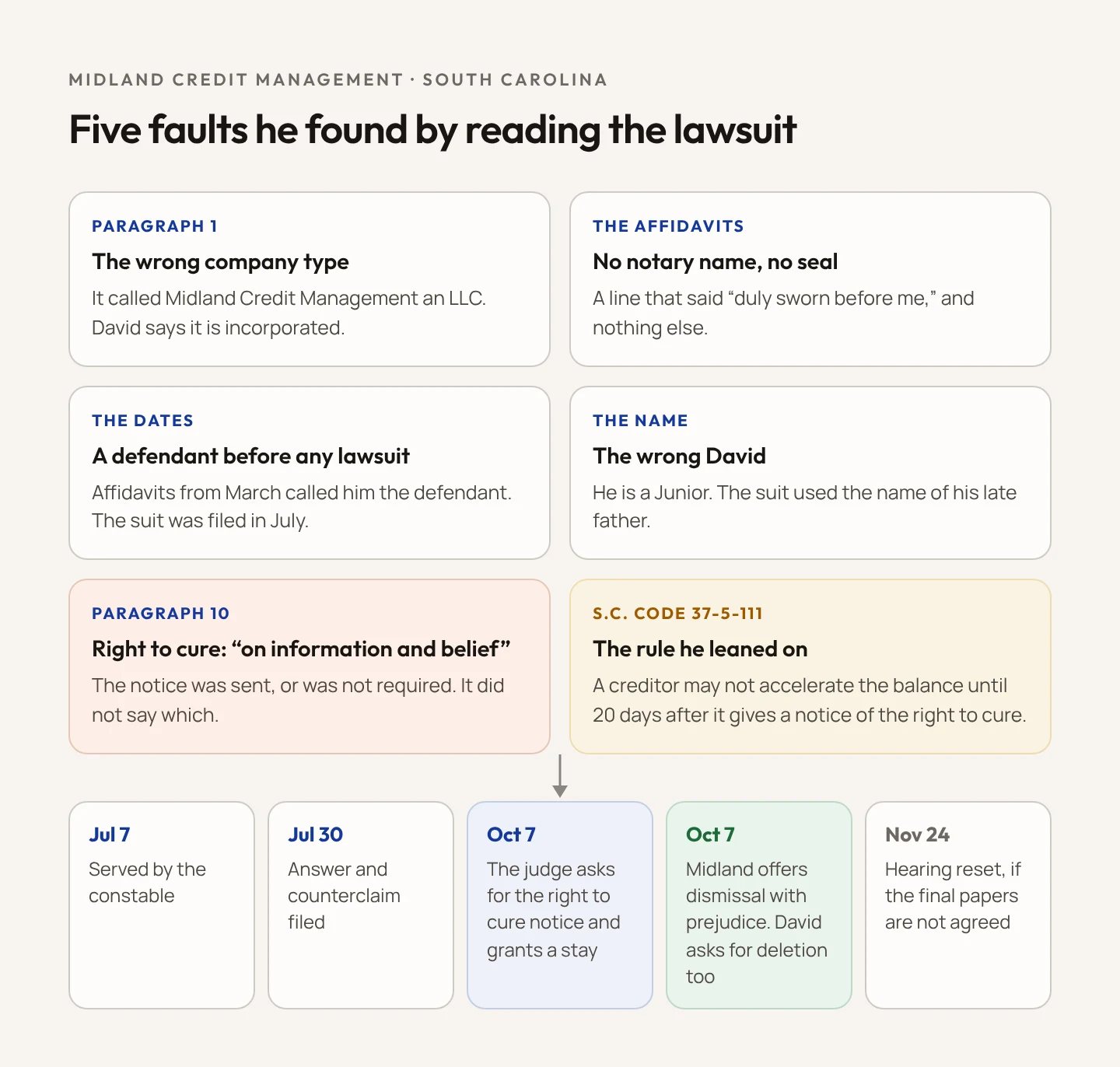
South Carolina gives consumers a right to cure. Under S.C. Code 37-5-110 and 37-5-111 (opens in a new tab), the creditor can send a written notice that says how much you must pay, and by what date, to make the account current. It may not accelerate the balance until 20 days after it gives that notice. The notice must state the consumer's right to cure. David once helped collect debts in South Carolina, and he knew the notice had to come before any lawsuit.
Midland's complaint did not attach one. Paragraph 10 said, on information and belief, that the notice "was sent to the defendant or was not required."
Brian's read of that phrase: when a lawsuit says "on information and belief," the plaintiff has neither the information nor the belief. It hopes to find proof later. And Brian says that if Midland knew the law, it would not have written "or was not required," because South Carolina requires the notice.
Brian talks about the right to cure in many of his videos. He says South Carolina and Wisconsin have strong versions. Other states have their own notice rules, so check yours.
Midland answered David's counterclaim with a motion for summary judgment. A 12-pound box of account statements landed on his back porch. David says the postage was dated August 24 and the motion August 26. Two other documents in the box were dated the 12th, with the date struck out in pen and changed to the 19th. A magistrate served him the same papers the next day.
David got to the courthouse 20 minutes early on Wednesday, October 7. He was the only defendant there. Before the hearing, Midland's attorney took him into the empty courtroom and asked him to sign a settlement. David said no. He told the attorney he would let the judge decide, and he raised the missing notice and the struck-out dates. The attorney said the notice was not needed, and that as an officer of the court he could swear the facts were true.
David did not have to raise the right to cure in front of the judge. The judge raised it first. He confirmed he had David's filings, then asked Midland's attorney where the right to cure notice was. David says the papers Midland offered "did not pass muster." The attorney read case law for about four pages. Then the judge said he saw no legal right to cure notice, and he granted a stay so that Midland could produce a valid one. If it could not, he would rule.
David had researched this judge. He says he could not find a single dismissal with prejudice from this court in the past two years.
David was walking out of the courthouse when Midland's attorney stopped him. The attorney said he did not want to drive two hours each way again over about $3,000, and offered a dismissal with prejudice. David said he would sign if Midland also deleted the accounts from his credit reports. The attorney said he was not authorized to agree to that.
About four hours later, the attorney's boss emailed David. The boss wrote that he thought he could get Midland to agree to David's terms.
Brian calls it a win on all three cards: a dismissal with prejudice plus a credit deletion. The final papers are still being worked out. David has turned down three drafts. He says the drafts include the phrase "upon payment hereunto," and he owes nothing. Midland also wants him to sign what he calls a nondisclosure agreement. He will not give up his rights under the Fair Credit Reporting Act unless Midland deletes the trade lines from all three credit bureaus. The hearing is reset for November 24 if it has to go forward.
That is the lesson Brian gives in every settlement: a term exists only if it is in writing, and you read every word before you sign.
David says his counterclaim repeated itself. Google's AI helped him draft it, and the same language showed up over and over. It also pointed him to the state and federal laws he cited, including the right to cure statute. His advice: you do not need to write like a lawyer. Say it once, and say it clearly.
If court makes you nervous, the Court Tester lets you practice in private with an AI judge before your hearing.

About the author
Brian Parker
I have over 30 years of experience defending consumers against debt collection lawsuits and have seen every tactic, threat, and pressure play that collectors use. Through KillDebt and ParkerGPT, I have systematized the proven defense strategies that actually work - so consumers can respond from a position of knowledge, not fear. My approach focuses on aggressive legal defense based on documented case success rather than false hope that leads to default judgments.