News Break
How to Get Out of a Default Judgment When You Were Sued in the Wrong County
November 18, 2026
Blog / News Break
A consumer showed a debt buyer's affidavit was re-dated and notarized after the fact. A federal court dismissed her FDCPA suit for lack of standing.
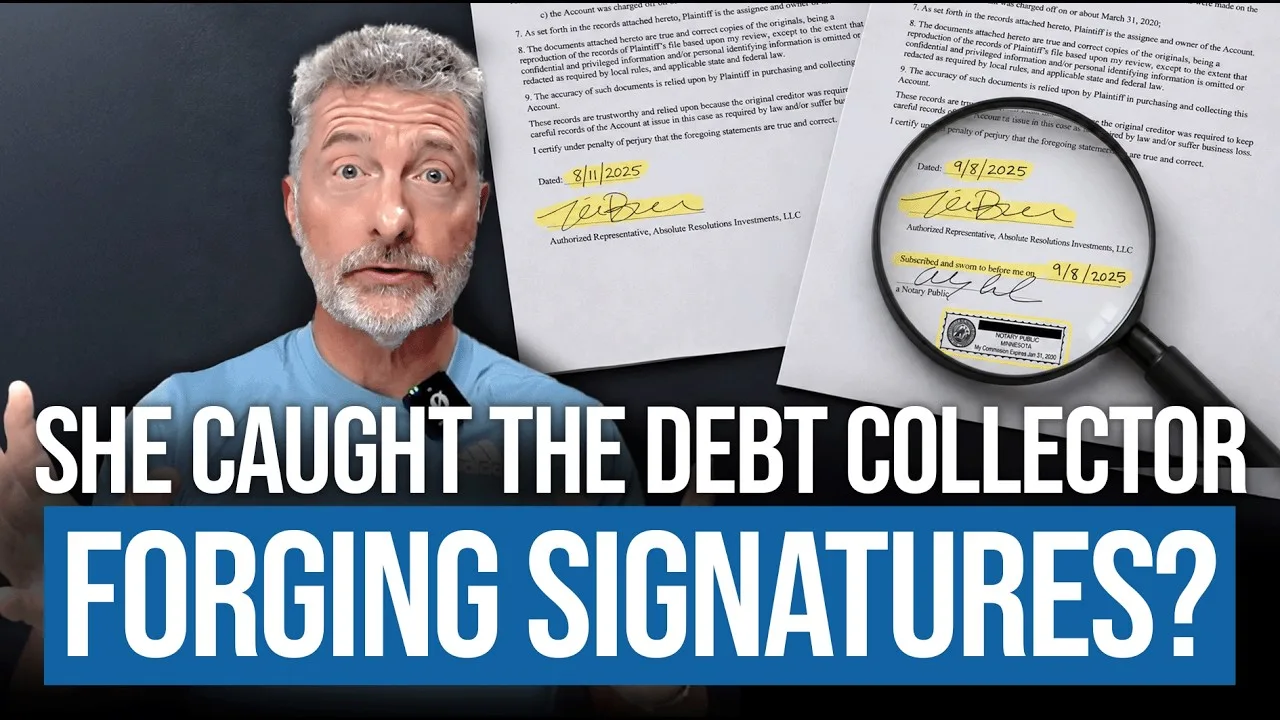
A debt buyer filed an affidavit with no notary stamp. A month later, its lawyers filed the same affidavit again, now "sworn before" a notary on a new date. The consumer laid one signature over the other. She says they matched stroke for stroke.
She took it to federal court and lost. In the video below, Brian Parker shows both affidavits and walks through why. His title for it: she caught the forgery, but she lost.
Key Takeaways
- Read every affidavit the other side files, and compare every version: the date, the jurat, the notary stamp.
- In federal court, a violation is not enough. You must show how it hurt you.
- Money out of your pocket is the clearest harm. Plead what you spent, how much, when, and who paid it.
- The state court where you are being sued can deal with a bad affidavit more directly.
On April 17, 2024, Absolute Resolutions Investments sued the consumer in Franklin County, Ohio, on a charged-off credit card account. Brian covered the same debt buyer in a Michigan case last week.
She fought back. She filed counterclaims under the FDCPA, Ohio's Consumer Sales Practices Act, and Ohio common law. The case moved to the Franklin County Court of Common Pleas. On August 11, 2025, both sides moved for summary judgment.
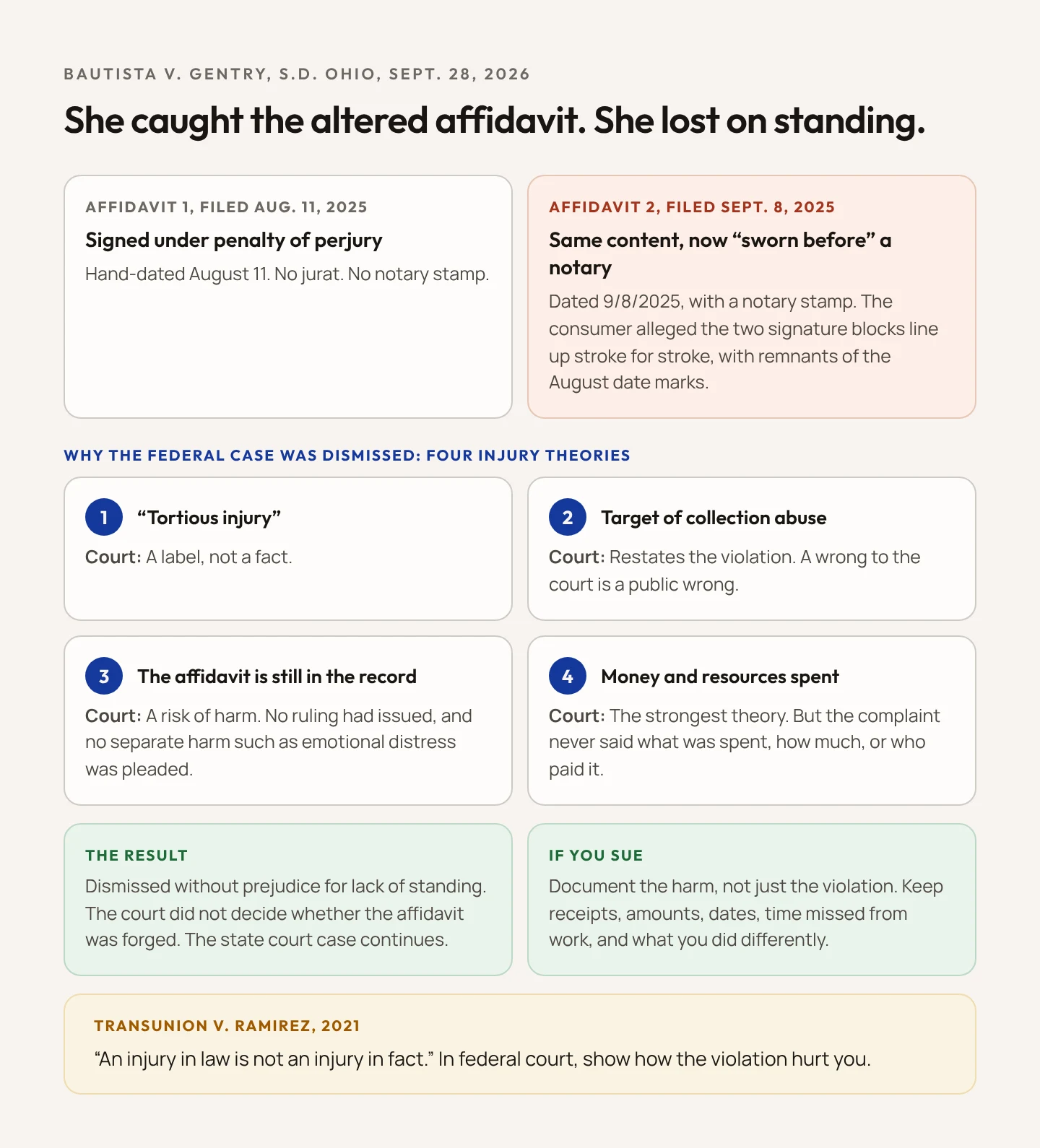
To support its motion, the debt buyer filed an affidavit from one of its representatives. It was signed under penalty of perjury and hand-dated August 11, 2025. It had no jurat, the part where a notary certifies that the person swore in front of her, and no notary stamp.
About a month later, on September 8, the debt buyer's lawyers filed a second version. Same content. Now it said it was subscribed and sworn before a notary on 9/8/2025, with a stamp.
The consumer overlaid the two signature blocks. According to her complaint, they registered perfectly: every stroke, the placement above the line, the date line. Remnants of the slash marks from the August date sat in the same spots, and the handwritten "9/8/2025" covered part of the line beneath it. Her conclusion: the second affidavit was a cut-and-paste forgery, signed back in August.
She asked the lawyers to withdraw it. They declined. Her complaint says filings made on September 23 admitted the date had been altered and that the affiant had not signed in front of the notary. The defense later filed an affidavit from the notary and photographs said to show the notarization. The federal court did not rely on any of it.
The consumer pasted the two signature images right into her pleadings. Brian does the same, so the judge does not have to dig through exhibits. "That's a Parker move," he says. He calls it demonstrative evidence: if you say the other side did something wrong, show it on the page.
On September 30, 2025, she sued eight defendants in federal court: the debt buyer, its representative, the notary, the collection law firm and two of its lawyers, and a second lawyer and his firm. She pleaded five counts: FDCPA violations under 15 U.S.C. 1692d (opens in a new tab), 1692e (opens in a new tab), and 1692f (opens in a new tab), negligence per se, civil conspiracy, negligence, and punitive damages.
The defendants did not argue about the forgery. Brian says that is a tactical move: some defendants will not dignify an accusation by answering it. They argued something more basic. She had no right to be in federal court.
A federal court decides only real cases and controversies. To get in, you need standing. You must show three things:
Brian says that for years the FDCPA worked close to a strict liability statute. Show the violation and you could recover statutory damages without proving a loss. Then came Spokeo v. Robins (opens in a new tab) in 2016, and TransUnion LLC v. Ramirez (opens in a new tab) in 2021. The Supreme Court held that "an injury in law is not an injury in fact." Only plaintiffs concretely harmed by a violation can sue over it in federal court.
What counts? Money and physical harm. Some intangible harms count too, such as damage to your reputation or the disclosure of private information. In a suit for money, a mere risk of future harm does not count.
Brian says TransUnion made his job a lot harder. Before he files, he has his client show how she was damaged, even in a small way. He says there is no minimum amount. You need a real harm, caused by the defendant, that a court can redress.
In Bautista v. Gentry (opens in a new tab), decided September 28, 2026, the federal court in the Southern District of Ohio took her four injury theories one at a time.
1. "Tortious injury." The complaint said each defendant caused a tortious injury. The court called that a label, not a fact.
2. "The target of debt collection abuses." The court said this restated the violation. She also argued a false notarization is a fraud on the court. The court agreed courts take that seriously. But it called it a wrong to the justice system, a public wrong, and not a harm to her. Brian calls that debatable.
3. "The forgery remains in the record." It does. Brian pulled the affidavits from the state court file and shows both signature pages side by side. But the state court had not ruled, and a risk of an adverse judgment is only a risk. She did not plead a separate harm, such as emotional distress.
4. Money and resources. This was her strongest theory. The court said money is the classic concrete injury, and that if she had pleaded an out-of-pocket loss, "this would be a different case." But the complaint never said what was spent, on what, when, how much, or whether she paid it rather than her lawyer.
The court also pointed out the contrast. The complaint described the two signatures down to the pixel, and described the harm in a single conclusory line.
Brian says he has won standing fights by showing that the client had to pay a lawyer because of the violation.
She leaned on two cases. The court distinguished both.
Brian's takeaway from Newman: always file your counter affidavit.
The court dismissed the FDCPA claim without prejudice for lack of standing. Her state law claims were dismissed too, also without prejudice, because no federal claim was left to anchor them.
Without prejudice means the court did not rule on the merits. The court said it was not deciding whether the affidavit was forged. The state court, where she had already raised it in a pending summary judgment motion, is the place for that. Brian says the decision has gone on appeal. And if she loses in state court because of that affidavit, he says, "now you got something."
One more detail. The court struck a reply brief one lawyer filed a day late, without asking for more time, and called the lateness "cavalier." Deadlines bind lawyers too.
Brian's own defense starts the same way every time: RACE. Read the lawsuit, answer with a responsive pleading, attach a counter affidavit, and add everything else, such as consent orders against the company suing you. Thinking about suing a collector? Start with the complete guide.
Upload the affidavits from your case to ParkerGPT. It reads them with you and helps you draft your answer and counter affidavit. If the paperwork looks off, a Debt Doc Audit reviews the chain of title.

About the author
Brian Parker
I have over 30 years of experience defending consumers against debt collection lawsuits and have seen every tactic, threat, and pressure play that collectors use. Through KillDebt and ParkerGPT, I have systematized the proven defense strategies that actually work - so consumers can respond from a position of knowledge, not fear. My approach focuses on aggressive legal defense based on documented case success rather than false hope that leads to default judgments.