
Blog / News Break

Sued by Absolute Resolutions Investments? Debt Buyers Need Proof Only If You Show Up

Absolute Resolutions sued on a Mission Lane card with nine paragraphs and no exhibits. Brian Parker shows three red flags and how he turned it around.
Consumer defense attorney Brian ParkerBrian Parker · 7 min read

Absolute Resolutions Investments sued Brian Parker's client in Michigan with a nine-paragraph complaint and nothing attached. No bill of sale. No statement. No agreement. It also used a name she had not gone by in 23 years.

Brian says the debt buyer is not required to bring the whole kitchen sink. A lawsuit with only pleadings and allegations can still win, if you do not show up. In the video below, he shows how to turn those nine paragraphs around.

Key Takeaways

  • A complaint with nothing attached is still a lawsuit. If you do not answer, the allegations can become a judgment.
  • Read every line. "To the best of plaintiff's knowledge" means they do not have it right now.
  • Your counter affidavit lists what is missing, and it must say you dispute the debt.
  • Do not call the collector. Excuses like "I lost my job" can be used as an admission that you owe.

RACE, one more time

Brian recorded this one on the road, at the end of a week of court dates. His framework stays the same:

  • R: Read. You get the lawsuit and you have your pity party. Then you get over it, and you read the summons to learn how much time you have. Brian files about five days before the deadline, because something weird always happens. Then read the complaint, and read it again. He says he once read a file 64 times and still found something new on the 65th.
  • A: Answer with a responsive pleading, so you stand out from the crowd of people waiting on one or two plaintiff's attorneys.
  • C: Counter affidavit, the most important piece. Brian says in some states, if you do not file one, you lose.
  • E: Everything else, such as consent orders. State or federal regulators may already have told the collector suing you to stop doing what it is doing in your lawsuit.

What the nine paragraphs say

Paragraph 1 says the plaintiff is the assignee of the defendant's Mission Lane account with Transportation Alliance Bank, Inc., doing business as TAB Bank. Brian says that is wrong on its own, because nothing proves it.

Below it, the complaint says: "This is a communication from a debt collector. This is an attempt to collect a debt. Any information obtained will be used for that purpose." That is the mini-Miranda warning. Brian argues that when a debt buyer puts it on a lawsuit, it starts the collection process, and the collector then owes you your validation rights within five days. Debt buyers believe a complaint is exempt from that duty. Brian says that holds unless they state they are collecting a debt, which this one did. He makes it one of his affirmative defenses.

Paragraph 4 says the account was opened in 2021 and the agreement was delivered to the defendant and, "to the best of the plaintiff's knowledge," is in her possession. They did not know her name, Brian points out, so what is the best of their knowledge? He reads it the same way as "upon information and belief": we do not have it right now, and we hope we will not need it, because most people default.

Brian's advice: read that line, give it right back to them, and give it to the judge. Nothing in the lawsuit supports it.
Three red flags

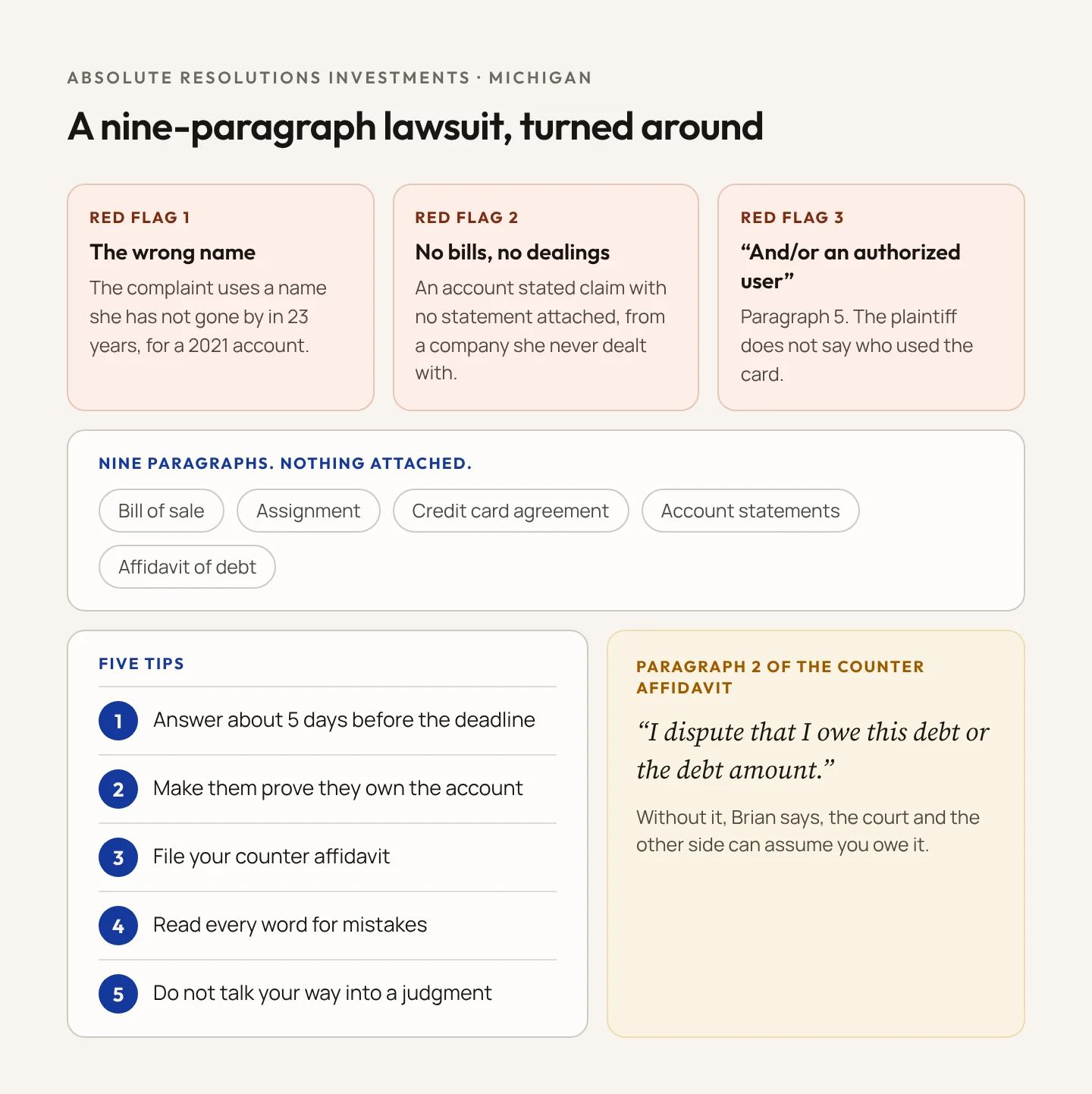
A diagram titled a nine-paragraph lawsuit, turned around, for an Absolute Resolutions Investments case in Michigan. Three red cards: red flag 1, the wrong name, a name she has not gone by in 23 years for a 2021 account; red flag 2, no bills and no dealings, an account stated claim with no statement attached from a company she never dealt with; red flag 3, and/or an authorized user, paragraph 5 does not say who used the card. A panel titled nine paragraphs, nothing attached, lists what is missing: bill of sale, assignment, credit card agreement, account statements, affidavit of debt. Five tips follow: answer about 5 days before the deadline, make them prove they own the account, file your counter affidavit, read every word for mistakes, and do not talk your way into a judgment. A gold panel quotes paragraph 2 of the counter affidavit: I dispute that I owe this debt or the debt amount. Without it, Brian says, the court and the other side can assume you owe it.

1. The wrong name. The complaint names the client with an "aka" and an old name. She has not gone by that name in 23 years, since she married. Yet the complaint says she opened the account in 2021. Brian says that if they owned anything, they would at least know her name. In his reading, the old name shows their information came from a source other than the original creditor's account records.

2. An account stated with no bills. Most debt buyer suits are account stated claims, and this one is too. In plain English, Brian says, that means: we sent you bills, you never objected, so you agreed the balance was right. Two problems. The complaint did not attach a single statement. And his client never had any dealings with Absolute Resolutions.

3. "And/or an authorized user." Paragraph 5 says "defendant and/or an authorized user used the account and failed to make payments." Brian calls that the plaintiff admitting, in its own lawsuit, that it does not know who used the card. If you do not know who made the charges, how do you swear she owes the debt?

The last paragraph asks the court to make her pay to avoid "substantial injustice." Brian's answer: Absolute Resolutions never lent her anything. The only injustice would be letting it get away with this.

The counter affidavit

Brian's client signed a counter affidavit as Exhibit 1 to her answer. It uses the lack of documents against the plaintiff:

  • No bill of sale and no assignment between whatever entities held the account. Every transfer in the chain of title has to be supported by an assignment, not just a bill of sale.
  • No credit card agreement. To breach the terms of anything, there have to be terms to show you breached.
  • No account statements, and no affidavit showing why she owes the debt, or to whom.
  • No owner at default. The complaint says the account was "formerly" with the bank. So who owned it when it went into default, or at charge-off? Did two or three other debt buyers own it first? The complaint does not say.
  • No agreement attached. The complaint says the agreement is in her possession. Brian says Michigan's court rules require a plaintiff suing on a written agreement to attach it, and it did not.

Paragraph 2 is the line Brian says you cannot leave out: "I dispute that I owe this debt or the debt amount" to Absolute Resolutions. He compares it to the kingdom lost for want of a nail. A great answer that never says you dispute the debt lets the court and the other side assume you owe it, and you end up arguing about how much.

The counter affidavit then states her name, and how long she has used it. Paragraph 15 lists what does not exist: no credit agreement, no account statements, no document, in bold. Brian says that without a counter affidavit you probably have no chance of winning. More on how to file one.

The answer

Brian's client made her appearance and filed a responsive pleading with affirmative defenses. It argues:

  • No standing. Absolute Resolutions has not shown it owns the account.
  • No chain of title. No bill of sale, no assignment.
  • No contract attached.
  • No account stated.
  • Hearsay. No sworn affidavit shows why their documents meet a business records exception.

Brian compares that to the plain admit, deny, admit, deny answer people buy online, which never says the defendant disputes the debt. If you were the other side's attorney, which one would you take seriously? He says strong answers often make the plaintiff decide the case is not worth pursuing, and it goes away. See his member interviews for examples.

Brian's five tips

  1. Answer on time. Know your deadline: Brian names 21 days as a common rule and 35 in New Jersey. File about five days early, and do not count on the mail.
  2. Make them prove they own your account. No chain of title, no money out of your pocket.
  3. File your counter affidavit. Brian says he cannot say it enough.
  4. Read every word of the complaint for mistakes. They file thousands of lawsuits. You have one. Their paperwork shows it, and the mistakes favor you.
  5. Do not talk your way into a judgment. The worst thing you can do is call before you do anything. "I lost my job," "I'm on disability," "my daughter needs braces": keep your excuses to yourself. They can be used as an admission that you owe. If you must call, Brian's script is: "I'm calling for settlement purposes and information only. I do not admit I owe anything, and I dispute it. What is this about?"

Upload your complaint to ParkerGPT and it drafts the responsive pleading, the affirmative defenses, and the counter affidavit from your documents.

Sued by Absolute Resolutions or another debt buyer? ParkerGPT drafts your answer and the counter affidavit that disputes the debt.

Frequently Asked Questions (FAQ)

Who is Absolute Resolutions Investments?
Absolute Resolutions Investments is a debt buyer. In the Michigan case Brian Parker shows, it sued on a Mission Lane credit card account, formerly with Transportation Alliance Bank, doing business as TAB Bank. Brian's client had never dealt with Absolute Resolutions. The complaint ran nine paragraphs and attached no bill of sale, assignment, agreement, or statement.
What does "to the best of plaintiff's knowledge" mean in a debt lawsuit?
Brian Parker reads it the same way as "upon information and belief": the plaintiff does not have the proof right now. In this case, the complaint said the credit agreement was delivered to the defendant and, to the best of the plaintiff's knowledge, is in her possession. Give that line back to the plaintiff and the judge, and point out that nothing supports it.
What if a debt buyer sues me under an old name?
Raise it in your answer and your counter affidavit. Brian Parker's client was sued under a name she had not used in 23 years, on an account the complaint said she opened in 2021. Her counter affidavit states her name and how long she has used it. Brian says it shows the plaintiff does not even know who it is suing.
Must a debt buyer attach the credit card agreement in Michigan?
Brian Parker says yes. When a lawsuit is based on a written agreement, Michigan's court rules require the plaintiff to attach it. In the Absolute Resolutions case, the complaint said the agreement was in the defendant's possession and attached nothing. Brian put that gap in his client's counter affidavit along with the missing statements and bill of sale.
Should I call the debt collector after I am sued?
Brian Parker says no. Calling before you answer is the worst thing you can do. Saying you lost your job or are going through a hard time can be used as an admission that you owe the debt. If you must call, he says to state that the call is for settlement and information only, that you admit nothing, and that you dispute the debt.
Consumer defense attorney Brian Parker

About the author

Brian Parker

I have over 30 years of experience defending consumers against debt collection lawsuits and have seen every tactic, threat, and pressure play that collectors use. Through KillDebt and ParkerGPT, I have systematized the proven defense strategies that actually work - so consumers can respond from a position of knowledge, not fear. My approach focuses on aggressive legal defense based on documented case success rather than false hope that leads to default judgments.

All articles