News Break
How to Answer a Debt Lawsuit So You Stand Out: The Responsive Pleading
November 9, 2026
Blog / News Break
Velocity sued on a Cross River Bank loan serviced by Upgrade. Brian Parker walks the 26 pages and shows why they cannot prove Velocity owns the debt.
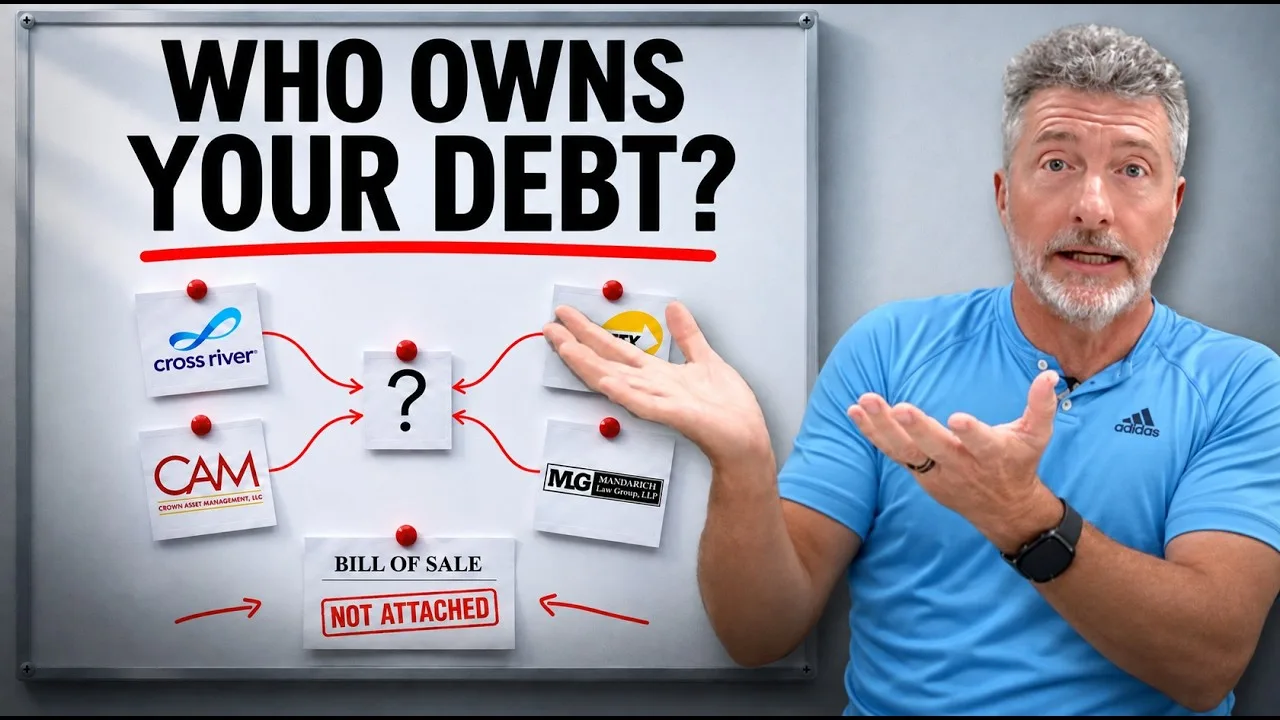
Velocity Investments sued Brian Parker's client in Michigan and attached 26 pages to prove it owned her debt. Brian says a lot of those pages were not even hers.
The loan came from Cross River Bank. Upgrade serviced it. The bill of sale came from Upgrade, and it did not name the client. In the video below, recorded on the road from a hotel room, Brian walks the file page by page and shows how he answered it.
Key Takeaways
- Velocity is a debt buyer. It never lent your money. Make it prove it owns your account.
- A bill of sale is a receipt. If your name is not on it, ask for the forward flow agreement it depends on.
- Servicing is not ownership. Upgrade serviced a Cross River Bank loan, then called itself the initial seller.
- Compare every date, APR, amount, and account number. In this file, two disclosures for one debt gave two different APRs.
Brian answers every collection lawsuit with RACE:
Brian says the law firm behind this suit files across the country but does not take great care in its work. In his experience, when you put up a fight, its attorneys go away. He has won cases where they did not show up, even for motions they filed.
The first thing Brian noticed was at the bottom of the complaint: "Approved, SCAO." It is the State Court Administrative Office's standard form. As Brian puts it, that is how much care they took.
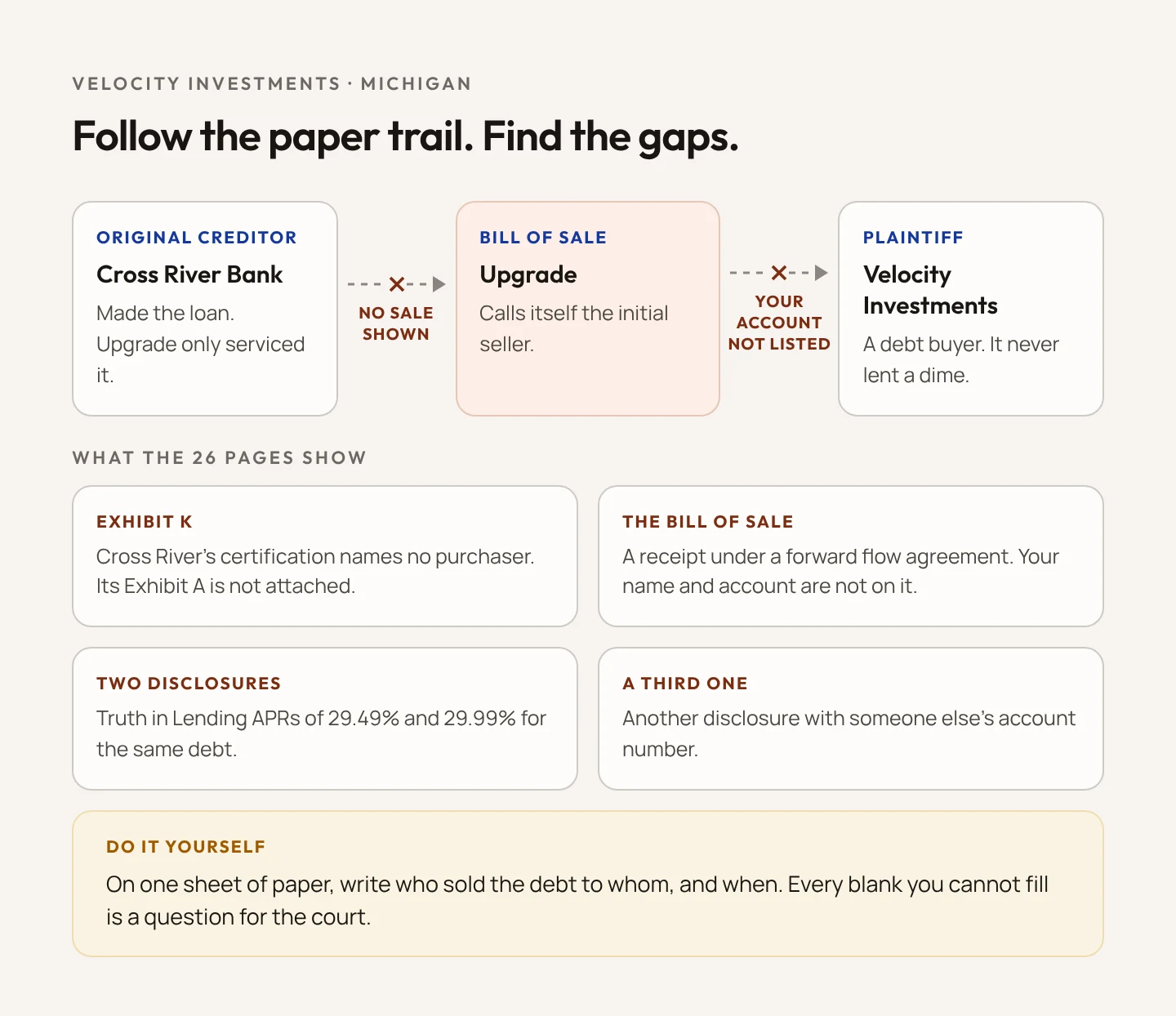
The complaint says Velocity got the account from Cross River Bank. So you would expect a bill of sale from Cross River. There isn't one.
The bill of sale is from Upgrade. It calls Upgrade the initial seller. Brian says that is impossible: Cross River made the loan, so Cross River is the initial creditor. Upgrade has nothing to sell until Cross River sells something to Upgrade, and nothing in the file shows that.
Velocity's own exhibit proves the point. Exhibit K is a one-page certification from Cross River Bank:
Brian's question: how did Upgrade get the right to sell anything to Velocity?
The bill of sale opens with "for value received and pursuant to the terms and conditions of the forward flow purchase agreement." Brian says that makes it a receipt, like the one you get at a gas station for 63 gallons and $150. It shows something changed hands. It does not show what.
The client's name and account number are not on it. So if the case gets into the weeds, Brian asks for the forward flow agreement. His argument to the judge: the bill of sale says it was made under that agreement, so the agreement is relevant, and the defendant needs it. And the bill of sale Velocity calls part of the chain of title does not list the defendant at all.
Every loan comes with a Truth in Lending disclosure under the federal Truth in Lending Act. Velocity attached one for the client's loan with an APR of 29.49%. Then it attached another, for the same debt, at 29.99%.
Brian says there was also a third disclosure in the file. It belonged to somebody else, with a different account number. He says he sees this every day.
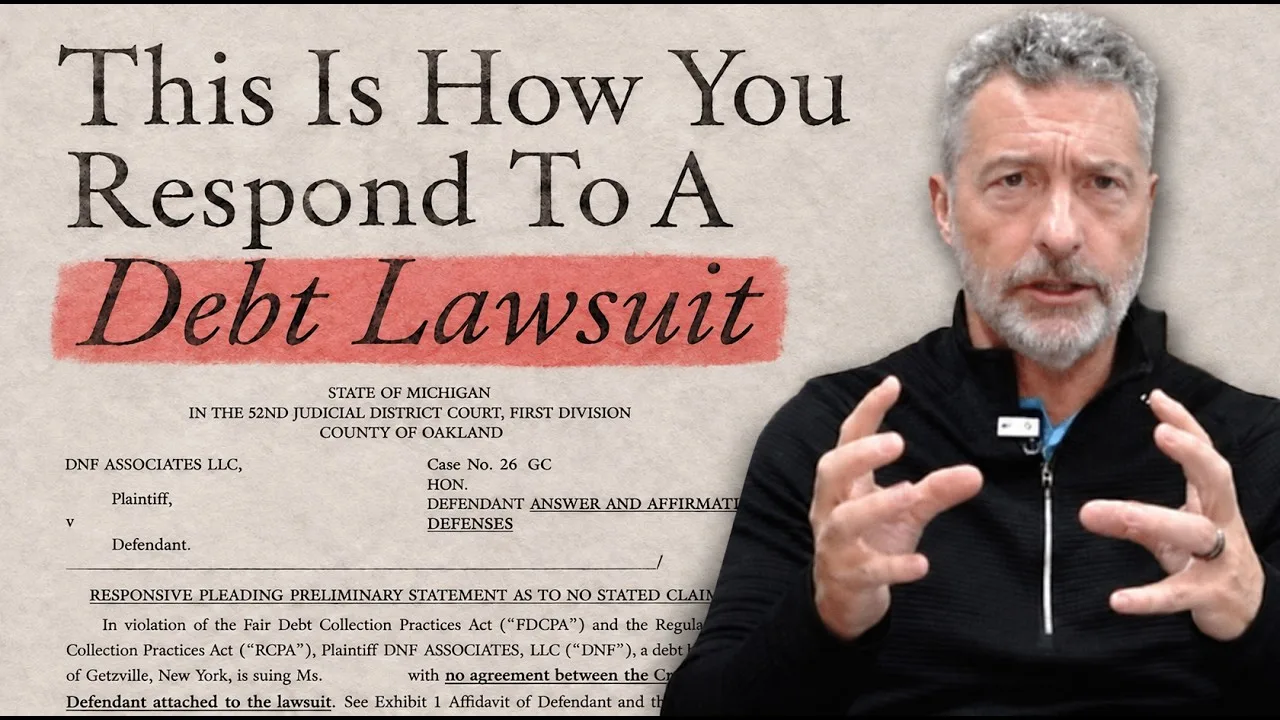
A preliminary statement. Brian's responsive pleading opens with one line that sums up the case: no chain of title from Cross River Bank to Velocity. It tells the judge what to look for before the paragraph-by-paragraph response. At a crowded pretrial, he says, you are the only one with a preliminary statement. You stand out from whatever the crowd's theme is that day.
Deny, and highlight it. Each paragraph of the complaint gets a response. Velocity's paragraph 1 says jurisdiction and venue are proper. Paragraph 2 says Velocity is the assignee of the account with Cross River Bank, by way of the bill of sale. Brian highlights every "defendant denies" so the reader's eye catches it. The answer then lists 11 affirmative defenses, all supported by Exhibit 1, the counter affidavit.
The counter affidavit. Michigan's MCL 600.2145 (opens in a new tab) makes a plaintiff's affidavit on an open account or account stated prima facie evidence of the debt unless the defendant files a counter affidavit denying it. Brian says that if Velocity had attached that affidavit and you had no counter affidavit, you would lose, and all that would be left is how much you owe. His client's counter affidavit says she is over 18, competent, and makes it under MCL 600.2145. Paragraph 3 says she denies owing Velocity.
That denial matters. Brian says the answers you can buy online often never say you deny owing the debt. He hears judges say it all the time: you are not denying you owe the debt. The other side will bring it up too. The greatest answer in the world goes nowhere without a denial. More on why the counter affidavit matters.
Brian's goal is a strong settlement or the debt eliminated. He shoots for elimination every time. For two more Velocity files, read the dates on their own exhibits and the missing contracts.
Upload your own complaint to ParkerGPT and it drafts the responsive pleading, the affirmative defenses, and the counter affidavit from your documents.

About the author
Brian Parker
I have over 30 years of experience defending consumers against debt collection lawsuits and have seen every tactic, threat, and pressure play that collectors use. Through KillDebt and ParkerGPT, I have systematized the proven defense strategies that actually work - so consumers can respond from a position of knowledge, not fear. My approach focuses on aggressive legal defense based on documented case success rather than false hope that leads to default judgments.