
News Break
Velocity Investments Lawsuit: Cross River, Upgrade, and a Chain of Title With Gaps
November 11, 2026
Blog / News Break
Sued by a debt buyer and due in court? Where to go, what to bring, the five people you will meet, and what to say when your case is called.

You were sued by a debt buyer. Now your paperwork has a court date on it, and a room you have never been in. This short video walks you through that room: where to go, the five people you need to know, and what to say when your case is called.
Key Takeaways
- Your summons or hearing notice lists the courthouse, courtroom, date, and time. Call the clerk's office if anything is unclear.
- Bring one organized folder, with copies for the judge and the other side.
- Learn the five people: the clerk at the window, the courtroom clerk, the bailiff, the other side's lawyer, and the judge.
- Do not agree to anything in the hallway on the spot. Read every word before you sign.
Find out where. Your summons or hearing notice usually lists the courthouse, the courtroom or department, the date, and the time. Some hearings now happen by video. If anything is unclear, call the clerk's office before the day.
Pack one folder. Put in your hearing notice, the complaint, everything you filed, any court orders, letters from the collector, and your proof, such as payment records. Bring copies for the judge and for the other side, and a photo ID for security.
Get there early. Many courthouses have a security line like an airport, and big buildings are easy to get lost in. Dress as you would for a job interview. Put your phone on silent before you walk in.
If you are running late, call the clerk's office right away. If you miss your hearing, the plaintiff may ask the court for a default or other relief, and that can limit your chance to fight the claim.
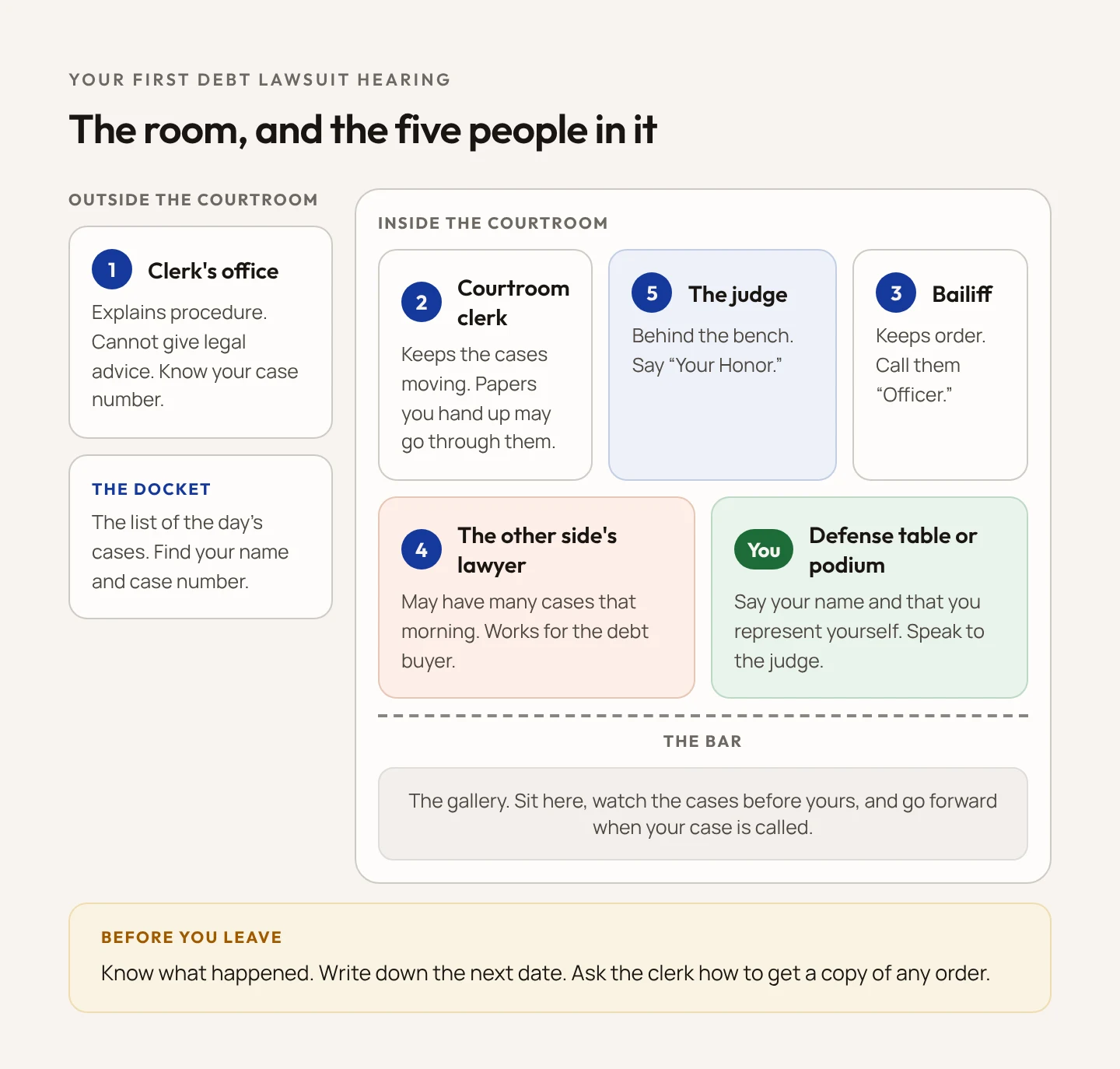
Many courthouses have a clerk's office with a window or a counter. Be polite to the clerk and the court staff. They deal with a busy courthouse all day. They can often explain the court's procedures, but they cannot give you legal advice. Know your case number, keep your paperwork organized, and say clearly what you need.
Outside many courtrooms is a list of the day's cases, called the docket or the calendar. Find your name and case number. Notice how many lines look like yours.
Every courtroom is set up a little differently, but most have the same pieces. Near the bench, the raised desk at the front, there is usually a courtroom clerk. The courtroom clerk keeps the cases moving, and anything you hand to the court may go through them.
The bailiff, or court officer, keeps order and security. Follow their directions, and call them "Officer" unless they tell you otherwise. If you do not know where to sit or when to go up, it is fine to ask quietly.
Some courts also have a court reporter who types every word. Others record the hearing. Some do neither. Speak clearly, and ask for anything important to be put on the record.
In a debt buyer case, a collection law firm often represents the plaintiff. The lawyer in the room may have many cases that same morning and may know very little about yours. Stay professional, but remember who they work for. What you tell them may go straight back to the firm.
The judge sits behind the bench, runs the room, and decides the issues. Address the judge as "Your Honor." Be respectful, be organized, and be ready to explain your position clearly.
You start in the gallery, with the public. In many courtrooms, a low wall called the bar separates the gallery from the front. You go forward when your case is called.
Check in with the clerk or the bailiff, if your court does that. Then sit and, if you are allowed, watch the cases before yours. You will learn how this judge runs things and how the other side talks.
Before your case is called, the plaintiff's lawyer may ask to talk in the hallway. You can listen. You do not have to agree to anything on the spot. Some agreements are entered as a judgment against you. Read every word before you sign, and ask what happens if a payment is missed. Brian's guide on settling at a pretrial conference covers what to get in writing.
Filing a lawsuit does not prove the claim. You can point out what the plaintiff's paperwork does not show and ask the court to require proof. Here is more on what not to say in court.
Before you leave, know what happened and what comes next. Write down the next date. Ask the clerk how to get a copy of any order.
The room is a lot less scary once you have seen it, and courtesy will help you get through it. But being polite does not replace knowing your case. Court staff cannot argue it for you. Your paperwork and your arguments still matter most.
Brian's framework for that is RACE: read the lawsuit, answer it with a responsive pleading, file a counter affidavit, and bring everything else.
Then get ready for the room itself. The cheat sheets build a guide from your own case: your key arguments, what the collector's lawyer may say back, the rules that apply, your key dates, and the questions to ask. Print it and bring it. Before the real hearing, the Court Tester sets up a courtroom built from your filings. You present your argument to a simulated judge, respond to opposing counsel, and get tips from an AI co-counsel. It is practice, and it does not predict the judge's decision.

About the author
Brian Parker
I have over 30 years of experience defending consumers against debt collection lawsuits and have seen every tactic, threat, and pressure play that collectors use. Through KillDebt and ParkerGPT, I have systematized the proven defense strategies that actually work - so consumers can respond from a position of knowledge, not fear. My approach focuses on aggressive legal defense based on documented case success rather than false hope that leads to default judgments.