
News Break
Parking Invoice in the Mail? How a $75 Bill Became a $2,500 Privacy Lawsuit
November 16, 2026
Blog / News Break
A debt buyer sued Brian Parker's client in the wrong county twice and garnished her wages twice. How to set aside a default, and what changed in 2026.
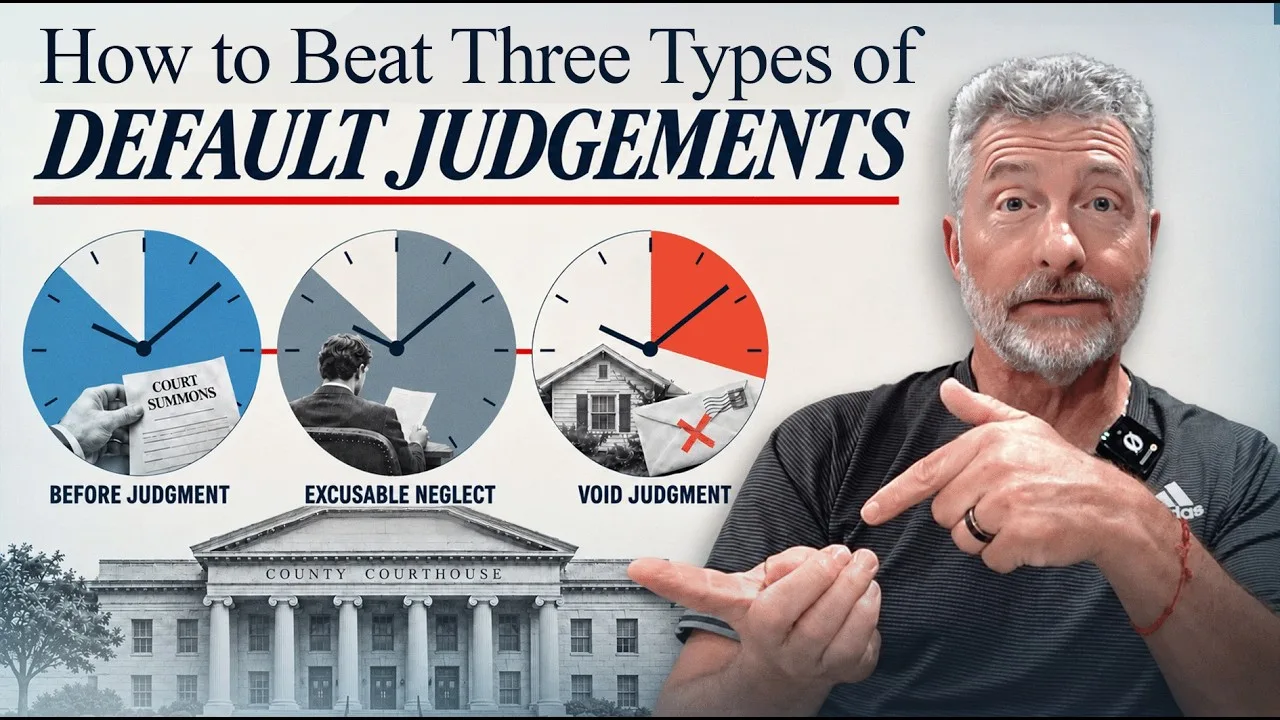
Two years ago, Brian Parker's client found out she had been sued only when her employer started sending her garnishment notices. A debt buyer had sued her in the wrong court, in the wrong county, and won a default judgment she never saw. Brian got it set aside with her state ID and her lease.
Now the same debt buyer has done it again. Same client, wrong county again, another default, another garnishment at work. In the video below, Brian explains how to get out of a default judgment, whether it was your fault or not, and why the second time is going to cost the collector.
Key Takeaways
- There are three default clocks: the default, the default judgment, and the void judgment. Know which one you are on.
- If you were never served, the judgment is void. But since the Supreme Court's 2026 Coney Island decision, you must still move within a reasonable time.
- A debt collector must sue you where you live or where you signed the contract. Suing in the wrong county can support an FDCPA claim.
- Act in the first 72 hours: get the garnishment papers, pull the court file, and put the collector on written notice.
Before a default, you get a lawsuit in the mail. Brian's RACE framework starts there:
But sometimes you get defaulted through no fault of your own. That is this case.
The first time, the client told Brian she had been sued in the wrong court and the wrong county. She learned about it only when her workplace started sending her garnishment notices. Brian says that when you learn about a default that way, you have a strong motion to set aside.
He had her sign an affidavit: wrong person, wrong court, wrong county. He showed the collector her state ID and proof that she did not live in the county where she was sued. Brian says that case was done in minutes. Her name is unusual, and she is not a Junior or a Senior, so a mix-up was hard to explain.
Two years later, the same plaintiff sued her in the wrong county again. Brian won't name it, except to say it goes by three initials. Again she learned about it from a garnishment notice at work, after assuring her employer the first time that the debt was not hers.
Why does the second time matter? Under the FDCPA, a collector can raise the bona fide error defense: the mistake was unintentional, and it happened despite reasonable procedures. Brian says that may cover the first time. Computers, things fall through the cracks. But the second time came after Brian put the collector on notice of her correct address. "They're going to pay," he says.
He also points out the irony. Collectors find you perfectly well when they want to garnish you. They just cannot seem to find you when it is time to serve you.
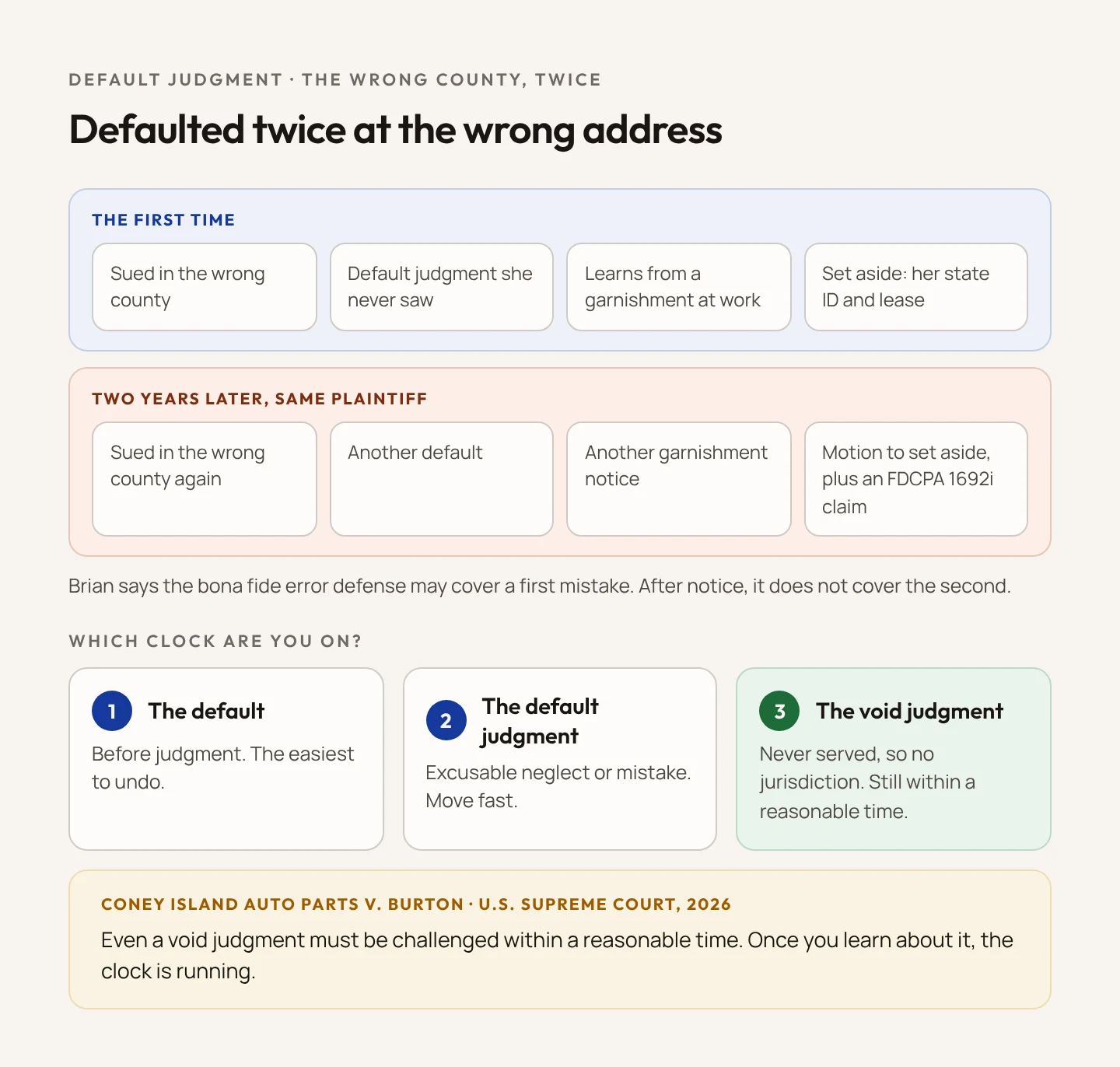
Brian sorts defaults into three kinds. His three clocks article covers them by state.
It used to be that a void judgment could be attacked at any time. Find out six years later, go to court, and say the court never had jurisdiction.
In Coney Island Auto Parts v. Burton (opens in a new tab), decided January 20, 2026, the Supreme Court said no. Under Federal Rule of Civil Procedure 60(b)(4), a motion to set aside a void judgment still has to be made within a reasonable time. The Court refused to treat void judgments as exempt. Brian says the party in that case waited about six years, after getting notices.
Brian says most states follow the federal rule, and Florida in particular expects you to move speedily. "Reasonable" is flexible. If you never knew about the lawsuit and found out only when your wages were garnished, waiting until then is reasonable. But once you know, the window starts to close. The longest Brian has gone is a default three years old. After a while, even courts stop caring.
Every one of Brian's motions to set aside ends the same way: "Your Honor, all I want is my day in court."
Most people who were never served find out the hard way: a credit report, or more often a garnishment at work or at the bank. Then they have to explain to a whole set of third parties that they are not deadbeats.
Once the default is set aside, Brian looks at claims against the collector.
Wrong venue. Under 15 U.S.C. 1692i (opens in a new tab), a debt collector suing on a consumer debt must file in the judicial district where you live or where you signed the contract. Brian's client lived and worked in one county and was sued in another, twice.
The one-year clock. FDCPA claims must be filed within one year (15 U.S.C. 1692k (opens in a new tab)), so be aware of it.
Credit reporting. If the collector puts the account on your credit report, send a dispute letter. Brian says that if they still do not take it off, you may have a claim under the Fair Credit Reporting Act, with a two-year statute of limitations, and an impermissible purpose claim. Before he files, he sends a permissible purpose letter asking why they are on the client's credit and what proof they have that they own the debt. He says nobody has answered that question in more than 30 years.
Unfair means. Brian also points to 15 U.S.C. 1692e and 1692f. Getting a judgment without real service and then using it to take someone's wages can be unfair. Doing it a second time after you were handed the consumer's correct address is worse.
Who you can sue. The debt buyer, the collection agency, and the collection law firm. Brian sues the law firm in maybe one case out of ten. Process servers are generally exempt under the FDCPA, but Brian says some collectors now own process serving companies. A server who pushes you to call the collector, or reads your lawsuit, may lose that protection, he says.
Not federal court as an appeal. Some people with a state default judgment go to federal court to overturn it. Under the Rooker-Feldman doctrine, only the U.S. Supreme Court can review state court judgments. Brian says the doctrine keeps getting weaker, but you generally cannot use federal court as an appeal from state court.
The void judgment is the best default to have, if there is such a thing. But even it has a clock now. If a garnishment is how you learned you were sued, start today. ParkerGPT drafts the motion to set aside and the counter affidavit from your court file.

About the author
Brian Parker
I have over 30 years of experience defending consumers against debt collection lawsuits and have seen every tactic, threat, and pressure play that collectors use. Through KillDebt and ParkerGPT, I have systematized the proven defense strategies that actually work - so consumers can respond from a position of knowledge, not fear. My approach focuses on aggressive legal defense based on documented case success rather than false hope that leads to default judgments.