News Break
Sued by Absolute Resolutions Investments? Debt Buyers Need Proof Only If You Show Up
November 13, 2026
Blog / News Break
Parking companies pulled drivers' DMV records to mail $75 invoices. A Florida federal court let a $2,500-per-person privacy class action go forward.
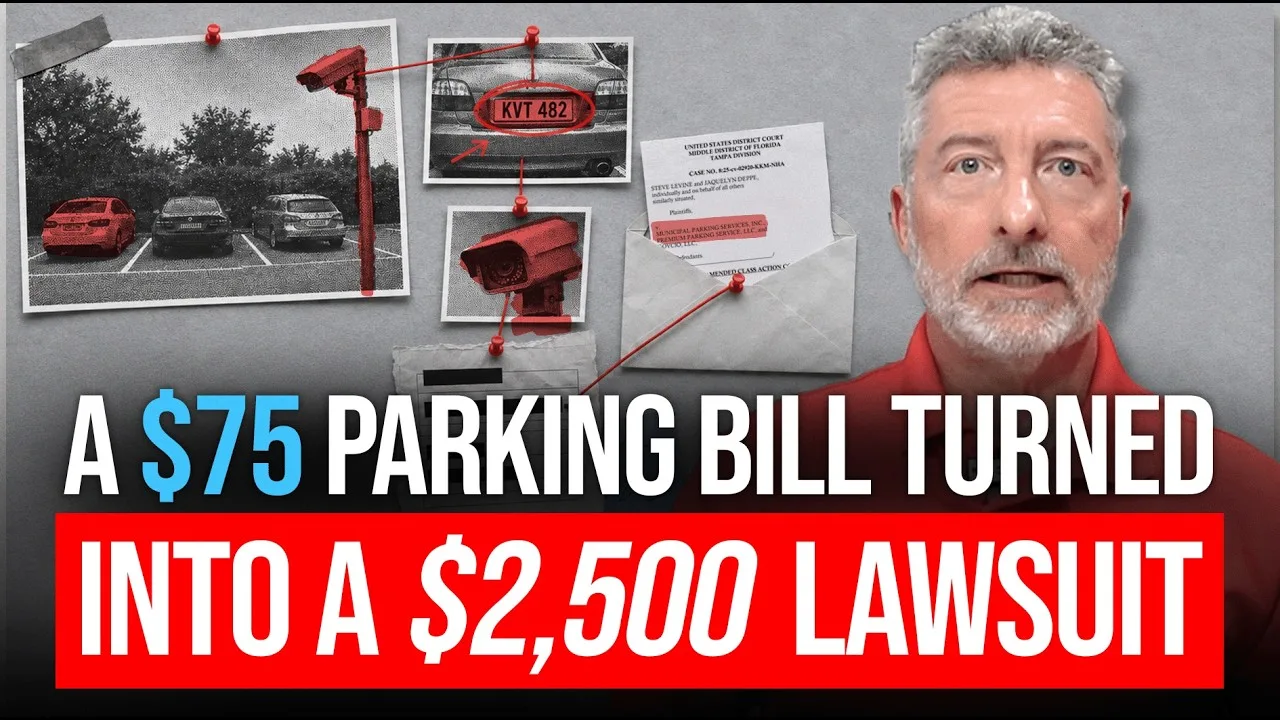
A woman drove into a private lot in Redington Shores, Florida, to drop her family off at the beach. She drove home, parked in her own garage, and walked back. Later she drove through the lot again to pick them up. She never parked there. A few days later, an invoice came in the mail: $75, rising to $115, or her car could be booted or towed.
She had never given that company her name or address. So how did it find her?
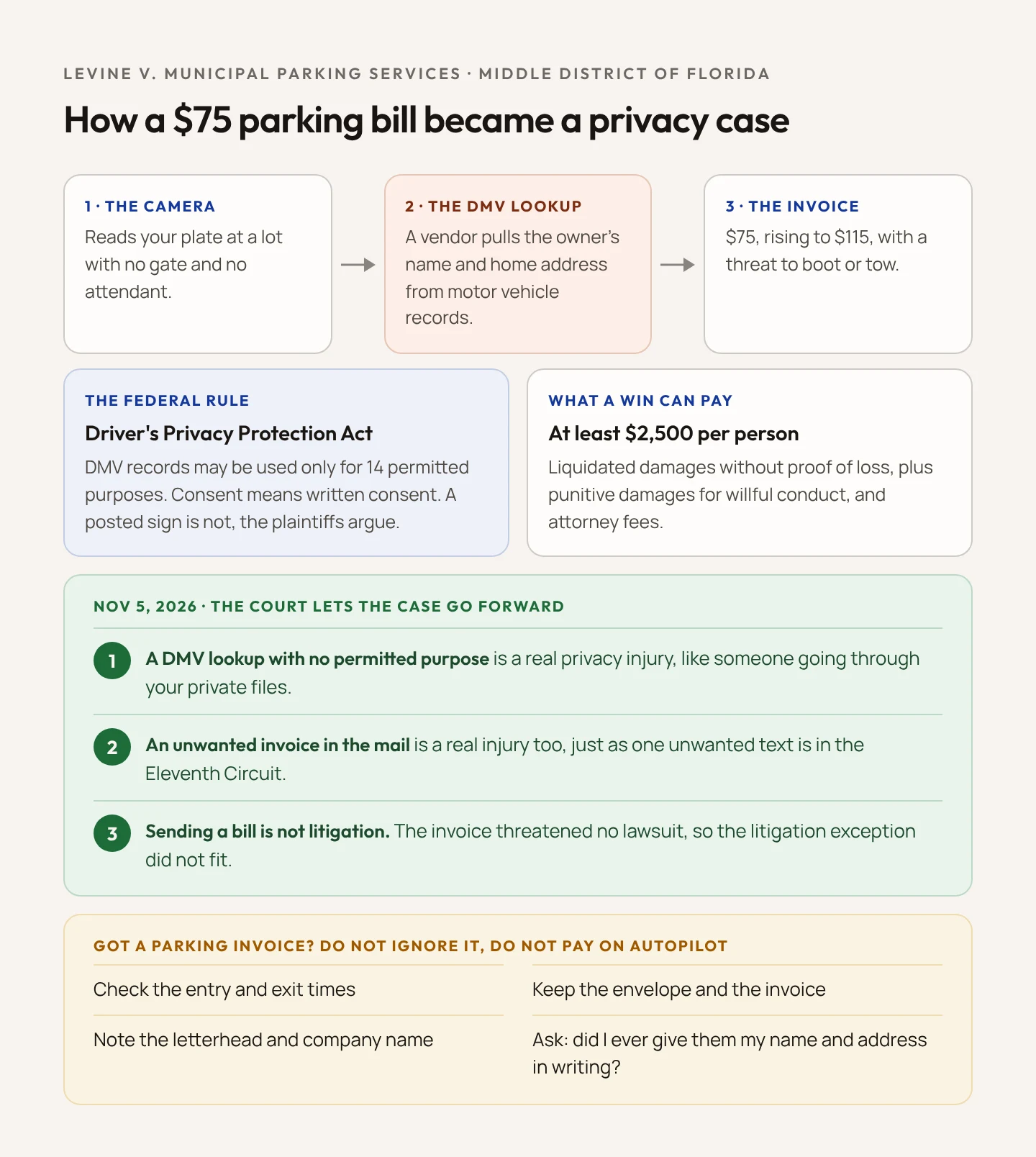
In the video below, Brian Parker reads Levine v. Municipal Parking Services, a class action under the federal Driver's Privacy Protection Act. On November 5, 2026, a federal court in the Middle District of Florida let it go forward. Each driver in the class could be owed at least $2,500.
Key Takeaways
- Your DMV record is protected. A company may use it only for one of 14 permitted purposes under the DPPA.
- The DPPA defines consent as written consent. The drivers argue that a posted sign, or driving into a lot, is not consent.
- The court held that one unwanted invoice in the mail is a real injury, the same as one unwanted text.
- Sending a bill is not litigation. The litigation exception did not cover these lookups.
A class action has class representatives, people whose claims stand for the whole class. This one has two.
Jaquelyn Deppe is the driver above. She entered the lot only to drop off family members and their beach gear, then drove home, which is within walking distance. Later she drove back through only to pick them up. Brian says the invoice claimed she had parked there for 3 hours.
Steve Levine is from Pinellas County. On October 7, 2025, his daughter parked his car in the same lot. The next day, October 8, an invoice was mailed to his home. Same terms: $75, or $115 if he did not pay. Levine himself had never dealt with these companies.
According to the complaint:
The drivers are not suing to avoid a parking payment. As their complaint puts it, the issue is how the defendants got their names and home addresses: from a protected motor vehicle record, used to send a private payment demand.
In 1989, actress Rebecca Schaeffer was murdered by a stalker who got her home address from the California DMV. Congress responded with the DPPA in 1994.
The law, 18 U.S.C. 2721 (opens in a new tab), says your DMV information can be obtained or used only for one of 14 permitted purposes. Government use and vehicle safety are on the list. So is use in court cases and in anticipation of litigation. Your name and home address are covered. The DPPA defines consent as written consent.
If someone gets your information for a purpose not on the list, 18 U.S.C. 2724 (opens in a new tab) lets you sue for:
Brian notes that you do not need to prove actual damages to recover the $2,500. Several cases stand for that.
What about the signs the parking companies posted in the lot? Brian shows two of them. The drivers argue that a posted sign, or simply entering a lot, is not written consent.
Brian also reads permitted use number three, which lets a legitimate business verify information you gave it, and correct it, to prevent fraud or recover a debt. His point: a parking company that never had your name or address has nothing to verify.
The defendants moved to dismiss. They argued the operation is legal, that Levine never denied his daughter parked without paying, that Deppe never used the dispute process, and that a bill in an envelope is not a real injury. They also argued they could pull DMV records to investigate in anticipation of litigation.
The court rejected every argument and let the case go forward. Three holdings stand out.
1. An improper DMV lookup is a real privacy injury. The court compared it to someone going through your private files without your permission.
2. An unwanted invoice in the mail is a real injury too. Brian calls this the one for anyone watching debt collectors. The Eleventh Circuit, in Drazen v. Pinto (2023), held that a single unwanted text message is enough to sue over in federal court. This court said mail is no different: "There is no meaningful distinction between the kind of harm caused by an unwanted text message and an unwanted invoice in the mail." A text buzzes and irritates. So does finding an unwanted invoice in your mailbox demanding payment and threatening to tow your car.
3. Collecting money is not litigation. Under the Supreme Court's decision in Maracich v. Spears (2013), what matters is the main purpose. This was an invoice. It did not threaten a lawsuit. It said it was not subject to civil penalties. And the complaint alleged the companies never sue over these charges.
TCPAWorld's summary of the ruling (opens in a new tab) notes the defendants had to answer the complaint by November 19, 2026. The case continues. Brian says the order will be used in other cases against parking companies that photograph your plate and mine your personal information to go after you. He has the complaint, the motion to dismiss, the response that won the day, the court's order, and his show notes inside KillDebt.
A private parking bill is a debt someone is trying to collect. The same habits Brian teaches for every collector apply: read every word, dispute what is wrong, and keep your paper. If a collector does sue, practice your hearing first in the Court Tester, in private, with an AI judge.

About the author
Brian Parker
I have over 30 years of experience defending consumers against debt collection lawsuits and have seen every tactic, threat, and pressure play that collectors use. Through KillDebt and ParkerGPT, I have systematized the proven defense strategies that actually work - so consumers can respond from a position of knowledge, not fear. My approach focuses on aggressive legal defense based on documented case success rather than false hope that leads to default judgments.