Success Stories
Sued by Cavalry SPV in Maryland: The Defects One Member Found by Reading
November 23, 2026
Blog / News Break
Bounce AI would not name a witness or answer document requests. Brian Parker shows how polite emails became two motions to compel.

You asked the debt buyer for its witness. You asked for its documents. Nobody answered. Now what?
Brian Parker hears about this all the time. In the video below, he shows what he does with a non-response in one of his own cases, emails and all. His answer: keep a paper trail, be pleasant, and let their silence build your motion.
Key Takeaways
- Read the plaintiff's initial disclosure line by line. If it lists a document, ask to see it.
- Demand a witness who can swear the company owns your account.
- Ask politely, in writing, again and again. The judge will read those emails.
- Deadlines apply to debt buyers too. When they miss one, put it in front of the judge right away.
This is the Michigan case from Brian's Bounce AI video in September. A debt buyer sued his client for about $25,000. The complaint attached no contract, no promissory note, no bill of sale, and not one statement. The plaintiff is several sales removed from the original lender. Brian calls it one of the worst lawsuits he has seen.
Paragraph three pleads "upon information and belief." Brian reads that literally: they have neither the information nor the belief. They are counting on a default. Brian puts the share of people who never answer at seven or eight in ten, citing Pew (opens in a new tab). So why would they do the work?
Michigan requires initial disclosures under MCR 2.302(A) (opens in a new tab). Early in the case, each side lays out its claims, its witnesses, and its documents. The idea is that when both sides show their cards, more cases settle.
Bounce AI's disclosure listed a membership enrollment agreement, the promissory note, the transaction history, an account statement, the bill of sale, the chain of title, an affidavit of sale, and an affidavit of debt. It produced none of them.
Brian's rule of thumb: if you say you have it, you have to produce it. And if you do not list it, you cannot claim later that you had it. So read their disclosure line by line, and ask to see everything on it. If they never show it, the court rules give you ways to press them, or to keep out what they claim to have and never showed you.
Brian's first request was for a corporate representative. In Michigan, MCR 2.306(B)(5) (opens in a new tab) lets you name the company as the deponent and list the topics. The company must designate a person to testify about what it knows or can reasonably find out.
That is different from asking for one named employee. You say: give me the person who can best answer these questions, and here are the questions and documents. Brian says you can do this yourself. There is no rule against it.
Then he builds the paper trail. He sends short, pleasant emails, knowing they will not answer:
Keep it simple, and keep it clean. The judge will read every one of these emails. No curses, no politics. "If you're pleasantly asking someone and they blow you off," Brian says, "that's something you can show in writing to the court."
They did nothing, even after Brian set the date. At 4:59 p.m. on a Friday, three business days before the deposition, the plaintiff's lawyers sent one line: they would not produce a corporate representative or appear. They also withdrew an offer to extend discovery, which Brian had turned down. He says that offer was a way to drag the case out. If you are busy, you might take it. Brian says not to.
On October 30, he filed a motion to compel the deposition, with a request for costs and attorney fees. Michigan's MCR 2.313 (opens in a new tab) covers motions to compel and what happens when a party fails to cooperate in discovery. More on writing a motion to compel and on deposition notices.
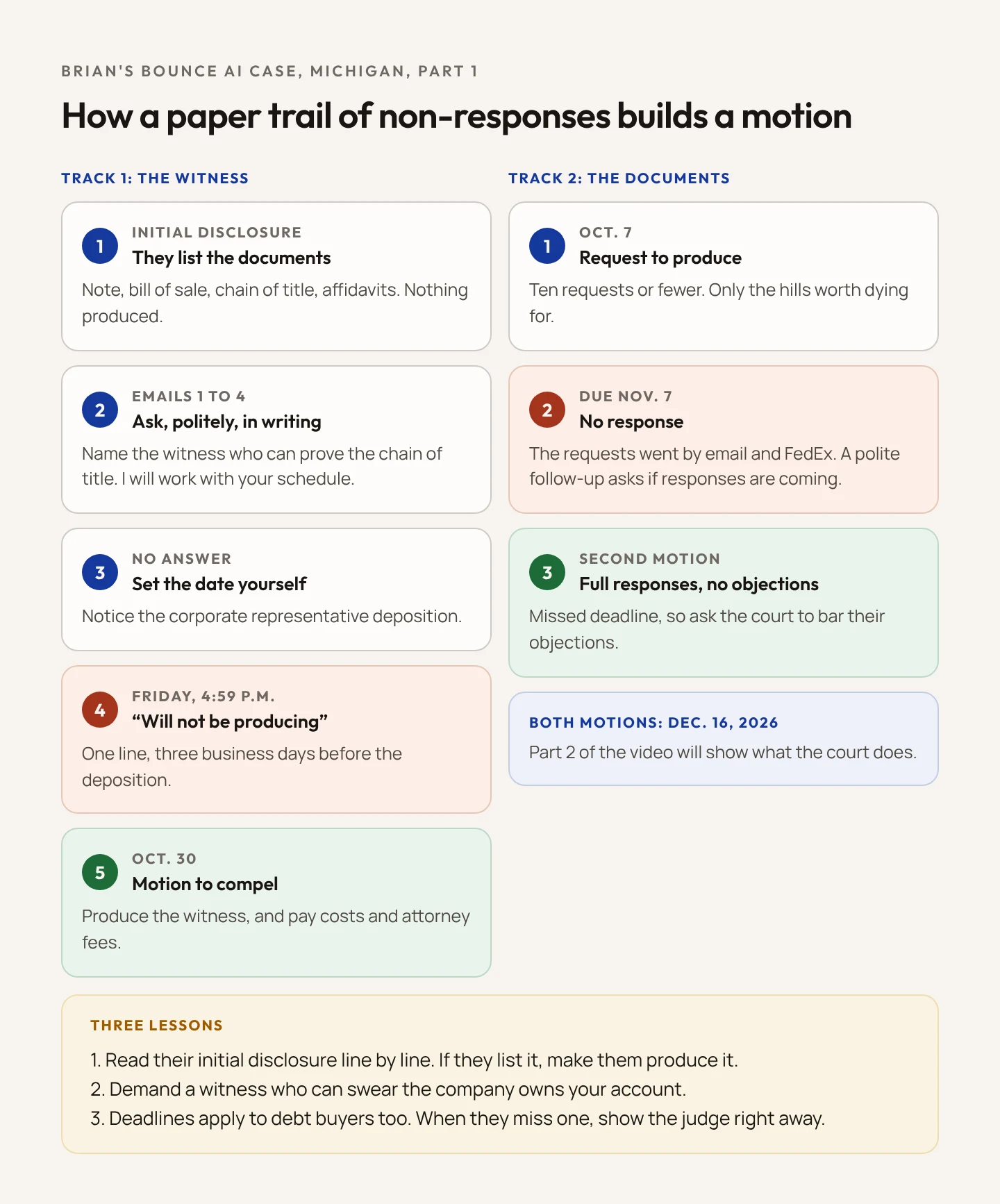
On October 7, Brian served a request to produce. He keeps these short. Many lawyers send dozens of interrogatories and requests, he says, and they end up overworking themselves and the judge. He sends 10 requests or fewer, and only fights "for the hill worth dying for."
What does he ask for? The documents they listed and never gave. And the ones he knows they cannot give, such as the assignment with his client's name on it, passing the account from the original creditor to each buyer in turn. See how to compel discovery when they stall.
The requests went out by email and FedEx. The responses, Brian says, were due November 7. Nothing came. So he sent another polite email: are the responses coming? If not, he would add a second motion to the hearing already set for December 16, 2026.
Then he filed it. The second motion asks the court to order full responses with no objections. Brian says a party that misses the deadline can lose the objections it would normally use to avoid answering fully. Take those away, and they have to answer.
His full ask to the court:
Brian's read on why debt buyers go quiet: the margins on each case are small, and some firms have a policy of not doing extra work. They expect a default. When you make them work, the case changes. Brian says that by this point, the other side often calls to settle. He will not settle unless it truly benefits his client.
He says he has seen judges run out of patience. In one case against JPMorgan, he says, the judge read his filings and dismissed the case against his client. In his last case with this same problem, he says, the plaintiff's case was dismissed too.
Brian calls this putting on legal blinders, like a racehorse. Have a plan, and do not let anyone talk you out of it.
Both motions are set for hearing on December 16, 2026. Brian will show what happens in part 2. Until then, the case continues.
Brian says both motions to compel, his discovery requests, and his answer and counter affidavit from this case are going into ParkerGPT, so you can adapt them to your case. Before a hearing, you can practice your argument in the Court Tester.

About the author
Brian Parker
I have over 30 years of experience defending consumers against debt collection lawsuits and have seen every tactic, threat, and pressure play that collectors use. Through KillDebt and ParkerGPT, I have systematized the proven defense strategies that actually work - so consumers can respond from a position of knowledge, not fear. My approach focuses on aggressive legal defense based on documented case success rather than false hope that leads to default judgments.