News Break
Sued but Not Served Yet? The Letters to Send Now
September 18, 2026
Blog / News Break
You know the lawsuit is coming. Brian Parker's pre-service playbook: the doorbell camera, the household briefing, and the complaint you can read early.

Most people find out they are being sued when somebody knocks on the door. This video is for the luckier group: the people who know it is coming. Maybe the warning was a letter from a bankruptcy attorney, who watch new filings and send help-is-available mail. Maybe it was a collector's threat to sue in 30 days. Either way, Brian Parker's message is that the warning is a gift. A lawsuit filed is not a lawsuit served, and everything you do in between builds the defense.
His letters piece from the same day covers what to send during that window. This one covers the physical side: your door, your household, and the person walking up the driveway with a summons.
Key Takeaways
- A doorbell camera is cheap insurance against a false "served her personally" claim. Bad service sworn to the court has died on camera footage before.
- In many states, handing the papers to a relative at your address is good service. Brief your household before the knock.
- Dodging the server invites alternate service: certified mail plus a notice taped to your door. Accepting service on your terms beats hiding.
- The complaint is on the public docket before you are served. Download it and read their case before you are a party to it.
First move: a doorbell camera. Brian's files hold process server footage he calls the wackiest in the business, including a man who made himself a fake FedEx shirt and knocked like he had a package. The client called FedEx, confirmed no such driver existed, and the impersonation caused the case enough problems that it went away, on Brian's account of it.
The camera earns its keep on service disputes. An affidavit that swears "served her personally" reads differently beside day-after-day footage of nobody knocking. In one of Brian's cases, a client spoke to the server through the camera, said she was away until the 13th, and watched him walk off with the complaint. He told the court she was served. The recording said otherwise. If sewer service is the disease, a doorbell camera is the test that proves it.
Second: tell everyone in your house what is coming, because in a lot of states, service on a relative or another adult staying at your address counts as service on you. Your teenager accepting an envelope at the door can start your answer clock. Nobody needs to hide; they need to know not to accept papers meant for you.
Third: evasion buys nothing. A server who keeps missing you goes back to the plaintiff, the plaintiff asks the court for alternate service, and in some states that means the lawsuit arrives by certified mail while a copy is posted on your door under bright tape for the whole street to read.
The stronger play, and Brian's pro tip, is to take control of the delivery. Servers who miss you leave cards and you-must-call-this-number letters; call back and offer to meet at a corner or a grocery store, away from your home and your neighbors. And if you hire an attorney, ask them to accept service for you. Brian does it for every client. Getting served is not the loss; not answering is.
Fourth: a process server who starts discussing your debt is doing something the law did not hire him to do. The FDCPA tightly limits who a debt collector may tell about your debt, and while a person serving legal process is not a debt collector under the statute, that protection assumes he sticks to serving. One who has read your complaint and lectures you on the porch about what you owe and why you should call the plaintiff's attorney is behaving like a collector, and Brian's observation from recent cases is that debt collectors have been buying process serving companies outright. So write down what was said the moment the door closes, or let the camera keep the record. It may become evidence.
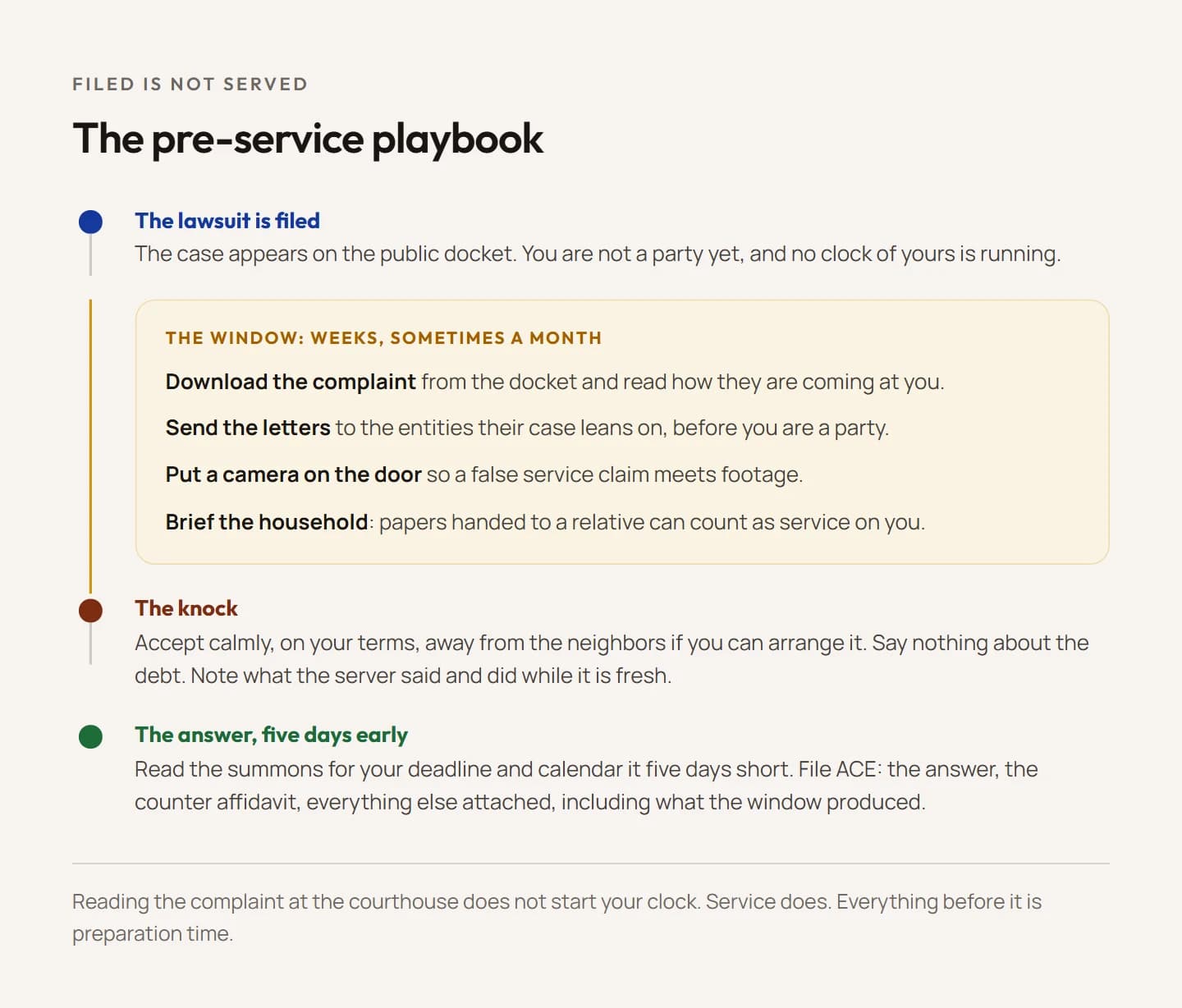
The heart of the playbook is the window itself. Filed on May 5, served on June 5: that month is what Brian calls garbage time, and it is the most useful stretch of the whole case. The complaint sits on the public docket from the day of filing, and in well-funded court systems, Florida's counties being his example, you can download it before anyone hands it to you. Now you can read exactly how they are coming at you: the accounts, the amounts, the entities whose records they lean on. Those entities usually have no idea they are named in a lawsuit, and letters to them during the window produce answers that contradict the collector's story later. The letters guide walks through each one; the pre-service checklist card is in the member library.
Stay calm and polite; the server may have a camera too. Say nothing about the debt, there as everywhere. Take your notes right after. Then open the summons and find your deadline, calendar it five days early, and answer with Brian's ACE: the Answer, the Counter affidavit that makes it more than a form, and Everything else attached, including any letters and responses your window work produced. File with the court, serve the other side with proof, and keep watching the docket.
Knowing the lawsuit is coming feels like dread. Used right, it is a head start the other side does not expect you to take.

About the author
Brian Parker
I have over 30 years of experience defending consumers against debt collection lawsuits and have seen every tactic, threat, and pressure play that collectors use. Through KillDebt and ParkerGPT, I have systematized the proven defense strategies that actually work - so consumers can respond from a position of knowledge, not fear. My approach focuses on aggressive legal defense based on documented case success rather than false hope that leads to default judgments.