
News Break
How to Stop Debt Collection When You Are Just the Guarantor
July 27, 2026
Blog / News Break
Learn legal requirements answer summons: Draft, file your response in 30 days, avoid default judgment, use defenses in debt lawsuits.
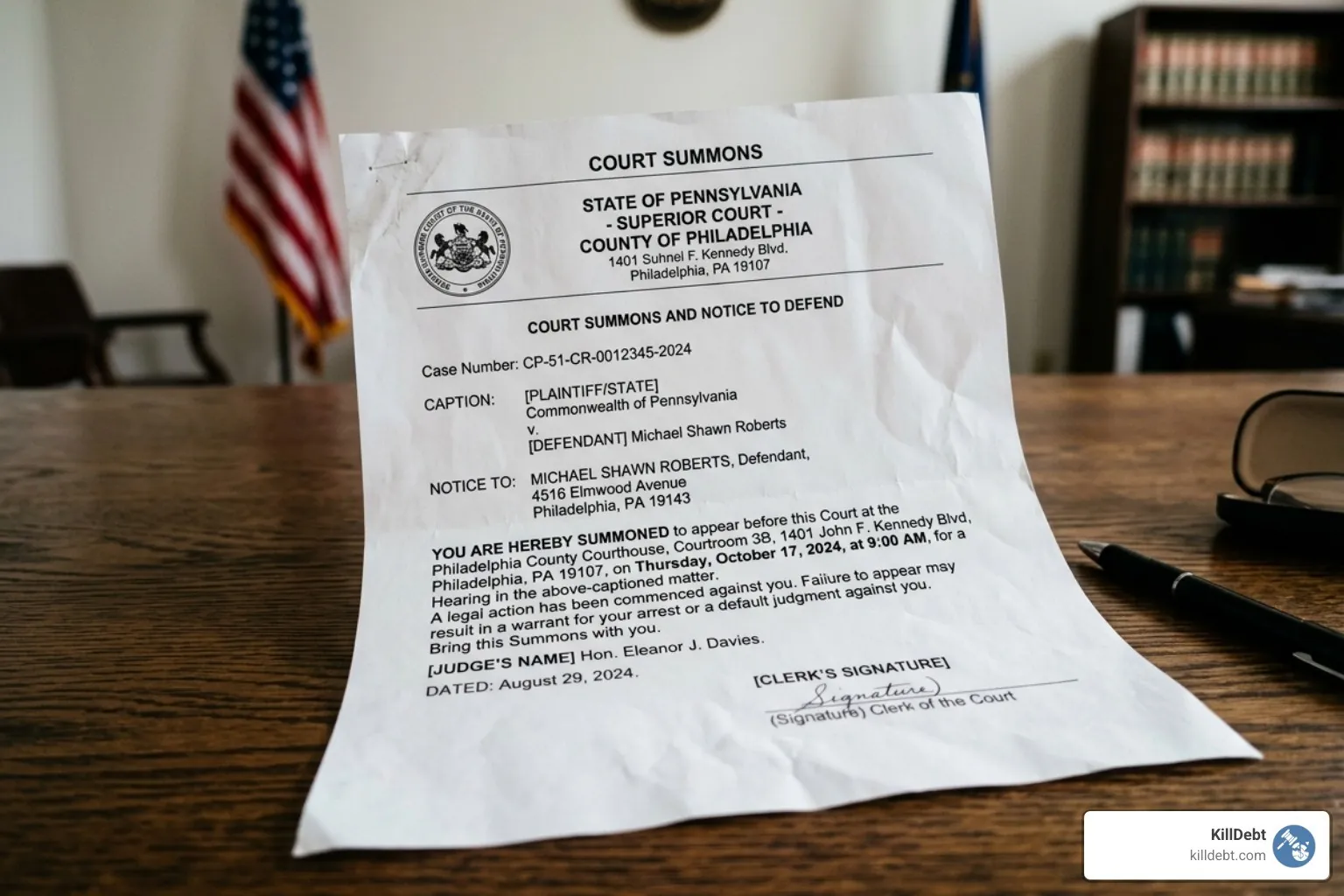
Understanding the legal requirements answer summons process could be the difference between keeping your paycheck and losing it to a garnishment order.
Here is what the law requires you to do when you receive a summons:
Missing any one of these steps can result in a default judgment — meaning the debt collector wins automatically, without ever having to prove the debt is valid.
Every year, courts hand debt collectors victories in over 70% of debt collection lawsuits — not because the defendants lost in court, but because they never showed up at all. A summons is not junk mail. It is a legal deadline with real consequences: wage garnishment, frozen bank accounts, and property liens. The clock starts the moment you are served.
I'm Brian Parker, founder of KillDebt, and I've spent over 30 years in courtrooms fighting debt buyers and collection law firms — I've seen exactly how and why people lose when they don't understand the legal requirements to answer a summons. In the sections below, I'll walk you through every step you need to take right now, in plain language, so you can fight back with confidence.


When a process server knocks on your door or you find a thick envelope in the mail, your first instinct might be to panic or ignore it. Don't. Receiving a summons means a legal action has officially started against you. It is the court’s way of saying, "You are being sued, and you have a right to defend yourself—but you must do it within our rules."
The legal requirements answer summons process involves two main documents: the Summons and the Complaint. The Summons is the notice that tells you where the case is filed and how long you have to respond. The Complaint is the list of specific allegations the debt collector is making against you. Understanding the difference between summons complaint in debt collection lawsuit is your first step in building a defense.
To meet the requirements, you must satisfy "Service of Process" rules. This means the plaintiff (the person suing you) must prove to the court that you actually received the papers. Once you have them, you are under the court's jurisdiction. If you're feeling overwhelmed, check out our what to do when sued by a debt collector complete first steps guide to get your bearings. You can also learn more about the broader context of these documents at Court Summons: What It Means and How to Respond (opens in a new tab).
In the legal world, time is your most precious resource—and your biggest enemy. In California, the Code of Civil Procedure is very strict: you generally have 30 days from the date you were served to file your response. If you were served in a federal case, Rule 4. Summons | Federal Rules of Civil Procedure (opens in a new tab) sets the standard, often giving you 21 days, though this can vary if you waive service.
In Michigan, the rules are slightly different depending on how you were served. If you were handed the papers personally, you usually have 21 days. If you were served by mail or outside the state, you might have 28 days. Regardless of the exact number, the time to respond debt collection lawsuit is non-negotiable. If you miss it by even one day, the plaintiff can file for a default.
Ignoring a lawsuit is the most expensive mistake you can make. If you fail to meet the legal requirements answer summons deadline, the court assumes you agree with everything the debt collector said. They will issue a default judgment.
A default judgment is essentially a "blank check" for the debt collector. With this piece of paper, they can:
Once a judgment is entered, it is much harder to fight. You can read more about what happens after summons to see why proactive defense is always the better path.

Now that you know you must respond, let's talk about how. Your response is called an "Answer." This isn't a letter to the judge explaining your life story; it is a formal legal document that addresses the Complaint point-by-point.
In California, many people use a form called a General Denial (PLD-050), but this is only allowed in certain cases (usually where the amount is under $25,000 or the complaint isn't verified). For most debt cases, you’ll need to create a formal Answer that matches the "case caption" found on the Summons. This includes the court name, the parties involved, and the case number.
If you’re looking for a starting point, we provide a sample answer to debt collection lawsuit that shows the proper layout. Following the correct how to answer a debt summons protocol ensures the clerk doesn't reject your filing on a technicality.
The meat of your Answer involves responding to every numbered paragraph in the Complaint. You have three choices for each paragraph:
| Response | When to Use It | Legal Effect |
|---|---|---|
| Admit | The statement is 100% true (e.g., your name and address). | You agree this fact doesn't need to be proven. |
| Deny | The statement is false or the collector lacks proof. | Forces the plaintiff to provide evidence to prove the claim. |
| Lack of Knowledge | You don't have enough info to know if it's true. | Acts as a denial; the collector must still prove it. |
Strategic denials are the key to strong answer in a collection lawsuit solid counter affidavit. By denying an allegation, you aren't necessarily saying "I never spent a dime"; you are saying "I demand you prove it with a valid contract and accounting records." This shifts the burden of proof back to the debt collector, where it belongs.
An Answer isn't just about saying "no"; it's also about saying "even if what you say is true, you still can't win because..." These are called Affirmative Defenses. If you don't include them in your initial Answer, you usually waive the right to use them later.
Common defenses include:
Using these defenses is how you win zombie lawsuit battles where collectors try to revive ancient debts. For a deeper dive, check out our debt lawsuit defense guide.
Completing the paperwork is only half the battle. To satisfy the legal requirements answer summons, you must "serve" the plaintiff and "file" with the court.
Filing is the act of giving your original documents to the court clerk. In California, filing fees can range from $225 to $450 depending on the amount of the lawsuit. If you cannot afford this, you must file an FW-001 Request for Waiver of Court Fees. Do not let the price tag stop you from responding; the cost of a default judgment is much higher. You can find more details on the california debt lawsuit answer process here.
"Service" is the formal process of giving a copy of your Answer to the person suing you. Crucial Rule: You cannot serve the papers yourself. You must have a third party (a friend, relative, or professional process server) who is over 18 and not involved in the case do it for you.
The most common method is Service by Mail. Your server mails the Answer to the plaintiff’s attorney via first-class mail. Then, the server signs a Proof of Service (Form POS-030 in California). You file this Proof of Service with the court along with your Answer. This is the only way the court knows you followed the rules. To understand where this fits in the bigger picture, see the debt collection lawsuit timeline what happens next after youre served.
Navigating the legal requirements answer summons doesn't have to be a nightmare. While the court system feels designed to favor big collectors, the rules are there for you to use, too. By filing a timely Answer, asserting your affirmative defenses, and demanding proof, you take control of the situation.
At KillDebt, we believe everyone deserves a fair fight. Our DIY legal defense system is powered by ParkerGPT, an AI trained on the real-world court strategies of attorney Brian Parker, who has over 30 years of experience. We don't just give you generic templates; we provide document analysis and step-by-step instructions tailored to your case.
Want to see how your defense holds up before you even step into a courtroom? Our brand-new Court Tester allows you to upload your filings and run an AI courtroom simulation. You'll argue your motion in front of an AI judge and against AI opposing counsel, while a private AI co-counsel whispers winning strategies in your ear.
Don't let a debt collector win by default. Use our fight debt collection lawsuit complete guide or visit KillDebt today to start building your defense with the power of AI. Your financial future is worth the effort.
Get started with KillDebt pricing
Important Legal Disclaimer
This educational content is based on general legal principles and my experience in debt collection defense. It is provided for informational purposes only and does not constitute legal advice. Laws vary by state and by local court. For specific legal advice, consult a qualified attorney licensed in your jurisdiction. No attorney-client relationship is created by reading this guide.
Critical Multi-State Variations: FDCPA applies uniformly at the federal level, but state consumer protection laws may provide additional rights and remedies. Statute of limitations periods vary significantly by state and debt type. What constitutes sufficient debt validation varies in practice across jurisdictions. State-specific rules on call frequency, written notice requirements, and permissible collector conduct may differ from federal minimums.

About the author
Brian Parker
I have over 30 years of experience defending consumers against debt collection lawsuits and have seen every tactic, threat, and pressure play that collectors use. Through KillDebt and ParkerGPT, I have systematized the proven defense strategies that actually work - so consumers can respond from a position of knowledge, not fear. My approach focuses on aggressive legal defense based on documented case success rather than false hope that leads to default judgments.
