News Break
Summons 101: Meeting the Legal Requirements
July 28, 2026
Blog / News Break
Learn a winning credit card lawsuit strategy to fight debt collectors, vacate judgments, and settle on your terms.

Having a solid credit card lawsuit strategy is the difference between losing by default and walking away with your wages, bank account, and credit intact. Here's what works:
Quick Answer: Top Credit Card Lawsuit Strategies
Creditors filed lawsuits against more Americans than ever in 2025, and roughly 70–80% of those cases end in default judgments — not because the creditor always wins on the merits, but because the defendant simply never responds. That's not a legal defeat. That's a paperwork defeat.
The stakes are real. A judgment can follow you for up to 20 years in New York, and it opens the door to wage garnishment, frozen bank accounts, and property liens.
I'm Brian Parker, founder of KillDebt, and I've spent over 30 years in the courtroom defending consumers against creditors, debt buyers, and collection law firms — developing and deploying every credit card lawsuit strategy in this guide. In that time, I've seen ordinary people win cases that looked hopeless on day one, simply because they knew what to demand and when to demand it.

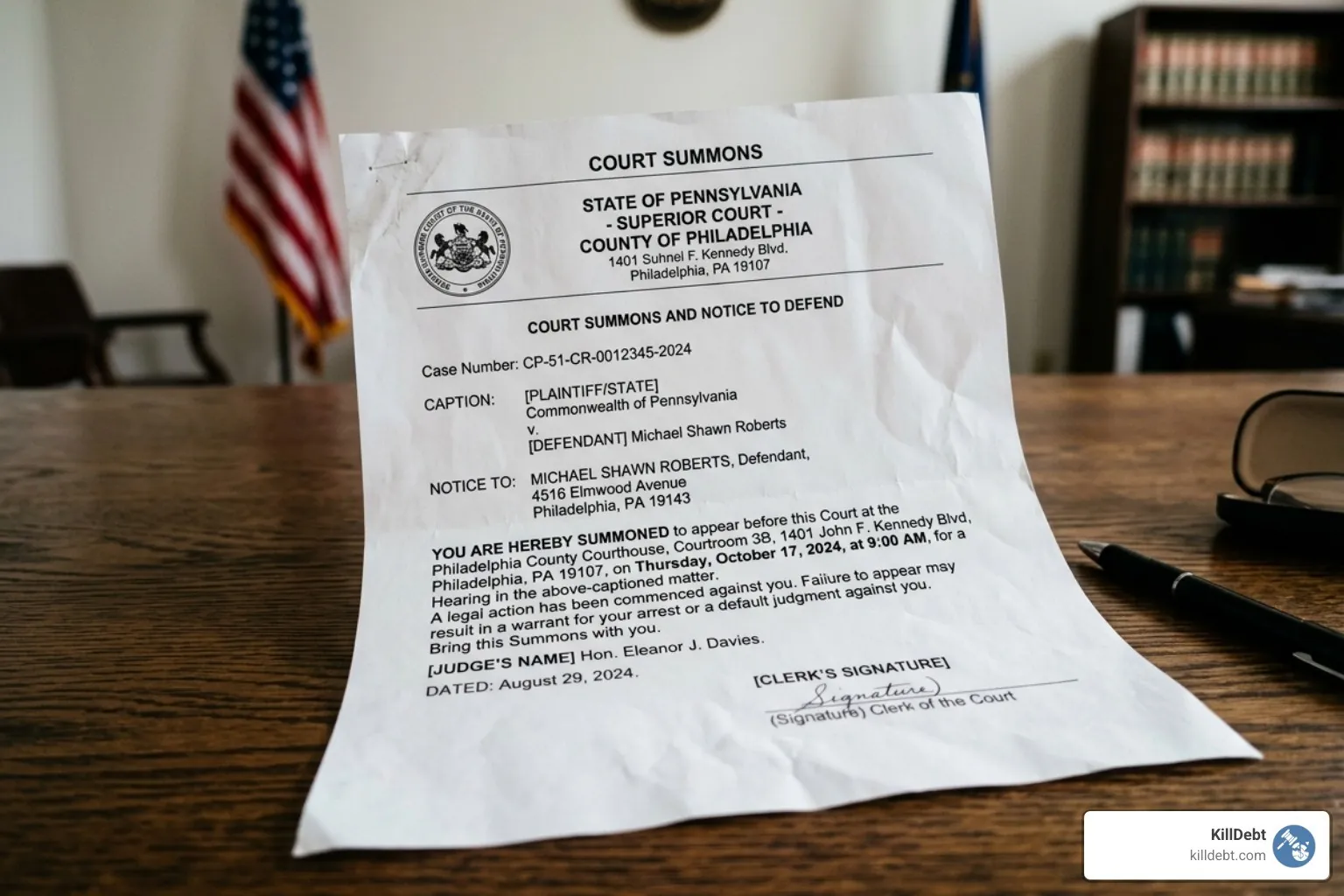
The moment a process server hands you a summons, or you find one taped to your door, a clock starts ticking. This is not the time to panic, and it is certainly not the time to ignore the paperwork hoping it will disappear.

Ignoring a lawsuit is the single most expensive mistake you can make. When you do not respond, the court assumes everything the creditor says is 100% true. They will quickly issue a default judgment, which allows them to garnish your wages, freeze your bank accounts, and tack on hundreds or thousands of dollars in interest, court costs, and attorney fees.
To protect yourself, you need to understand the rules of the game in your specific state.
Your response window depends entirely on where you live and how you were served:
If you are currently negotiating a settlement, remember this: negotiation does not pause the lawsuit. Unless you have a signed, written extension filed with the court, you must still file your Answer before the deadline to prevent a default. For more details on handling this crucial first step, read our guide on How to Answer a Debt Summons.
A written Answer is your formal response to the lawsuit. It is not your opportunity to tell your life story or explain why you fell behind on your payments. The court only wants to know whether you agree or disagree with the statements in the complaint.
For every numbered paragraph in the plaintiff's complaint, you must respond in one of three ways:
Once drafted, you must file the original copy with the Clerk of Court where the lawsuit was filed, keep a stamped copy for your records, and send a copy via certified mail (with a return receipt) to the plaintiff's attorney. To get a jumpstart on drafting, check out our walkthrough on How to Write an Answer to a Credit Card Lawsuit and download our Debt Lawsuit Response Template to ensure your formatting is correct.
Who is actually suing you? This is one of the most important questions in your credit card lawsuit strategy. Fighting an original creditor (like Citibank, Capital One, or Chase) is a very different battle than fighting a third-party debt buyer (like Midland Credit Management, LVNV Funding, or Portfolio Recovery Associates).
Original creditors usually have direct access to your original contract, signed applications, and years of monthly billing statements. They have a clear paper trail.
Debt buyers, on the other hand, buy charged-off accounts in bulk portfolios for pennies on the dollar (often between 2 and 10 cents per dollar of debt). These portfolios are usually transferred via a massive spreadsheet containing thousands of names, account numbers, and balances—but very little actual documentation. This lack of paperwork is their greatest weakness, and your greatest opportunity. You can read more about these differences in Sued in a Credit Card Debt Lawsuit? Your Real Defenses (opens in a new tab).
If a third-party debt buyer is suing you, they must prove they actually own your specific debt. They cannot just show up in court and say, "Trust us, we bought it." They must establish a complete, unbroken chain of title from the original creditor down to them.
This requires them to produce:
If there is even one missing link in this chain of assignments, they lack the legal standing to sue you. In court, you can object to their generic, unauthenticated spreadsheets and boilerplate affidavits. If they cannot produce the proper documentation, the court must dismiss the case. Learn how to raise this defense in our guide on Lack Standing Debt Suit.
Do not make the plaintiff's job easy by admitting to the debt balance. The legal burden of proof lies entirely on them. They must prove:
Demand that they produce a complete accounting of the debt from a $0 balance up to the charged-off amount. This means showing every purchase, every payment, every interest calculation, and every late fee. If they cannot produce these records, or if they have added unauthorized fees and inflated interest charges, you can dismantle their case. Discover how to exploit these documentation gaps in our article on Debt Buyer Lawsuit Weaknesses.
An affirmative defense is a legal reason why the plaintiff should not win, even if their claims against you are technically true. You must include your affirmative defenses in your initial written Answer, or you risk waiving them forever.
The statute of limitations is the legal time limit a creditor has to file a lawsuit against you. If they sue you after this time has expired, the debt is "time-barred," and you can get the case dismissed immediately.
The time limit varies significantly by state:
Be extremely careful: making even a tiny payment or acknowledging the debt in writing can restart the statute of limitations clock. If a debt collector contacts you about an old, expired debt, do not agree to a payment plan before analyzing your case. Under regulations like New York's DFS Regulation 23 NYCRR 1.3, debt collectors are legally required to disclose in writing if a debt is past the statute of limitations and acknowledge they cannot sue on it.
Did you discover a judgment against you for a lawsuit you never knew existed? This is often the result of a practice known as "sewer service"—where a corrupt process server fails to deliver the court papers but falsely claims they did (throwing them "in the sewer").
If you were never properly served, the court never had jurisdiction over you, and the default judgment is legally void. You can fight back by filing a Motion to Vacate Default Judgment (under rules like New York's CPLR § 5015 or equivalent rules in Florida and Michigan).
To win a motion to vacate, you must typically show:
Once the judgment is vacated, the creditor's enforcement actions (like frozen bank accounts or active garnishments) must stop, and you are given a fresh opportunity to fight the lawsuit. For a deeper look at defending these actions, see our Defending Credit Card Lawsuit Guide 2026.
You do not have to play defense the entire time. You can use powerful federal and state consumer protection laws to turn the tables on aggressive debt collectors, sometimes forcing them to dismiss their lawsuit or pay you damages.
The federal Fair Debt Collection Practices Act (FDCPA) (15 U.S.C. § 1692) regulates what third-party debt collectors and debt buyers can and cannot do. A collector violates the FDCPA if they:
In addition to federal law, states have their own consumer protection statutes. For example, New York's General Business Law (GBL) § 349 prohibits deceptive acts and practices in business and litigation conduct, and can be used to penalize debt buyers who file lawsuits using intentionally falsified or unverified documentation.
If a debt collector violates the FDCPA, you can file a counterclaim against them within the same lawsuit. Under the FDCPA, a successful consumer can recover:
Because debt collectors must pay your legal fees if they lose an FDCPA claim, filing a legitimate counterclaim completely changes their financial equation. It often forces them to quickly dismiss the lawsuit against you in exchange for you dropping your consumer protection claims. Learn how to build this leverage with our Fight Debt Collection Lawsuit Complete Guide.
Most credit card lawsuits never make it to a trial. Instead, they are resolved at the negotiation table. However, you must negotiate from a position of strength, using your affirmative defenses and documentation demands as leverage to drive the settlement percentage down.
| Settlement Type | Typical Percentage | Pros | Cons |
|---|---|---|---|
| Lump-Sum Settlement | 30% – 50% (often 25% with debt buyers) | Lowest overall cost; resolves the debt immediately; maximum negotiating leverage. | Requires having a chunk of cash available immediately. |
| Structured Payment Plan | 50% – 70% | Spreads the cost over several months; easier on immediate cash flow. | Higher overall cost; if you miss a single payment, they can file a judgment for the full original amount. |
When you are ready to make an offer, start low. If you can afford to settle for 50%, start your opening offer at 10% to 20% to leave room for bargaining.
Before you pay a single dollar, you must obtain a written settlement agreement signed by both parties. This agreement must explicitly state:
Be aware of the tax implications: if a creditor forgives $600 or more of a debt, they are required to report it to the IRS using Form 1099-C (Cancellation of Debt). The IRS treats forgiven debt as taxable income.
However, you can avoid paying taxes on this amount by utilizing the insolvency exception via IRS Form 982. If your total liabilities (what you owe) exceeded your total assets (what you own) at the time of the settlement, you are considered insolvent, and you do not have to pay income tax on the forgiven portion.
A lawsuit itself does not directly appear on your credit report, but the underlying delinquent account and any potential court judgments certainly do.
During your negotiations, use your settlement as leverage to clean up your credit profile. Insist on a clause in your settlement agreement regarding credit reporting. Negotiate for the creditor to report the account as "Paid in Full" or, ideally, agree to a "Pay for Delete" where they agree to remove the negative collection tradeline from your credit reports entirely.
Facing a credit card lawsuit is incredibly stressful, but you do not have to navigate the complex court system alone, and you do not have to spend thousands of dollars on a traditional defense attorney.
At KillDebt, we provide a DIY legal defense system powered by ParkerGPT—an advanced AI trained specifically on consumer debt law and real-world courtroom strategies developed over 30+ years by veteran defense attorney Brian Parker.
Unlike generic AI tools, ParkerGPT analyzes your actual lawsuit documents, uncovers hidden weaknesses in the creditor's paperwork, identifies missing links in their chain of title, and generates highly customized, court-ready written Answers and motions with clear, step-by-step filing instructions—all at a fraction of the cost of hiring a traditional lawyer.
We have also just rolled out our brand-new Court Tester AI courtroom simulator! This cutting-edge tool allows you to upload your actual lawsuit filings and practice your arguments in minutes. You will face an AI judge and AI opposing counsel in a simulated hearing, while a private AI co-counsel whispers real-time strategies, objections, and responses that only you can see.
Do not let the banks win by default. Take control of your financial future, protect your hard-earned wages, and beat the debt collectors at their own game. Visit KillDebt DIY Legal Defense today to analyze your case and build your winning strategy.
Get started with KillDebt pricing
IMPORTANT LEGAL DISCLAIMER
This educational content is based on general legal principles and my experience in debt collection defense. It is provided for informational purposes only and does not constitute legal advice. Laws vary by state and by local court. For specific legal advice, consult a qualified attorney licensed in your jurisdiction. No attorney-client relationship is created by reading this guide.
Critical Multi-State Variations: FDCPA applies uniformly at the federal level, but state consumer protection laws may provide additional rights and remedies. Statute of limitations periods vary significantly by state and debt type. What constitutes sufficient debt validation varies in practice across jurisdictions. State-specific rules on call frequency, written notice requirements, and permissible collector conduct may differ from federal minimums.

About the author
Brian Parker
I have over 30 years of experience defending consumers against debt collection lawsuits and have seen every tactic, threat, and pressure play that collectors use. Through KillDebt and ParkerGPT, I have systematized the proven defense strategies that actually work - so consumers can respond from a position of knowledge, not fear. My approach focuses on aggressive legal defense based on documented case success rather than false hope that leads to default judgments.
