News Break
From Payment to Mistake: Your Guide to Contract Defenses
July 1, 2026
Blog / News Break
Learn how self-help legal documents help you handle civil cases without an attorney and save money.

Self-help legal documents are official or standardized legal forms that ordinary people can fill out and file in court — without hiring an attorney.
Here's a quick overview of where to find them:
| Document Type | Where to Find Free Forms |
|---|---|
| Debt lawsuit response | KillDebt, your state court website |
| Divorce forms | State court self-help portals (e.g., California, Texas, Wyoming) |
| Eviction / housing | State judicial branch websites, legal aid organizations |
| Name change | Your county court clerk's website |
| Wills and trusts | State court websites (e.g., California Statutory Will) |
| Power of attorney | State bar or legal aid organization websites |
| Small claims | Your local court's self-help center |
The numbers tell a sobering story. Roughly 75% of low-income households face at least one civil legal problem every year — yet 86% of those problems receive little or no legal help. At the same time, self-represented litigants now make up more than 75% of cases in many family law courts across the U.S.
That gap — between legal need and legal help — is exactly why self-help forms exist.
Whether you've just been handed a court summons, received a debt collection letter, or simply need to file paperwork you can't afford to hand off to a lawyer, self-help legal documents give you a real path forward. They're not a second-rate option. Used correctly, they can be just as effective as attorney-drafted forms for many common legal matters.
I'm Brian Parker, and I've spent over 30 years in the courtroom fighting debt collectors, creditors, and collection law firms across the country. I built KillDebt specifically to put self-help legal documents and professional-grade defense strategies into the hands of everyday people — so you can stand up for yourself without paying thousands in attorney fees.
When you choose to represent yourself in court, you are acting as a pro se litigant. "Pro se" is simply a Latin term meaning "for oneself." Choosing this path does not mean you are at a disadvantage, but it does mean you have to handle your own document preparation.
So, how do self-help legal documents stack up against forms prepared by a traditional, high-priced attorney?
Self-help documents are typically standardized templates designed by state court systems, legal aid organizations, or legal tech platforms. They are written to be accessible to the public, using plain language where possible, with blank spaces for you to fill in your specific details.
Attorney-drafted documents, on the other hand, are customized from scratch (or built from highly specialized firm templates) to fit the exact nuances of a unique case. While custom drafting is necessary for highly complex corporate litigation or multi-million dollar estates, it is often complete overkill for standard legal matters.
The primary difference comes down to cost and control. Hiring an attorney to draft a simple response to a lawsuit can easily run you $1,500 to $3,000 in billable hours. By using self-help forms, you save thousands of dollars while maintaining direct control over your case.
| Feature | Self-Help Legal Documents | Attorney-Drafted Documents |
|---|---|---|
| Cost | Free to low-cost (often under $150) | High ($250–$500+ hourly rates) |
| Accessibility | Easily downloaded online | Requires consultations and appointments |
| Complexity | Best for straightforward, uncontested issues | Best for highly complex, multi-party disputes |
| Control | You manage your own timeline | The attorney manages the case flow |
If you are stepping into the courtroom on your own, we highly recommend reviewing our comprehensive list of Pro Se Litigant Resources to help you get your bearings.
You might be surprised by just how many legal issues can be resolved using standardized forms. State courts and legal organizations have worked hard to create templates for the most common civil matters.
For those residing in the Sunshine State, the state court system provides an extensive library of Family Law Forms - Florida Courts to help you handle divorce, custody, and name changes without a lawyer.
The secret to successfully using self-help forms is ensuring you are getting them from a legitimate, official source. Filing an outdated or incorrect form can result in your case being dismissed or delayed.
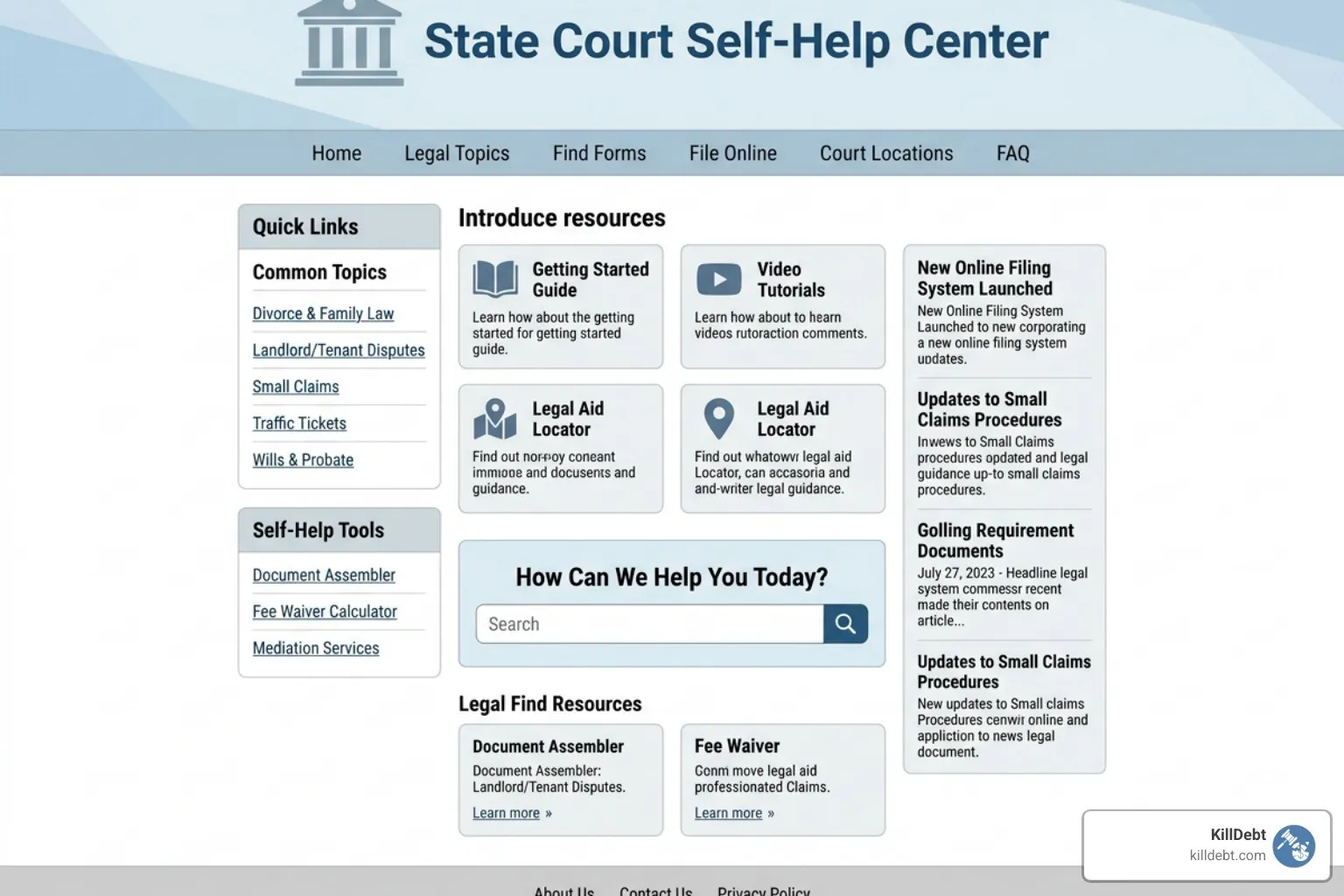
To find official forms, start with your state's judicial branch website. Most state courts maintain a dedicated "Self-Help" or "Pro Se" portal.
For instance, if you live in Michigan, your absolute best starting point is Michigan Legal Help: Home. This portal is packed with free, court-approved forms, step-by-step toolkits, and localized instructions.
If you are in Florida, you can access the official Self-Help Information / Family Courts / Services - Florida Courts portal. For regional matters in north-central Florida, you can also leverage resources directly from Self-Help – The Eighth Judicial Circuit of Florida.
When searching for forms, keep these best practices in mind:
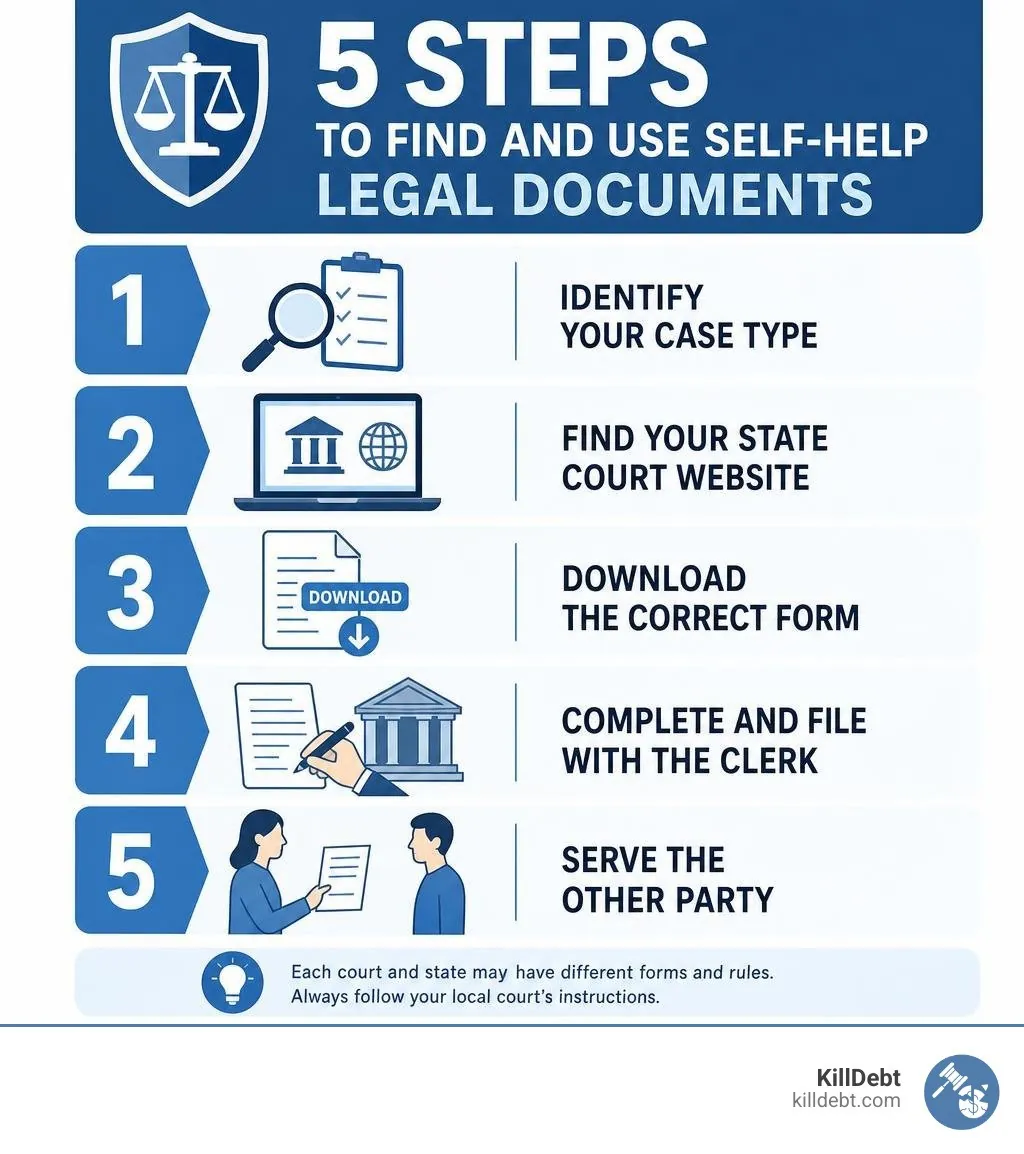
Once you have located the correct self-help legal documents, you must follow a strict procedural path to ensure the court accepts them.

Read the instructions accompanying your form packet from start to finish before writing anything down. Type your answers if possible, or print legibly in black ink. Be honest, precise, and avoid scratching out mistakes. If you make an error, start fresh with a clean printout.
Many legal forms are invalid unless they are signed in front of a notary public or witnessed by independent third parties. Do not sign the document until you are in the presence of the required notary or witnesses.
Take your completed, signed, and notarized documents to the local court clerk's office. You will need the original document plus at least two copies (one for your records, and one to serve to the opposing party).
Note: If you cannot afford the court's filing fees, ask the clerk for a "Fee Waiver" application. If you meet the income requirements, the court will waive the filing costs.
You cannot simply mail the papers to the other party yourself. You must follow formal "service of process" rules. This usually involves paying a small fee to the local sheriff's department or hiring a professional process server to hand-deliver the documents.
If you are responding to an urgent legal threat, like a debt collection lawsuit, knowing How to Answer a Debt Summons is your critical first step. You can use a structured Sample Answer to Complaint to draft your formal response.
As technology has evolved, self-help forms have split into two main formats: static forms and interactive guided forms.
Studies show that interactive online form tools reduce filing errors by up to 40% compared to paper forms completed without guidance. They eliminate the guesswork of knowing which box to check or which legal jargon to write down.
While self-help documents are incredibly powerful, they are not appropriate for every single scenario. You must evaluate the complexity of your situation before deciding to go it alone.
Self-help forms are highly effective for:
However, you should seek professional legal counsel if:
If you have received a summons and complaint from a debt collector, the clock is ticking. In most jurisdictions, you have a strict window of 14 to 30 days to file a formal written answer with the court. If you ignore this deadline, the collector will win a default judgment against you, allowing them to garnish your wages or freeze your bank accounts.
Do not panic, and do not fall for common Debt Collection Lawsuit Myths: 7 Things That Won't Save You. Ignoring the lawsuit or assuming it will disappear because the debt is old are fast tracks to losing by default.
Instead, take immediate action. You can learn How to Write an Answer to a Credit Card Lawsuit to protect your rights. By drafting a formal response, you force the debt buyer to actually prove they own the debt, have the right to sue you, and are suing for the correct amount.
To get started, you can utilize a Sample Answer to Debt Collection Lawsuit or file a simplified General Denial Answer Form depending on your local court rules. Filing this answer stops the default judgment process cold and forces the collector to the negotiating table.
Taking control of your own legal matters can feel intimidating, but you do not have to walk this path alone. Armed with the right self-help legal documents, official court resources, and a clear understanding of the rules, you can successfully defend your rights, protect your family, and save thousands of dollars in the process.
At KillDebt, we believe that justice shouldn't belong only to those who can afford a retainer. That's why we built our DIY legal defense system powered by ParkerGPT — an AI trained specifically on consumer debt law and real-world court strategies developed over 30+ years by attorney Brian Parker.
Unlike generic AI tools that simply spit out basic text templates, ParkerGPT analyzes your actual lawsuit documents, uncovers hidden procedural weaknesses, and generates customized, court-ready responses with step-by-step instructions.
And if you want to practice before stepping foot in front of a judge, our brand-new Court Tester tool provides an interactive, real-time AI courtroom simulation built on your actual case. You can upload your filings and practice arguing your motion in front of an AI judge, against AI opposing counsel, with a private AI co-counsel whispering winning strategies directly to you.
Ready to stand up, fight back, and resolve your debt on your own terms? Explore our KillDebt Pricing and AI Tools today and put a 30-year courtroom veteran in your corner.
IMPORTANT LEGAL DISCLAIMER
This educational content is based on general legal principles and my experience in debt collection defense. It is provided for informational purposes only and does not constitute legal advice. Laws vary by state and by local court. For specific legal advice, consult a qualified attorney licensed in your jurisdiction. No attorney-client relationship is created by reading this guide.
Critical Multi-State Variations: FDCPA applies uniformly at the federal level, but state consumer protection laws may provide additional rights and remedies. Statute of limitations periods vary significantly by state and debt type. What constitutes sufficient debt validation varies in practice across jurisdictions. State-specific rules on call frequency, written notice requirements, and permissible collector conduct may differ from federal minimums.

About the author
Brian Parker
I have over 30 years of experience defending consumers against debt collection lawsuits and have seen every tactic, threat, and pressure play that collectors use. Through KillDebt and ParkerGPT, I have systematized the proven defense strategies that actually work - so consumers can respond from a position of knowledge, not fear. My approach focuses on aggressive legal defense based on documented case success rather than false hope that leads to default judgments.