
News Break
How to Protect Your Paycheck Under Florida Wage Garnishment Laws
June 24, 2026
Blog / News Break
Access essential pro se litigant resources to navigate court, find free legal aid, and draft your debt defense documents.

Pro se litigant resources are the tools, guides, forms, and support services available to people who represent themselves in court — without an attorney.
Here's a quick-reference list of the most important resources available right now:
If you've just received a debt collection summons, a court deadline, or a wage garnishment threat, you're probably feeling overwhelmed. That's completely understandable.
The legal system wasn't designed to be easy to navigate alone. And yet, millions of people do it every year. In 2023, roughly 27% of civil cases filed in U.S. federal district courts involved at least one self-represented litigant. In some state family courts, that number climbs as high as 75%.
The good news? There are more free and low-cost tools available today than ever before — you just need to know where to look.
I'm Brian Parker, founder of KillDebt and a debt collection defense attorney with over 30 years of courtroom experience fighting creditors, debt buyers, and collection law firms. I've seen how the right pro se litigant resources can level the playing field for people who can't afford an attorney. This guide pulls together everything I'd tell a friend sitting across from me with a summons in their hand.
IMPORTANT LEGAL DISCLAIMER
This educational content is based on general legal principles and my experience in debt collection defense. It is provided for informational purposes only and does not constitute legal advice. Laws vary by state and by local court. For specific legal advice, consult a qualified attorney licensed in your jurisdiction. No attorney-client relationship is created by reading this guide.
Critical Multi-State Variations: FDCPA applies uniformly at the federal level, but state consumer protection laws may provide additional rights and remedies. Statute of limitations periods vary significantly by state and debt type. What constitutes sufficient debt validation varies in practice across jurisdictions. State-specific rules on call frequency, written notice requirements, and permissible collector conduct may differ from federal minimums.

"Pro se" is a Latin term meaning "for oneself." When you appear pro se, you are acting as your own attorney. While you have the absolute right to represent yourself, the court expects you to follow the same rules, timelines, and procedures as a licensed lawyer.
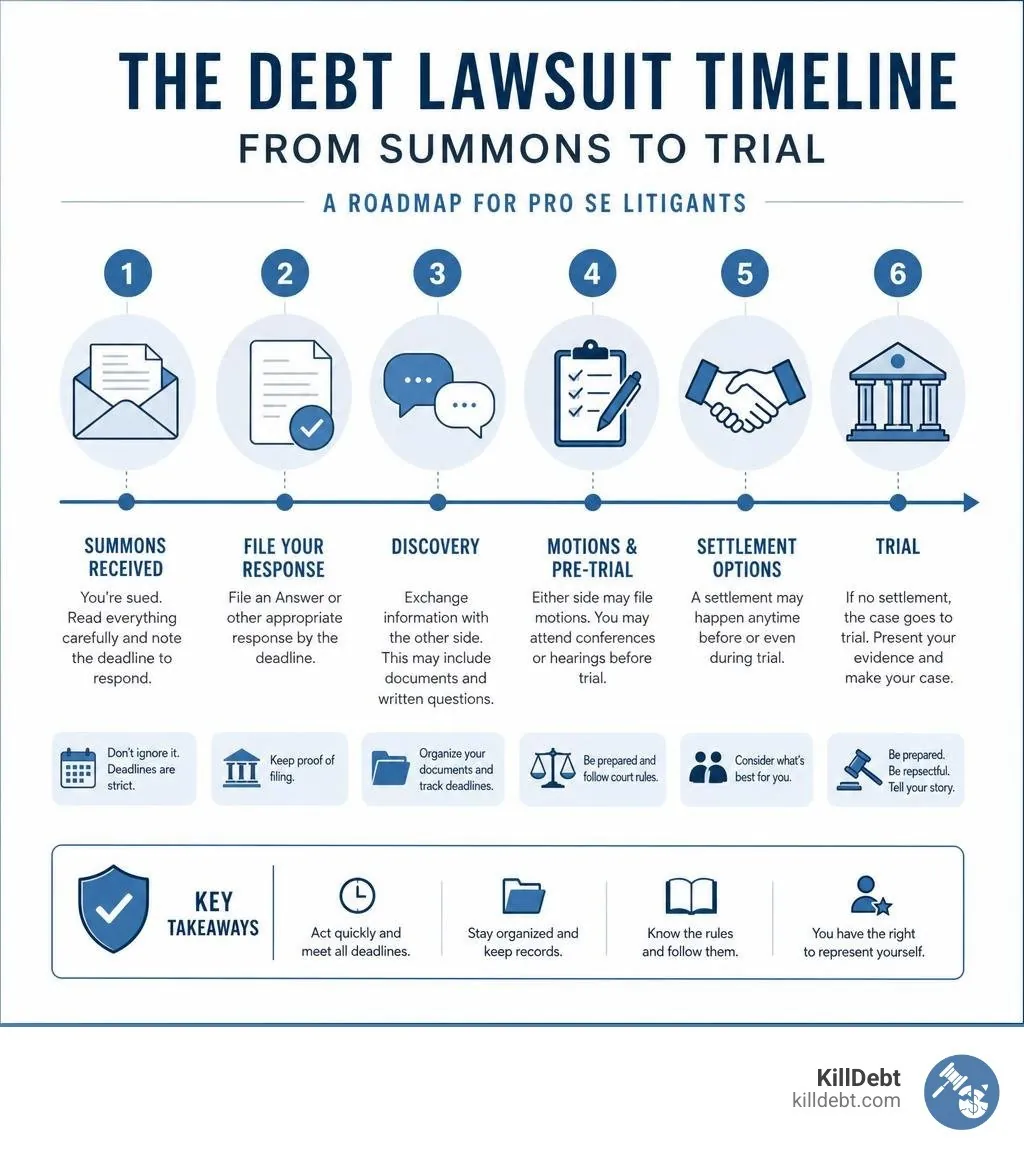
If you have just been served with a summons, your very first step is to read every single page immediately. Do not tuck it into a drawer hoping it will go away. Debt collectors rely on your panic and avoidance. In fact, up to 90% of debt collection lawsuits result in a default judgment simply because the consumer failed to respond. To prevent this, check out our What to Do When Sued by a Debt Collector Complete First Steps Guide.
Before you file any response or initiate a claim, you must understand three critical legal foundations:
If you are the one considering filing a lawsuit, always explore alternatives to litigation first. Can you settle the matter directly? Is there an administrative agency (like the CFPB for credit issues) that can intervene? Litigation is exhausting, expensive, and time-consuming. However, if you are the defendant, you do not have a choice: you must respond to protect your wages and assets.
When you walk into a courthouse or call the clerk's office, you will quickly discover that court staff are helpful but highly restricted. Under federal law (such as 28 U.S.C. § 955) and state rules, court clerks and librarians are strictly prohibited from giving legal advice.
Understanding this distinction is vital. If you ask a clerk, "What should I write in my answer?" they must refuse to answer. If you ask, "What is the deadline to file this answer?" they can easily give you the factual rule.
| Legal Information (Clerks Can Provide) | Legal Advice (Only Attorneys Can Provide) |
|---|---|
| Explaining court rules, definitions, and procedures | Recommending whether you should file a specific motion |
| Providing standard, approved court forms | Telling you what specific words to write in your form |
| Checking your case docket or filing status | Predicting how a judge will rule on your case |
| Explaining how to schedule a hearing | Interpreting a judge's order or explaining its impact on your rights |

Navigating the court system requires finding the precise rules that apply to your specific geographic location and court level. Whether you are in federal district court or a local state court, dedicated handbooks are available to guide you step-by-step.
For federal cases, a great starting point is the comprehensive Representing Yourself in Federal Court: A Handbook for Pro Se Litigants, which demystifies the complex Federal Rules of Civil Procedure (FRCP).
Federal courts are highly formal. If you are sued in or need to file a case in a federal district court, you must comply with both the nationwide FRCP and the "Local Rules" of your specific district.
To start a civil case in federal court, you must file a complaint accompanied by a Civil Cover Sheet and pay a filing fee (currently $405 in most districts). If you cannot afford this fee, you must file an application to proceed In Forma Pauperis (IFP). If the court approves your IFP application, your filing fees will be waived.
For those navigating appellate courts, resources like The Pro Se Handbook provide specialized guidance on how to appeal a ruling, draft briefs, and manage the appellate record without a lawyer.
Because KillDebt operates primarily in Michigan and Florida, we focus heavily on the rich self-help networks available in these states:
Even if you represent yourself, you don't have to do it in a vacuum. There are numerous organizations designed to help low-to-moderate-income individuals access legal assistance. Before assuming you must go entirely alone, read our guide on Do I Need a Lawyer for a Debt Collection Lawsuit to weigh your options.
If you need professional advice but cannot afford a private firm, look into these legal aid networks:
Using the wrong form can result in the court rejecting your filing, which could cause you to miss crucial deadlines. If you are responding to a debt lawsuit, you must use approved templates. We provide a General Denial Answer Form and a Sample Answer to Complaint to help you get started.
For step-by-step instructions on drafting your response, see our guides on How to Answer a Debt Summons, How to Write an Answer to a Credit Card Lawsuit, and Responding to Credit Card Lawsuit.
Most courts now require electronic filing (e-filing) through centralized portals like Odyssey eFileIL or state-specific equivalents.
However, many jurisdictions offer automatic or certifiable e-filing exemptions for pro se litigants who:
If you qualify, you can file a simple certification form to submit your documents on paper.
The days of spending hours waiting in a physical courtroom for a two-minute status conference are largely over. Many civil and debt collection hearings are now conducted remotely via platforms like Zoom.
If you are scheduled for a remote appearance, test your camera, microphone, and internet connection ahead of time. Dress professionally, find a quiet space, and remain muted until your case is called.
Courts are also legally required to provide equal access to justice. If you have limited English proficiency (LEP) or require disability accommodations, you have the right to request a court-appointed interpreter or ADA accommodations at no cost to you. Contact the court clerk's office as early as possible before your hearing to make these arrangements.
When drafting court documents, clarity is your superpower. Avoid trying to sound like a fictional TV lawyer. Do not load your documents with archaic "legalese" or copy-paste paragraphs you don't understand. State the facts clearly, use numbered paragraphs, and get straight to the point.
If you are sued by a debt collector, your first document is your Answer. In your Answer, you must respond to each numbered paragraph of the collector's complaint by admitting, denying, or stating that you lack sufficient knowledge to answer. For a complete blueprint on building your defense, read our Debt Lawsuit Defense Guide.
As your case progresses, you will likely participate in a Case Management Conference (CMC), where the judge sets a timeline for the case. This is followed by Discovery, the formal process where both sides exchange evidence. You can serve the plaintiff with:
Always keep meticulous, organized copies of every document you send or receive. Meet every deadline, and if you need more time, request an extension in writing before the deadline passes.
With the rise of generative AI tools like ChatGPT and Copilot, many pro se litigants are turning to technology to write their court briefs. While AI is an incredible tool for brainstorming, summarizing complex concepts, or polishing your grammar, using generic AI to draft legal documents carries massive risks.
Generic AI models do not "know" the law; they predict the next most likely word in a sentence. Because of this, they are prone to hallucinations — including fabricating entirely fake case law, inventing non-existent statutes, and misrepresenting real judicial decisions.
Under Federal Rule of Civil Procedure 11 (and state equivalents), you certify that every factual and legal claim you submit to the court is accurate to the best of your knowledge. If you submit a document containing fake cases generated by an AI, you can face severe financial sanctions, and the judge may throw out your case.
Furthermore, generic AI tools often store the data you enter. If you upload sensitive personal information, medical records, or financial statements, you may compromise your privacy.
If you use AI to help edit your documents, you must independently verify every single case citation, statute, and legal assertion using a reliable legal database.
Representing yourself in court can feel like walking a tightrope over a canyon. But with the right pro se litigant resources, you can stand your ground and defend your financial future.
At KillDebt, we believe that a lack of funds shouldn't mean a lack of justice. That's why we created a DIY legal defense system powered by ParkerGPT — an AI trained specifically on consumer debt law and real-world court strategies developed over 30+ years by veteran defense attorney Brian Parker.
Unlike generic AI tools that hallucinate fake cases, ParkerGPT analyzes your actual lawsuit documents, uncovers critical weaknesses in the debt collector's paperwork, and generates customized, court-ready responses.
Want to practice before you step into the courtroom? Our newly launched Court Tester provides an interactive AI courtroom simulation. You can upload your actual case filings and, within minutes, argue your motion in front of an AI judge, face off against an AI opposing counsel, and receive real-time, strategic whispers from a private AI co-counsel.
Don't let debt collectors win by default. Take control of your case today:
IMPORTANT LEGAL DISCLAIMER
This educational content is based on general legal principles and my experience in debt collection defense. It is provided for informational purposes only and does not constitute legal advice. Laws vary by state and by local court. For specific legal advice, consult a qualified attorney licensed in your jurisdiction. No attorney-client relationship is created by reading this guide.
Critical Multi-State Variations: FDCPA applies uniformly at the federal level, but state consumer protection laws may provide additional rights and remedies. Statute of limitations periods vary significantly by state and debt type. What constitutes sufficient debt validation varies in practice across jurisdictions. State-specific rules on call frequency, written notice requirements, and permissible collector conduct may differ from federal minimums.

About the author
Brian Parker
I have over 30 years of experience defending consumers against debt collection lawsuits and have seen every tactic, threat, and pressure play that collectors use. Through KillDebt and ParkerGPT, I have systematized the proven defense strategies that actually work - so consumers can respond from a position of knowledge, not fear. My approach focuses on aggressive legal defense based on documented case success rather than false hope that leads to default judgments.