News Break
Sue Your Debt Collector Without Breaking a Sweat
June 4, 2026
Blog / News Break
Learn how the homestead exemption debt shield protects your home equity from creditors and lawsuits in 2026.
The homestead exemption debt shield is one of the most powerful — and most misunderstood — legal protections available to American homeowners facing creditors.
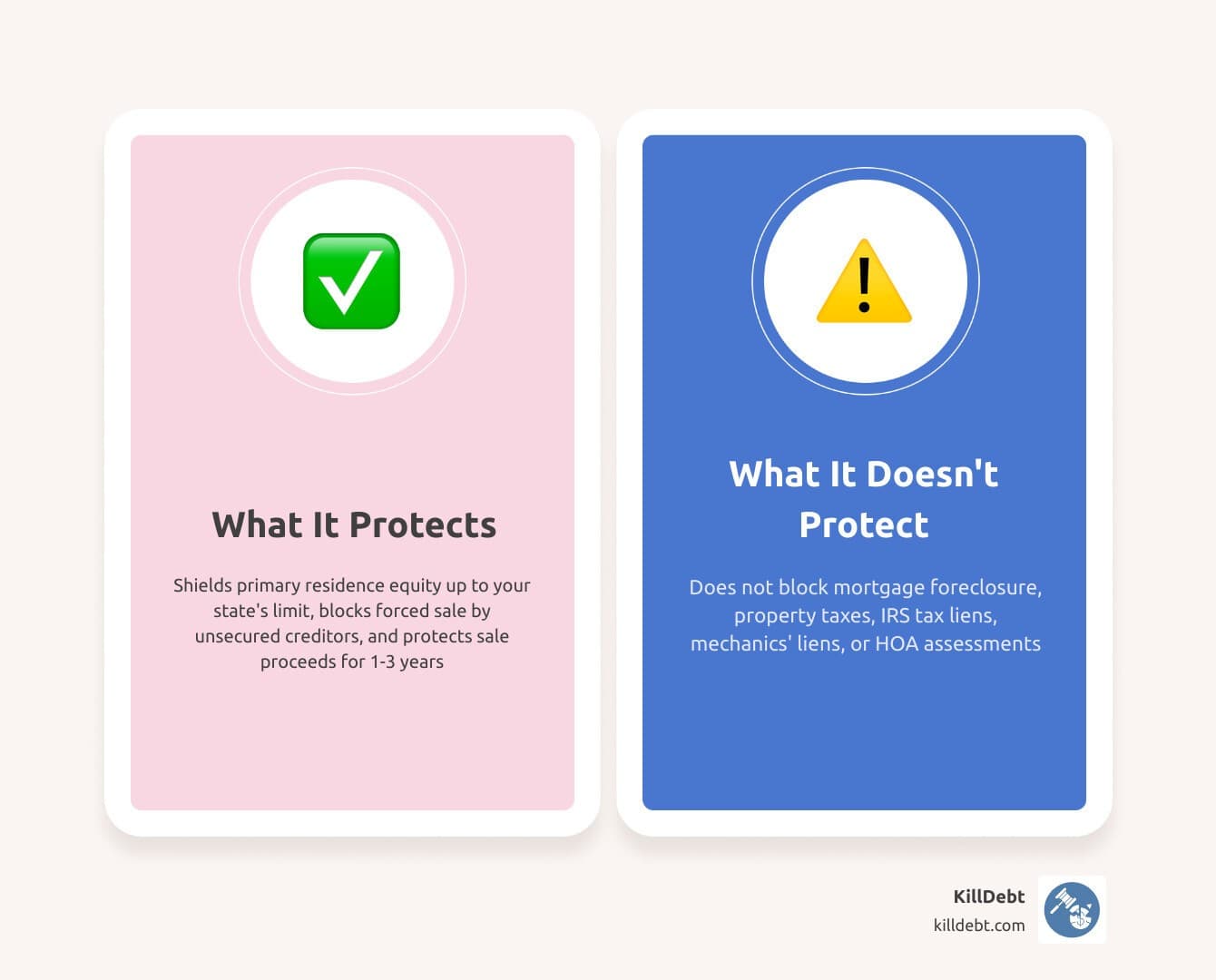
Here's the quick answer:
| What it does | What it doesn't do |
|---|---|
| Protects a set amount of home equity from unsecured creditors | Does NOT protect against your mortgage lender |
| Prevents forced sale of your primary residence (up to your state's limit) | Does NOT stop property tax liens |
| Shields equity in bankruptcy proceedings (Chapter 7 and Chapter 13) | Does NOT block IRS federal tax liens |
| Can protect sale proceeds for 1-3 years after selling | Does NOT cover vacation homes or rental properties |
The protection varies enormously by state:
If you just received a collection letter, a court summons, or a threat of wage garnishment, knowing whether your home equity is protected right now could be the most important thing you read today.
Most people only discover this shield exists when a creditor is already at the door — and by then, mistakes are easy to make. The O.J. Simpson case became a well-known example of someone deliberately relocating to Florida specifically to take advantage of that state's generous homestead protections. You don't have to be a celebrity to use this law. You just need to understand how it works before a judgment is entered against you.
I'm Brian Parker, and for over 30 years I've been in courtrooms across the country fighting debt collectors, debt buyers, and collection law firms — using the homestead exemption debt shield as one of the key tools to protect homeowners from losing what they've worked hardest for. At KillDebt, I've built the same strategies I used for thousands of clients into an AI-powered platform anyone can use, starting today.

In the simplest terms, a homestead exemption debt shield is a legal provision that prevents a creditor from seizing and selling your home to pay off a debt. Think of it as a "no-go zone" for debt collectors. When you own a home, you have "equity"—the difference between what the home is worth and what you owe on your mortgage. Creditors look at that equity like a pot of gold they can tap into if you stop paying your bills.
However, the law recognizes that losing a roof over your head is a catastrophic event. To prevent families from becoming homeless due to financial misfortune, states created homestead exemptions. This shield provides a level of judicial immunity. If a credit card company sues you and wins a judgment, they might try to put a lien on your house. But if your equity is below the state's exemption limit, they generally cannot force a sale of the property.
At KillDebt, we often see homeowners panic when they receive a summons, thinking their house is gone the next day. In reality, your homestead protection is a primary pillar of your defense. To learn more about how to handle the legal side of these threats, check out our Debt Lawsuit Defense Guide.
Activation depends entirely on where you live. In many states, such as Florida and Wisconsin, the protection is "automatic." The moment you move into a home and intend to make it your permanent residence, the shield is active. You don't need to file a special piece of paper with the court to prevent a creditor from taking your home equity, though you might need to file for a tax exemption separately.
Other states require a "Filed Declaration." In Massachusetts, for example, you have an automatic protection of $125,000, but you can increase that protection to a massive $1,000,000 by filing a simple declaration at the Registry of Deeds.
To see where your state stands in May 2026, refer to this Homestead Exemptions by State: Creditor Protection Comparison Chart (opens in a new tab). That "domicile rules" matter. You generally cannot buy a house in a high-protection state today and file for bankruptcy tomorrow to save it; federal law often requires you to have lived in the state for at least 730 days (two years) before you can use their specific state exemptions.
The "shield" isn't the same size in every state. Some states give you a small umbrella, while others give you a reinforced concrete bunker. As of May 2026, here is how some of the most notable states compare:
| State | Exemption Amount (Single/Joint) | Special Notes |
|---|---|---|
| Florida | Unlimited | Must be primary residence; acreage limits apply |
| Michigan | ~$46,000 - $69,000 | Adjusted for inflation; higher for elderly/disabled |
| California | $300,000 - $600,000 | Based on county median home prices |
| Colorado | $250,000 - $350,000 | Includes "dwellings" like trailers and tiny homes |
| Ohio | $125,000 - $250,000 | Per individual debtor |
| Wisconsin | $75,000 - $150,000 | Can be doubled for married couples |
| Nevada | $605,000 | One of the highest statutory limits |
In Michigan, where we have a strong presence, the exemption protects a modest but vital amount of equity. If you are facing a lawsuit in a state with lower limits, you might need to look into the 2026 Federal Homestead & Wildcard Exemptions (opens in a new tab) to see if the federal system offers better protection for your specific situation.
Seven states (and D.C.) are famous for providing "unlimited" homestead protection: Florida, Texas, Kansas, Iowa, Oklahoma, South Dakota, and Arkansas.
In Florida, for example, if your home is worth $10 million and you own it free and clear, a credit card company cannot touch a penny of that equity. However, there are "acreage limits." In Florida, you only get unlimited protection for up to half an acre within a municipality (city) or up to 160 acres in a rural area.
There is also the "1,215-day rule." Under federal bankruptcy law, if you haven't owned your home in an unlimited state for at least 1,215 days (about 3.3 years), your protection in bankruptcy may be capped at a federal limit (currently $214,000 for 2026) to prevent people from "mansion-crashing" into Florida just to hide money from creditors.
It is a common myth that a homestead exemption makes your home untouchable by everyone. That is simply not true. Your homestead exemption debt shield is designed to block unsecured creditors—people you didn't specifically give a "security interest" to, like credit card companies, medical billers, or personal loan lenders.
The shield has cracks when it comes to "Statutory" or "Consensual" liens:
If you're worried about collectors coming after other parts of your life, you should read our guide: Can debt collectors take my wages and bank account?
Beyond taxes and mortgages, there are other "super debts" that can pierce the shield. Obligations like child support and spousal maintenance (alimony) are often exempt from homestead protections. The law prioritizes the welfare of children over the property rights of the debtor.
Additionally, if you bought your home with embezzled funds or committed fraud, the court can "disregard" the homestead protection. You cannot use the law to hide the "fruits of a crime." For more on what will and won't protect you, see our article on Debt collection lawsuit myths: 7 things that won't save you.
Bankruptcy is where the homestead exemption debt shield truly shines. When you file for bankruptcy, you must list all your assets on "Schedule C" and claim your exemptions.
For a deeper dive into these rules, check out the Homestead Bankruptcy Exemption 2026: Home Equity Protection (opens in a new tab). For 2026, the federal bankruptcy cap is $214,000 for those who haven't met the 40-month domicile residency requirement.
In some states, you get to choose between using the State exemptions or the Federal exemptions. You cannot "mix and match"—you have to pick one "bucket" and stick with it.
For 2026, the Federal Homestead Exemption is $31,575. If you are a married couple filing jointly, you can double that to $63,150.
Why would someone choose the lower federal amount? Because of the "Wildcard." The federal system allows you to take any unused portion of your homestead exemption (up to about $15,800) and apply it to anything else—like cash in the bank or a second car. If you live in a state like Florida, you are "opted out" of the federal system and must use the state's unlimited homestead, which is usually a much better deal anyway.
If you're wondering what the next steps are after being served, read about What happens after a summons.
If you've received a summons, the clock is ticking. In many states, you have only 20 days to respond. If you do nothing, the creditor gets a "default judgment," which is like giving them a key to your financial life.
Your home is more than just an asset; it's your sanctuary. The homestead exemption debt shield is the legal wall that keeps that sanctuary safe from the storms of debt. Whether you are in Florida with unlimited protection or Michigan with more modest limits, understanding these laws is the first step toward financial defense.
At KillDebt, we don't believe you should have to spend $5,000 on an attorney just to protect your own home. I’ve taken my 30+ years of experience and poured it into ParkerGPT, our AI legal assistant. It doesn't just give you templates; it analyzes your specific lawsuit documents and helps you build a real defense.
We’ve also just rolled out the Court Tester, an AI courtroom simulation. You can upload your actual filings and "practice" your arguments against an AI opposing counsel before you ever step foot in a real courtroom. Don't let a debt collector's summons bully you into losing your equity.
Protect your home and resolve your debt today with the tools and strategies used by the pros. You have the shield—we'll help you learn how to hold it.

About the author
Brian Parker
I have over 30 years of experience defending consumers against debt collection lawsuits and have seen every tactic, threat, and pressure play that collectors use. Through KillDebt and ParkerGPT, I have systematized the proven defense strategies that actually work - so consumers can respond from a position of knowledge, not fear. My approach focuses on aggressive legal defense based on documented case success rather than false hope that leads to default judgments.