
News Break
Florida Debt Lawsuits: Know Your Rights Before You Go to Court
July 1, 2026
Blog / News Break
Master breach of contract defense strategies to protect your rights when facing a summons or debt collection lawsuit.
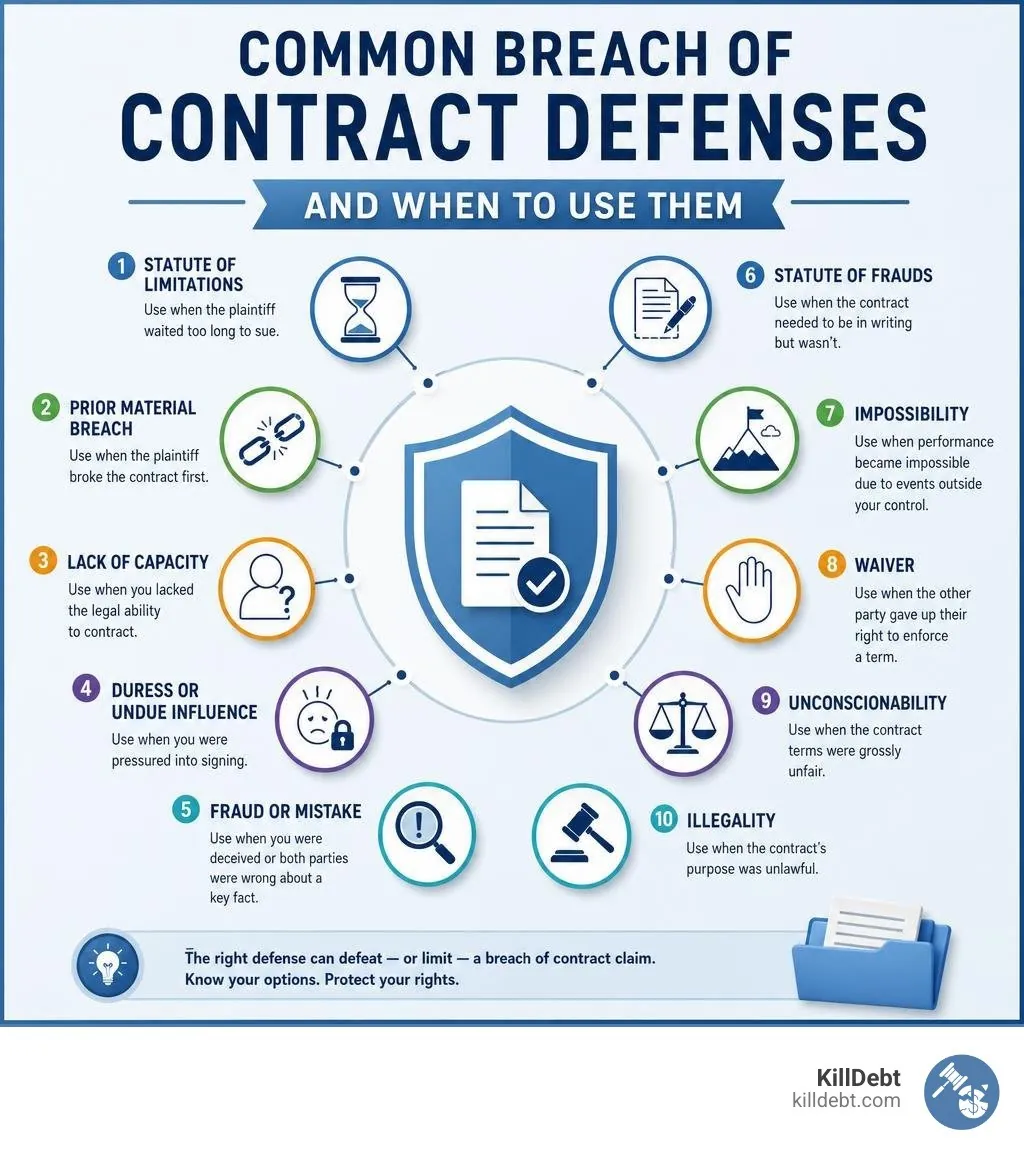
A breach of contract defense is any legal argument that defeats — or limits — a claim that you failed to meet your contractual obligations. If you've just been served with a summons or collection lawsuit, here are the most common defenses at a glance:
| Defense | What It Means |
|---|---|
| Statute of Limitations | The plaintiff waited too long to sue |
| Prior Material Breach | The plaintiff broke the contract first |
| Lack of Capacity | You lacked the legal ability to contract |
| Duress or Undue Influence | You were pressured into signing |
| Fraud or Mistake | You were deceived or both parties were wrong about a key fact |
| Statute of Frauds | The contract needed to be in writing but wasn't |
| Impossibility | Performance became impossible due to events outside your control |
| Waiver | The other party gave up their right to enforce a term |
| Unconscionability | The contract terms were grossly unfair |
| Illegality | The contract's purpose was unlawful |
Being sued for breach of contract is stressful — especially when you're already dealing with debt collectors, confusing legal documents, and tight deadlines. But being sued doesn't mean you've lost. The law gives defendants real tools to fight back, and many claims fall apart when the right defenses are raised.
This guide walks you through every major defense category, how they work in practice, and what you can do right now to protect yourself.
I'm Brian Parker, founder of KillDebt, and over 30 years of fighting debt buyers and collection law firms in courtrooms across the country has shown me exactly how powerful a well-timed breach of contract defense can be. Whether you're facing a credit card lawsuit or a complex commercial dispute, the strategies in this guide are drawn from the same playbook I've used to protect thousands of consumers.
Before you can build a strong breach of contract defense, you must first understand what the other side has to prove. In any contract lawsuit, the burden of proof rests squarely on the plaintiff (the party suing you). If they cannot prove every single element of their claim, the court must dismiss the case.
To establish a valid claim, a plaintiff must show that a legally binding agreement existed, that they fulfilled their own end of the bargain, that you failed to fulfill yours, and that this failure directly caused them financial harm.
For example, under the Michigan breach of contract elements, a plaintiff must establish that a contract existed, that the defendant breached its terms, and that the plaintiff suffered damages as a result. Similarly, when determining What Constitutes a Breach of Contract in Florida?, courts require proof of a valid contract, a material breach, and resulting damages.
If you are facing a lawsuit from a credit card company or a debt collector, they cannot simply claim you owe them money; they must produce the actual contract or account agreement that binds you. If you need immediate help understanding how to handle these claims, check out our guide on More info on responding to a debt lawsuit.
For a contract to be legally enforceable, it must contain five core elements. If even one of these is missing, no contract ever existed in the eyes of the law:
In Michigan, the Contracts - Michigan Courts benchbook emphasizes that mutual assent (a "meeting of the minds") on all essential terms is absolutely required for formation. If the terms are too vague or indefinite, the agreement is unenforceable.
In consumer debt cases, plaintiffs — especially third-party debt buyers — fail to prove their claims surprisingly often. They routinely suffer from:

When you are served with a lawsuit, you cannot just show up to court and tell your story. You must file a formal written response called an "Answer." In this document, you must specifically state your affirmative defenses. If you do not raise them in your initial Answer, the court may rule that you have waived them forever.
To protect your rights, you must act quickly. Learn how to write an answer to a credit card lawsuit to ensure you do not miss critical procedural steps.
One of the most powerful defenses available is the Statute of Limitations. This is a strict legal deadline for filing a lawsuit. If the plaintiff files even one day after this deadline, the case is dead on arrival.
The deadline depends on the state and whether the contract was written or oral:
If a debt buyer tries to sue you on an old credit card debt that has been inactive for years, checking these dates is your first line of defense. For a complete breakdown of state-by-step timelines, consult our Debt Lawsuit Defense Guide.
If the party suing you broke the contract first, you may be legally excused from performing your duties. This is known as a prior material breach.
For example, if you hired a contractor to remodel your kitchen, and they walked off the job halfway through, they cannot sue you for failing to pay the final installment. Their failure to complete the work was a material breach that excused your obligation to pay. Under New York common defenses, a party who commits a material breach cannot turn around and sue the other party for non-performance.
In credit card and consumer debt contexts, if the creditor unilaterally changed your interest rate or terms in violation of the original agreement, you may have grounds to raise this defense. Discover more advanced tactics in our Defending Credit Card Lawsuit Guide 2026.
Sometimes, the best breach of contract defense is showing that a valid contract was never actually formed in the first place. If the agreement itself is legally defective, the court cannot enforce it.
If you are drafting your response, reviewing the official Florida contract defenses list can help you identify which formation defects apply to your situation. For a step-by-step walkthrough on raising these, read our guide on how to answer a debt summons.
A contract requires the free will and understanding of both parties. If those are absent, the contract is void or voidable:
If the agreement was built on lies or gross unfairness, the law will not back it up:
The law requires certain agreements to be in writing to prevent fraud:
Even if a valid contract was formed, supervening events or procedural mistakes by the plaintiff can completely defeat a breach of contract claim.
Whether you are looking at Kentucky contract defenses or local rules in Michigan and Florida, understanding how to excuse non-performance is a core part of a winning court debt defense strategy.
These defenses apply when unexpected, massive events make performing the contract radically different from what was agreed upon:
Sometimes, the parties' own actions change their legal duties:
These defenses focus on the legal rules of the courtroom:
Facing a breach of contract lawsuit can feel overwhelming, but you do not have to navigate the complex legal system alone or spend thousands of dollars on a defense attorney.
At KillDebt, we provide a DIY legal defense system powered by ParkerGPT — an AI trained specifically on consumer debt law and real-world court strategies developed over 30+ years by myself, attorney Brian Parker. Unlike generic AI tools, ParkerGPT analyzes your actual lawsuit documents, identifies critical weaknesses in the plaintiff's case, and generates court-ready written answers and motions customized to your jurisdiction.
To give you complete confidence before you step foot in a courtroom, we recently rolled out our brand-new Court Tester. This cutting-edge tool is an AI courtroom simulation built on your actual case. By simply uploading your filings, you can practice arguing your motions in front of an AI judge, face off against an AI opposing counsel, and receive private, real-time strategy tips from an AI co-counsel.
Protect your wages, defend your bank accounts, and take control of your financial future. Explore our affordable subscription plans on our KillDebt Pricing page and start building your defense today.
IMPORTANT LEGAL DISCLAIMER
This educational content is based on general legal principles and my experience in debt collection defense. It is provided for informational purposes only and does not constitute legal advice. Laws vary by state and by local court. For specific legal advice, consult a qualified attorney licensed in your jurisdiction. No attorney-client relationship is created by reading this guide.
Critical Multi-State Variations: FDCPA applies uniformly at the federal level, but state consumer protection laws may provide additional rights and remedies. Statute of limitations periods vary significantly by state and debt type. What constitutes sufficient debt validation varies in practice across jurisdictions. State-specific rules on call frequency, written notice requirements, and permissible collector conduct may differ from federal minimums.

About the author
Brian Parker
I have over 30 years of experience defending consumers against debt collection lawsuits and have seen every tactic, threat, and pressure play that collectors use. Through KillDebt and ParkerGPT, I have systematized the proven defense strategies that actually work - so consumers can respond from a position of knowledge, not fear. My approach focuses on aggressive legal defense based on documented case success rather than false hope that leads to default judgments.