
News Break
Paying Off Your Fines Before the Collection Agency Calls
April 18, 2026
Blog / News Break
Can a debt collection agency take you to court? Learn your rights, respond to summons, beat lawsuits & avoid judgments.
Can a debt collection agency take you to court? Yes — and it happens more often than most people realize. Here's what you need to know upfront:
Quick Answer:
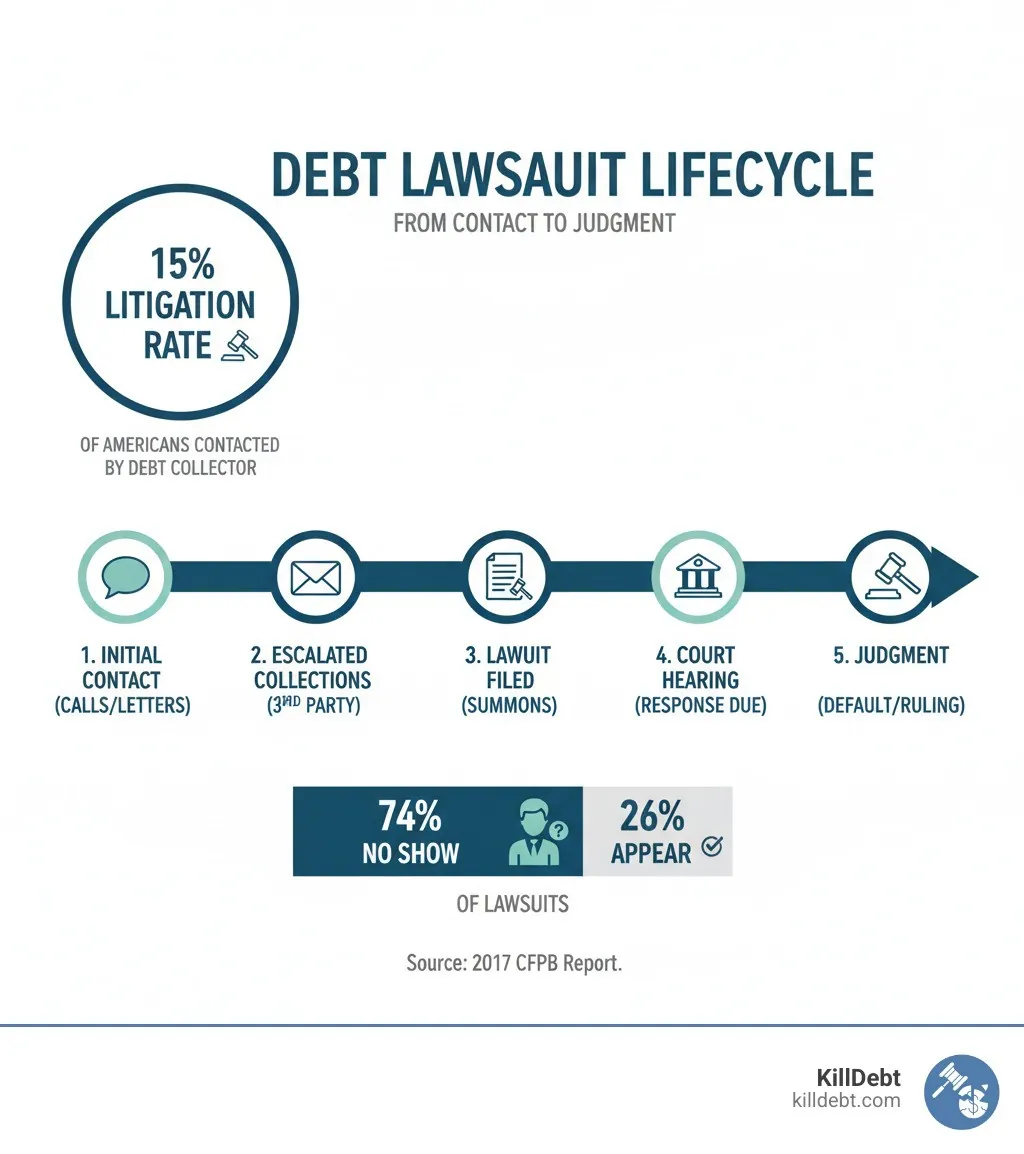
Most people don't think a lawsuit is coming until the papers land in their hands. And that shock is completely understandable — but it's also dangerous. According to a 2017 CFPB report, roughly 15% of Americans contacted by a debt collector have been sued. Of those, only 26% showed up to their court hearing. That means the vast majority lost automatically — not because they didn't have a defense, but because they didn't respond.
The good news: responding to a lawsuit does not mean admitting you owe the debt. It simply forces the collector to prove their case. And that's a bar many of them struggle to clear.
This guide breaks down exactly how debt collection lawsuits work, what your rights are, and what steps to take if you've been served — even if you can't afford an attorney.

The short answer is a resounding yes. If you have an outstanding balance that has gone unpaid for several months, the entity holding that debt has the legal standing to file a civil lawsuit against you. However, "who" is suing you matters just as much as "why" they are suing.
In debt, there are two main players who might drag you into a courtroom. First, there is the original creditor—the bank, credit card company, or medical provider you initially did business with. Second, there are debt buyers. These are companies that purchase "charged-off" debts for pennies on the dollar. Once they buy the debt, they own the right to collect it, which includes the right to sue you. Understanding Who is Suing Me? Original Creditor vs. Debt Buyer Explained is crucial because debt buyers often lack the original paperwork required to prove their case in court.
According to the Debt Collection FAQs from the Federal Trade Commission (opens in a new tab), a collector cannot legally threaten to sue you if they have no intention of doing so. However, if the debt is large enough and they believe you have assets or a steady paycheck, a lawsuit becomes a very real "trigger" in their collection strategy.
When you signed up for that credit card or took out that loan, you entered into a legal contract. By failing to pay, you are technically in breach of contract.
Once a debt is "charged off" (usually after 180 days of non-payment), the original creditor writes it off as a loss for tax purposes. But don't be fooled—the debt hasn't vanished. They often sell the account to a collection agency. If you've been sued by a debt collector, they are essentially asking a judge to turn that private contract into a court-ordered judgment. This judgment acts as a "super-powered" collection tool that allows them to use the state's resources to get their money.
Collectors don't sue everyone. It’s a business decision based on math. They look at:
Data shows that consumer debt lawsuits are surging again in 2024-2025, as collectors use increasingly automated systems to file thousands of cases at once, hoping you won't show up to defend yourself.
One of the most powerful defenses against the question of can a debt collection agency take you to court is the Statute of Limitations. This is a state-mandated "expiration date" on the collector's right to sue you.
In our neck of the woods, the rules vary:
If a collector sues you for a debt where the last activity was 10 years ago, that is considered time-barred debt. However, the court won't magically know the debt is too old. You must raise the statute of limitations as an affirmative defense in your response.
Warning: Be extremely careful about talking to collectors on old debts. In many states, making even a $5 "good faith" payment or acknowledging in writing that you owe the debt can "restart the clock," giving the collector a brand-new window of time to sue you.
If a process server knocks on your door or you receive a certified letter from the court, do not panic—but do not wait. You have just been "served" with a Summons and Complaint.
The Summons is the notice telling you that you are being sued and where the court is located. The Complaint lists the specific allegations (e.g., "The defendant owes $5,400 to XYZ Bank").
You have a very limited time to respond to a debt collection lawsuit:
It is vital to understand the difference between a summons and a complaint. The Complaint is where the collector makes their claims; your job is to respond to those claims paragraph by paragraph. As the Consumer Financial Protection Bureau advises (opens in a new tab), ignoring these papers is the worst thing you can do.
Responding involves filing a formal document called an Answer. In your Answer, you shouldn't just tell your life story or explain why you couldn't pay. Instead, you should:
For a more in-depth look, check out our Complete First Steps Guide.
If you ignore the lawsuit, the collector will ask the judge for a Default Judgment. This is essentially an automatic win for the collector. Once they have a judgment, they transition from a "debt collector" to a "judgment creditor," and they gain terrifying new powers.
There are many debt collection lawsuit myths out there—like the idea that they can't touch you if you're unemployed. In reality, a judgment can follow you for a decade or more, accruing interest the entire time.
| Power | Before Court Judgment | After Court Judgment |
|---|---|---|
| Phone Calls/Letters | Yes (subject to FDCPA) | Yes |
| Credit Reporting | Yes | Yes (Judgment adds more damage) |
| Wage Garnishment | NO | YES (Up to 25% of take-home pay) |
| Bank Account Levy | NO | YES (They can take every penny) |
| Property Liens | NO | YES (Prevents selling/refinancing home) |
While a debt collection agency can take you to court, they aren't allowed to break the law to get there. The FDCPA is a federal law that protects you from:
In Michigan, MCL Section 445.251 (opens in a new tab) provides additional state-level protections against "unregulated collection practices." If a collector violates these laws, you might be able to countersue them for statutory damages of up to $1,000 plus your attorney fees. Understanding the debt collection lawsuit timeline helps you spot these violations as they happen.
We know that facing a lawsuit feels like a David vs. Goliath battle. The collectors have high-priced attorneys and automated systems; you just have your kitchen table and a lot of stress. That’s why we created KillDebt.
Our DIY legal defense system is powered by ParkerGPT, an AI trained specifically on consumer debt law and real-world court strategies developed over 30+ years by attorney Brian Parker. Unlike generic AI, ParkerGPT understands the specific nuances of Michigan and Florida law. It can analyze your lawsuit documents, identify legal weaknesses in the collector's claims, and generate court-ready responses for a fraction of the cost of an attorney.
We’ve even introduced the Court Tester—an AI courtroom simulation. You can upload your actual filings and "rehearse" your case against an AI opposing counsel. While you argue, a private AI co-counsel whispers strategies to you that only you can see.
Don't let a debt collector win by default. You have rights, you have defenses, and now, you have the technology to fight back.
Ready to take control? Visit https://killdebt.com/ to start your defense today.

About the author
Brian Parker
I have over 30 years of experience defending consumers against debt collection lawsuits and have seen every tactic, threat, and pressure play that collectors use. Through KillDebt and ParkerGPT, I have systematized the proven defense strategies that actually work - so consumers can respond from a position of knowledge, not fear. My approach focuses on aggressive legal defense based on documented case success rather than false hope that leads to default judgments.