
News Break
How to Write a Credit Collection Letter That Actually Works
June 23, 2026
Blog / News Break
Learn how to respond to a business debt collection suit with proven defenses, deadlines, and strategies to protect your company.
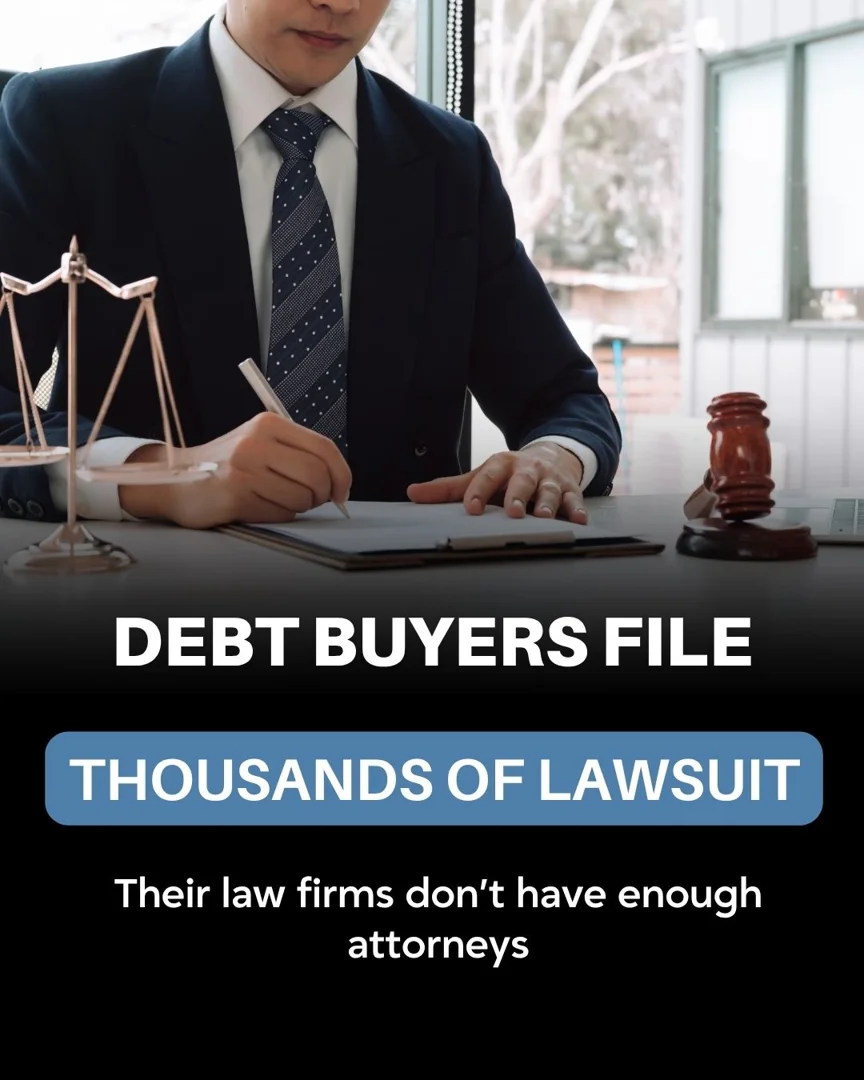
A business debt collection suit is a legal action filed by a creditor or debt collector to recover money owed by a business — and if you've just been served with a summons, the clock is already ticking.
Quick answer: What should you do right now?
The stakes are real. If a creditor wins, they can pursue wage garnishment, bank levies, or liens against your assets. And it happens faster than most people expect.
But here's what many business owners don't realize: winning a lawsuit is not automatic for the plaintiff. They have to prove they own the debt, that you owe it, and that the amount is correct. That's three things they can get wrong — and each one is a potential defense for you.
This guide walks you through exactly how to defend yourself, step by step, without needing to spend thousands on an attorney before you even understand what you're up against.
I'm Brian Parker, founder of KillDebt, and I've spent over 30 years in the courtroom fighting creditors, debt buyers, and collection law firms — including in business debt collection suit cases across the country. I've seen every tactic collectors use, and I built this platform to put those same defense strategies in your hands.
IMPORTANT LEGAL DISCLAIMER
This educational content is based on general legal principles and my experience in debt collection defense. It is provided for informational purposes only and does not constitute legal advice. Laws vary by state and by local court. For specific legal advice, consult a qualified attorney licensed in your jurisdiction. No attorney-client relationship is created by reading this guide.
Critical Multi-State Variations: FDCPA applies uniformly at the federal level, but state consumer protection laws may provide additional rights and remedies. Statute of limitations periods vary significantly by state and debt type. What constitutes sufficient debt validation varies in practice across jurisdictions. State-specific rules on call frequency, written notice requirements, and permissible collector conduct may differ from federal minimums.
A business debt collection suit is a formal civil lawsuit initiated by a creditor, lender, or third-party debt buyer against a business entity (and sometimes its owners) to recover an outstanding commercial obligation. Unlike consumer debt, which is incurred primarily for personal, family, or household purposes, commercial debt arises from business operations, vendor agreements, commercial leases, or business credit lines.

When your business falls behind on vendor invoices, commercial loans, or business credit cards, creditors do not just disappear. If internal collection efforts fail, they often sell the account to a debt buyer or hire a collection law firm to file a lawsuit.
Understanding how liability works in these suits is critical:
Before you panic, you have options and rights. You can learn the fundamentals of building your defense in our comprehensive Debt Lawsuit Defense Guide.
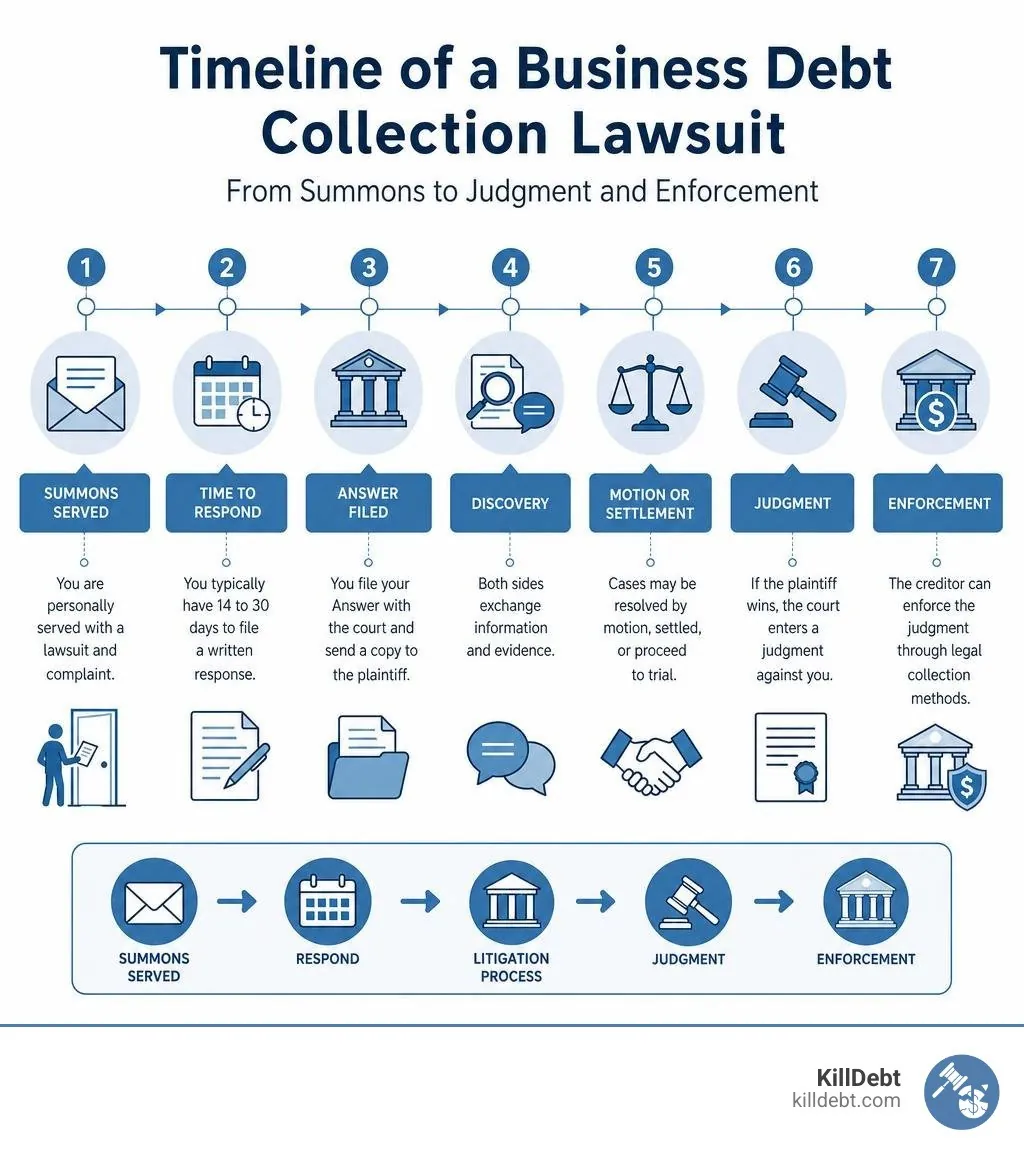
The day you are served with a lawsuit is the day the countdown begins. The worst mistake you can make is throwing the papers in a drawer and hoping they go away. If you ignore the lawsuit, the plaintiff will file for a default judgment.
A default judgment means the creditor wins automatically. With a judgment in hand, they can freeze your business bank accounts, garnish your personal wages (if you are personally liable), and place liens on your property. To prevent this, you must act decisively. For a detailed breakdown of what to do immediately, see our guide on Sued for a Debt? Here's Exactly What to Do in the First 7 Days.
When you are served, you will receive two primary legal documents: the Summons and the Complaint.
To dive deeper into how these documents function and what to look for, read our article on the Difference Between Summons & Complaint in Debt Collection Lawsuit.
Your deadline to respond is set by state law and begins the day after you are formally served.
Missing this deadline by even a single day can trigger a default. Calculate your exact response window carefully, and learn more about tracking these critical timelines in our guide on the Time to Respond Debt Collection Lawsuit.
In a business debt collection suit, the plaintiff (the creditor or debt buyer) bears the burden of proof. They must legally prove three fundamental elements to win their case:
If they cannot prove all three with admissible evidence, their case falls apart. This is especially true when dealing with third-party debt buyers who purchase charged-off business accounts in bulk. These buyers often lack the original contracts, payment histories, or assignment paperwork needed to establish a clean "chain of custody." Learn how to identify who is pursuing you in our article Who is Suing Me? Original Creditor vs. Debt Buyer Explained.
"Standing" is the legal right to initiate a lawsuit. If a debt has been sold multiple times, the plaintiff must prove they own your specific account by producing signed purchase agreements and bills of sale for every transfer.
Even in complex commercial disputes, standing and the precise wording of contracts dictate who has a possessory interest in disputed funds. For instance, in commercial leasing and finance disputes, courts strictly evaluate whether a party has a possessory right to collateral or security deposits before allowing conversion or collection claims to proceed, as highlighted in federal rulings like Nitel, Inc. v. Cerberus Business Finance, LLC et al, No. 1:2021cv05996 - Document 78 (S.D.N.Y. 2022) . If the plaintiff cannot prove they own the contract or the debt, you can move to dismiss the suit for lack of standing.
The statute of limitations is the legal expiration date for filing a lawsuit to collect a debt. Once this window closes, the debt becomes "time-barred," and suing you for it is a violation of your rights.
Be incredibly careful: the "clock" generally starts from the date of your last payment or written acknowledgment of the debt. Making even a tiny partial payment or signing a document admitting you owe the money can reset the clock, giving the creditor a brand-new window to sue you. If you are facing an old claim, review your local court procedures using resources like Going to Court to Defend a Debt Collection Case | Michigan Legal Help.
When a business debt escalates, both creditors and debtors have different paths they can take. Understanding these paths helps you anticipate the plaintiff's next moves and choose your own strategy.
| Option | Cost Level | Representation | Best For | Key Risks / Downsides |
|---|---|---|---|---|
| Collection Agency | Moderate (typically 33% contingency fee) | Non-legal collectors | Out-of-court collections, early-stage delinquency | No legal power to force payment; cannot issue judgments |
| Small Claims Court | Low ($50 - $100 filing fees) | Self-representation (often required or encouraged) | Claims under local limits (e.g., up to $10,000) | Limited discovery; quick judgments can be hard to appeal |
| Hiring a Lawyer | High ($250 - $500+/hour or contingency) | Professional attorney | Complex commercial litigation, high-value disputes | Legal fees can quickly exceed the total value of the debt |
Deciding whether to hire professional representation is a major financial decision. Discover when it makes sense to go it alone or bring in counsel in our guide: Do I Need a Lawyer for a Debt Collection Lawsuit?.
Many business owners assume they have no rights when a collector calls. While it is true that the federal Fair Debt Collection Practices Act (FDCPA) primarily protects consumers rather than commercial entities, you are not entirely defenseless.
First, if you are personally sued under a personal guarantee, the line between business and consumer debt can sometimes blur depending on how the funds were used. Second, state-specific laws offer broader protections.
For example, in Florida, the Florida Consumer Collection Practices Act (FCCPA) protects individuals from abusive collection tactics, regardless of whether the debt is commercial or personal. Under state regulations, collectors cannot harass you, call you at unreasonable hours (before 8 a.m. or after 9 p.m.), or threaten legal action they do not intend to take. You can learn more about state-level protections through the How to Protect Yourself: Debt Collections | My Florida Legal portal.
If your business is facing overwhelming liabilities, filing for bankruptcy protection triggers an automatic stay.
The automatic stay is a powerful legal shield that immediately halts all active collection efforts, including pending business debt collection suit proceedings, bank levies, and foreclosure actions. Under Chapter 11 (or Chapter 11, Subchapter V for small businesses), you can restructure your business debts and continue operating while paying off creditors under a court-approved plan. Under Chapter 7, the business assets are liquidated to pay down creditors, bringing a formal end to the entity and its liabilities.
Defending your business against a lawsuit doesn't have to bankrupt you. At KillDebt, we provide a powerful, DIY legal defense system built around ParkerGPT — an AI trained on real-world debt collection defense strategies developed over 30+ years by veteran attorney Brian Parker.

Instead of paying thousands of dollars in hourly attorney fees, you can upload your lawsuit documents to ParkerGPT. Within minutes, our AI analyzes the filing, spots structural weaknesses in the plaintiff's case, and generates customized, court-ready responses with step-by-step instructions.
To make sure you are completely prepared, we recently introduced the Court Tester — an immersive AI courtroom simulation built directly from your actual case documents. With Court Tester, you can practice arguing your motions in front of an AI judge, face off against an AI opposing counsel, and receive real-time strategic advice from a private AI co-counsel.
You don't have to let creditors dictate your business's future. Check out our straightforward KillDebt Pricing to find the right defense tools for your budget and start fighting back today.
IMPORTANT LEGAL DISCLAIMER
This educational content is based on general legal principles and my experience in debt collection defense. It is provided for informational purposes only and does not constitute legal advice. Laws vary by state and by local court. For specific legal advice, consult a qualified attorney licensed in your jurisdiction. No attorney-client relationship is created by reading this guide.
Critical Multi-State Variations: FDCPA applies uniformly at the federal level, but state consumer protection laws may provide additional rights and remedies. Statute of limitations periods vary significantly by state and debt type. What constitutes sufficient debt validation varies in practice across jurisdictions. State-specific rules on call frequency, written notice requirements, and permissible collector conduct may differ from federal minimums.

About the author
Brian Parker
I have over 30 years of experience defending consumers against debt collection lawsuits and have seen every tactic, threat, and pressure play that collectors use. Through KillDebt and ParkerGPT, I have systematized the proven defense strategies that actually work - so consumers can respond from a position of knowledge, not fear. My approach focuses on aggressive legal defense based on documented case success rather than false hope that leads to default judgments.