
News Break
How to Defend My Debt the Right Way
June 19, 2026
Blog / News Break
Resolve court-ordered debt collections franchise tax board fast with wage garnishment and bank levy defense strategies.

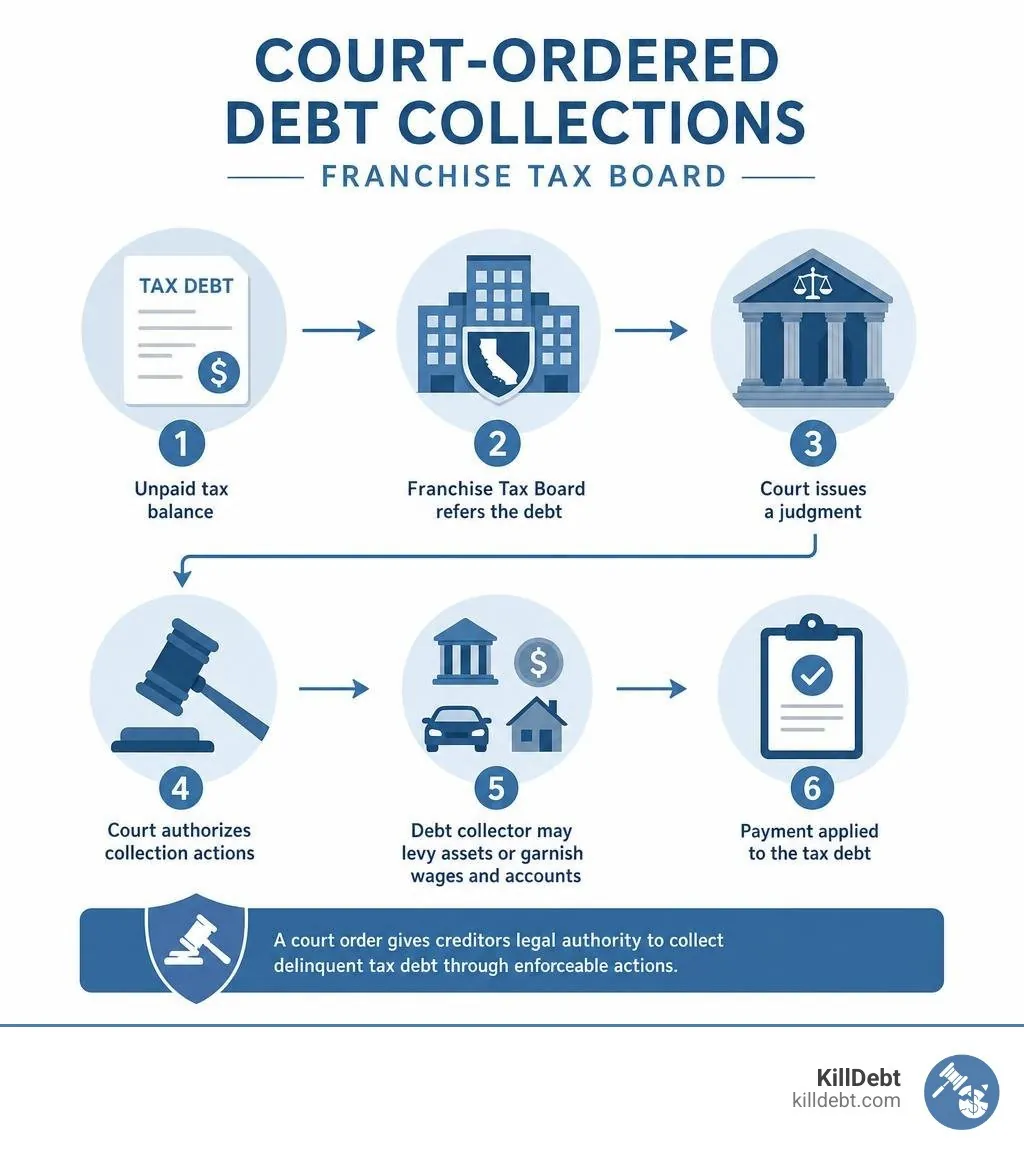
When you deal with court-ordered debt collections Franchise Tax Board, you aren't just dealing with a local clerk's office anymore. You are dealing with a state agency that has been given massive authority. Since 2004, the Court-Ordered Debt (COD) program has been a permanent fixture in California, involving participation from all 58 counties.
The legal "teeth" behind this program come from California Revenue and Taxation Code (R&TC) Sections 19280 through 19282. These laws basically say: "If someone owes the court money, the FTB can go get it as if it were an unpaid tax liability."
For a case to be handed over to the FTB, it usually meets three criteria:
You can find more specifics on their authority at the official Court-ordered debt collections | FTB.ca.gov page.
The FTB doesn't just collect income tax. Under the COD program, they handle a wide variety of "non-tax" debts that started in a courtroom. Common examples include:
Sometimes, you might get a letter from a private company instead of a government envelope. The FTB and various Superior Courts (like Orange County) often use outside collection vendors to assist in the process.
Common vendors include AllianceOne and Linebarger Goggan Blair & Sampson. If your debt has been referred to one of these agencies, you may need to coordinate your payments or disputes directly through them. However, if they fail to collect, the debt often bounces back to the FTB for more aggressive "involuntary" actions like garnishment.
This is where things get serious. Unlike a credit card company that has to sue you and win a judgment before they can touch your paycheck, the court-ordered debt collections Franchise Tax Board process is administrative. They already have the "order" from the court.
If you don't pay voluntarily, the FTB uses two primary weapons:
If you're worried about your paycheck, check out our guide on Can Debt Collectors Take My Wages and Bank Account for a deeper dive into your rights.
Before the FTB can just reach into your bank account, they have to follow "due process." This usually starts with a Demand for Payment notice.
Once that notice is sent, you typically have a 10-day window to resolve the debt or set up a plan. If you ignore this notice, the FTB will move to involuntary actions. For wage garnishments (EWOs), you generally have at least 15 days from the time your employer receives the notice before the money actually starts being deducted, giving you a very small window to fight back.
The FTB also has a "Continuous Order to Withhold." This is often used for people who aren't traditional W-2 employees. A COTW can attach to:
These orders can stay in effect for up to 12 months, catching any money that comes your way through third-party payers until the debt is satisfied.
Ignoring the FTB is like ignoring a hornets' nest in your mailbox—it only gets worse. Here is how to handle it step-by-step.
The fastest way to see what you owe is to use the My Court-Ordered Debt Account login. You will need:
The FTB offers several ways to pay, which you can review at Pay your court-ordered debt | FTB.ca.gov.

If your driver's license is suspended due to unpaid court debt, you are likely in a hurry. Western Union is currently the only payment option the FTB offers that can expedite the release of a license.
The Process:
Using the My COD portal isn't just for payments. It allows you to verify your balance, see which court referred the debt, and ensure your personal information is correct. If your SSN doesn't match what the FTB has on file, it can cause major headaches (especially for employers), so keep this data accurate.
What if the debt isn't yours? Or what if you already paid it three years ago? Or what if the 25% wage garnishment means you can't buy groceries?
The FTB is the collector, not the judge. If you disagree with the amount of the debt, do not call the FTB first. You must contact the court or county listed on your notice.
The FTB can only stop collecting if the court tells them to. If you have proof of payment (like a receipt from the court clerk), send that directly to the referring agency and ask them to recall the debt from the FTB.
For more on why simply "telling" a collector you don't owe it won't work, see Debt Collection Lawsuit Myths: 7 Things That Won't Save You.
If the FTB has already issued an Earnings Withholding Order (EWO), you have the right to contest it via an administrative hearing.
If you've already paid the court but the FTB is still coming after you, there is a lag in communication. The FTB distributes collected revenue back to the courts on a pro-rated basis (minus administrative fees). If your records show a zero balance with the court, get a "clearance" letter or "satisfaction of judgment" and provide it to the FTB COD department immediately to stop further levies.
Dealing with court-ordered debt collections Franchise Tax Board feels like fighting a giant. They have the law, the technology, and the power to take your money without asking. But you don't have to face them alone or spend thousands on a lawyer.
At KillDebt, we provide a DIY legal defense system designed to level the playing field. Our platform is powered by ParkerGPT, an AI trained on decades of real-world consumer debt law and strategies from attorney Brian Parker.
If you are facing a complicated court situation or need to understand the documents the FTB is sending you, our tools can help:
Don't let the FTB catch you off guard. Whether you need to file an answer to a summons or negotiate a hardship modification, we have the tools to help you win.
Resolve your debt today with KillDebt
Get started with KillDebt pricing
Important Legal Disclaimer
This educational content is based on general legal principles and my experience in debt collection defense. It is provided for informational purposes only and does not constitute legal advice. Laws vary by state and by local court. For specific legal advice, consult a qualified attorney licensed in your jurisdiction. No attorney-client relationship is created by reading this guide.
Critical Multi-State Variations: FDCPA applies uniformly at the federal level, but state consumer protection laws may provide additional rights and remedies. Statute of limitations periods vary significantly by state and debt type. What constitutes sufficient debt validation varies in practice across jurisdictions. State-specific rules on call frequency, written notice requirements, and permissible collector conduct may differ from federal minimums.

About the author
Brian Parker
I have over 30 years of experience defending consumers against debt collection lawsuits and have seen every tactic, threat, and pressure play that collectors use. Through KillDebt and ParkerGPT, I have systematized the proven defense strategies that actually work - so consumers can respond from a position of knowledge, not fear. My approach focuses on aggressive legal defense based on documented case success rather than false hope that leads to default judgments